
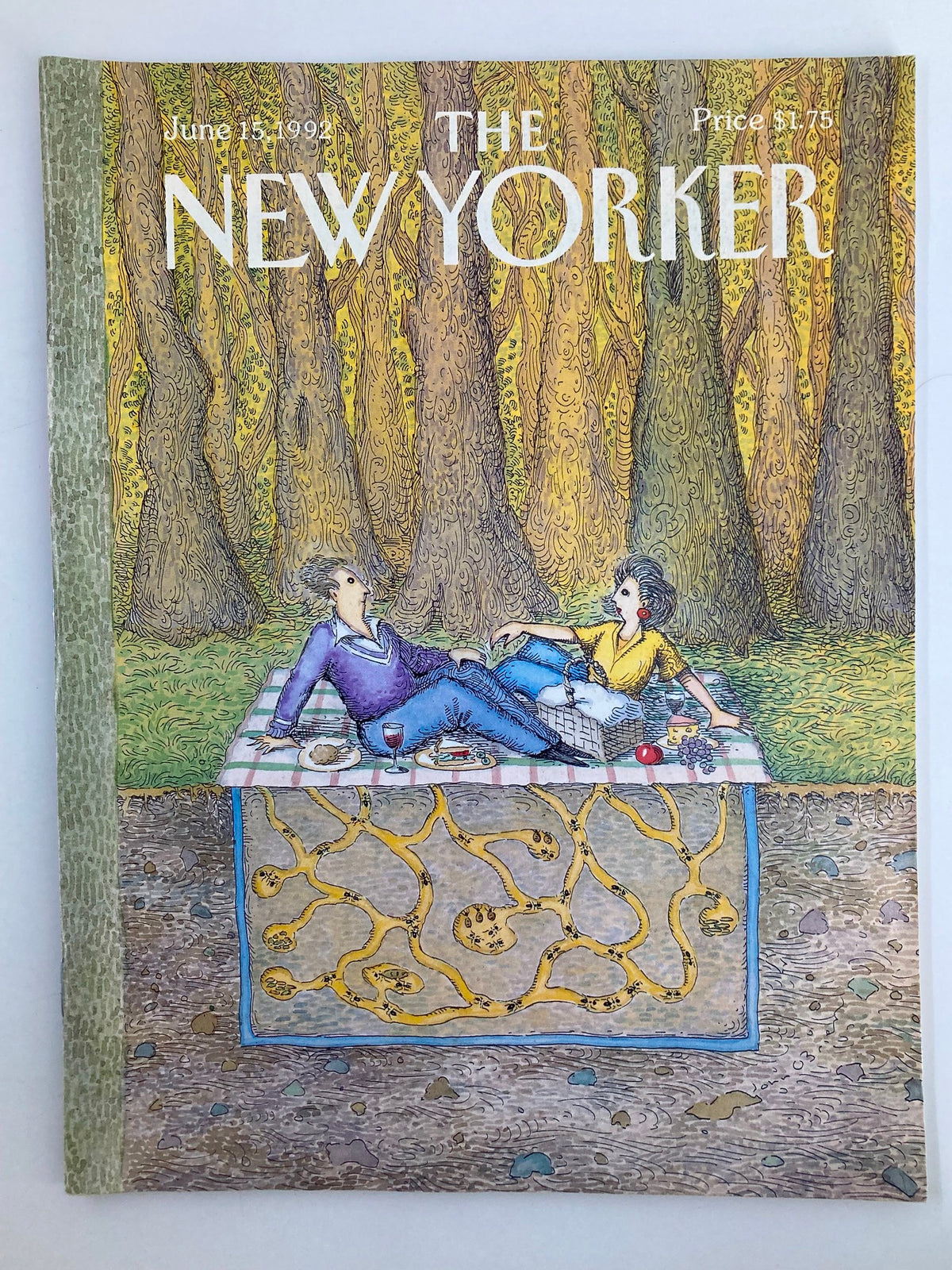


Description
Collector's Note – Why This Issue Matters
The June 15, 1992 issue of The New Yorker features a cover illustration by John O’Brien, identified in the listing by the descriptive theme “Picnic Above Ants.” O’Brien became known for constructing visual ideas in which ordinary situations are altered by scale, perspective, or an unexpected relationship between subjects. The picnic-and-ants concept fits naturally within that approach, transforming a familiar outdoor activity into an image that rewards closer observation. Its humor depends on visual suggestion rather than explanatory cover lines, following the restrained editorial tradition associated with The New Yorker. For collectors of magazine illustration, the issue preserves a dated example of O’Brien’s imaginative contribution to the publication’s cover archive.
The magazine appeared during the opening months of the 1992 United States presidential campaign, when incumbent President George H. W. Bush, Democratic challenger Bill Clinton, and independent candidate Ross Perot were competing in an unusually fluid political environment. Elizabeth Drew’s “Letter from Washington” addresses that developing three-way contest, preserving contemporary analysis before the election’s final shape was known. The issue also reflects international uncertainty through commentary on the war in Yugoslavia and the destruction surrounding Sarajevo. These political subjects place the magazine within a year marked by the adjustment to a post-Cold War world and debate over the future direction of American government. The issue therefore offers more than a decorative cover; it captures public questions that were still unfolding in June 1992.
Its remaining contents move through cinema, architecture, poetry, crime reporting, fiction, literary criticism, and shorter observations of metropolitan life. This range demonstrates the editorial balance that allowed The New Yorker to combine immediate news analysis with cultural criticism and imaginative writing. The contrast between John O’Brien’s playful cover idea and the serious material inside is characteristic of the magazine’s refusal to reduce an issue to a single subject. Other examples of its illustrated and literary history can be studied through the archive of vintage New Yorker magazines. The broader collection of magazines published in 1992 provides additional context for the political reporting, entertainment, visual culture, and public concerns of the same year.
About the Publication
The New Yorker is an American magazine founded in 1925 and historically associated with reporting, commentary, criticism, profiles, fiction, poetry, humor, and cartoons. Although strongly identified with New York City, its editorial interests have long extended to national politics, international affairs, literature, architecture, cinema, theatre, music, science, and social life. Its weekly structure traditionally combines short pieces in “The Talk of the Town” with longer articles, essays, reviews, stories, poems, and illustrated humor. The covers are especially distinctive because they generally present a single work of art without conventional headlines advertising the contents. This gives the illustrator room to establish a mood or visual joke that may be independent of the principal articles inside. By 1992, the magazine had developed a substantial archive involving several generations of influential writers, reporters, critics, cartoonists, and artists. Complete physical issues preserve that work in its original editorial sequence alongside advertisements, typography, departments, and other details often absent from later digital reproductions.
Key Highlights Inside
- The June 15, 1992 cover is officially credited to John O’Brien, while the listing identifies its theme as “Picnic Above Ants.” The concept reflects the artist’s interest in visual relationships and imaginative changes of scale, though no separate official title is displayed in the magazine’s online issue archive.
- Elizabeth Drew’s “Letter from Washington” examines the developing presidential contest involving George H. W. Bush, Bill Clinton, and Ross Perot. Written months before Election Day, the article preserves an immediate view of a campaign whose alliances, messages, and political momentum were still unsettled.
- The issue’s “Notes and Comment,” written by Liesl Schillinger, considers the war in Yugoslavia and the crisis surrounding Sarajevo. The commentary connects the city’s historical associations with the violent collapse of Yugoslavia and the challenge the conflict posed to Europe and the United States.
- Alec Wilkinson’s “A Violent Act—II,” published under the “Annals of Crime” heading, continues an account involving Mike Wayne Jackson and the manhunt that followed his crimes. The article extends beyond the pursuit itself to consider the grief and lasting consequences experienced by those connected to the case.
- Film criticism includes Terrence Rafferty’s review of Patriot Games, starring Harrison Ford, and Michael Sragow’s discussion of The Waterdance and Sister Act. These pieces preserve contemporary critical responses to three films released during the summer movie season of 1992.
- The issue also contains Scott B. Smith’s fiction “The Empty House,” poetry by Charles Simic, Philip Levine, and Gertrude Schnackenberg, and Brendan Gill’s architectural discussion of Louis I. Kahn. Brad Leithauser contributes a books essay concerning editions of The Golden Treasury, further demonstrating the issue’s mixture of creative writing, design criticism, and literary scholarship.
Condition & Rarity
The magazine is described as being in Good condition, with minor wear visible throughout from age, storage, or ordinary handling. Its newsstand origin and absence of a subscriber mailing label leave John O’Brien’s cover illustration unobstructed, an important presentation quality for collectors focused on cover art. The listing identifies it as a full magazine, indicating that it is presented as the complete issue rather than an isolated cover or extracted group of pages. No major tears, detached covers, writing, moisture damage, or missing pages are specifically reported, although those characteristics should be confirmed through examination of the photographs and interior. Common grading points include spine stress, staple security, corner softness, edge rubbing, page completeness, and any surface marks visible under direct light. Minor wear is typical of weekly magazines that were originally purchased for reading rather than long-term preservation, but its extent and location determine the final collector grade. The supplied plastic protective covering is a later storage accessory rather than an original part of the publication, though it can help limit dust, abrasion, and additional handling damage.
Looking for More Issues Like This?
The June 15, 1992 issue is a specific reference point for collectors interested in John O’Brien’s cover art and the magazine’s early-1990s editorial history. Exact dated examples with complete interiors and unobstructed covers can take time to identify. The broader collection of original New Yorker magazines includes other illustrated covers, political reporting, criticism, fiction, poetry, and cartoons from across the publication’s history. Readers studying the surrounding period can also explore other original magazines from 1992. Comparing publications from the same year provides a wider view of how editors and artists documented politics, film, literature, design, and popular culture.