


Description
Collector's Note – Why This Issue Matters
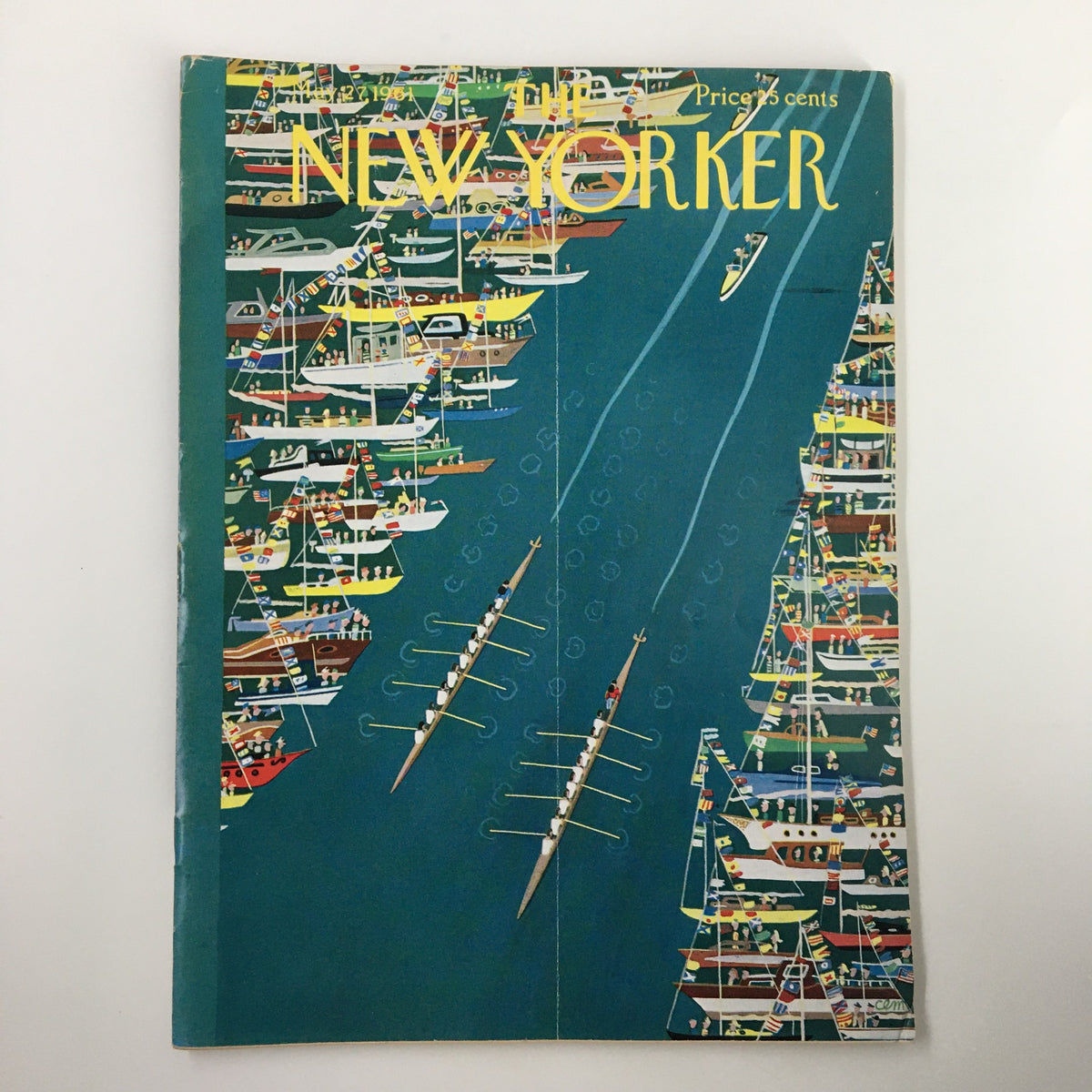
The May 27, 1961 issue of The New Yorker features a cover titled "Boat Festival" by Charles E. Martin — and for collectors who follow the magazine's visual history with any depth, Martin's name is one of the most important in the entire roster of artists who shaped its identity across the twentieth century. Martin contributed covers and cartoons to The New Yorker for an extraordinary span of decades, beginning in the late 1940s and continuing well into the 1990s, making him one of the longest-serving and most prolific visual contributors in the magazine's history. His covers were characterized by a particular kind of playful, precisely observed wit — scenes of American leisure and social life rendered with clean lines, vivid color, and a comedic intelligence that made his work immediately recognizable to generations of readers. A late May cover devoted to a boat festival is a quintessentially Martin subject: the specific pleasures and absurdities of American recreational life, captured at the moment of peak seasonal anticipation, when summer is just becoming real and the promise of outdoor celebration is still fresher than the reality.
May 27, 1961 falls in the first year of the Kennedy administration, at a moment of considerable national energy and some considerable anxiety. Kennedy had delivered his inaugural address just four months earlier; the Bay of Pigs disaster had occurred in April, humiliating the new administration on the world stage; and the Freedom Rides were underway in May 1961, with civil rights activists facing violent resistance as they tested the desegregation of interstate bus travel across the Deep South. The New Yorker under William Shawn engaged these currents with characteristic intelligence and indirection, and a late spring issue from 1961 sits at the intersection of the magazine's sustained editorial seriousness and the particular hopefulness of the Kennedy moment before its complications fully registered. For collectors focused on vintage New Yorker issues from the Shawn era, early 1961 issues document a publication at the height of its literary and journalistic authority, operating in a cultural atmosphere of genuine possibility.
Charles E. Martin's "Boat Festival" cover belongs to a tradition of late spring and early summer New Yorker covers that have always been among the most visually joyful in the magazine's annual cycle — celebrations of the seasonal turn that gave the magazine's cover artists their most unambiguously pleasurable subject matter. Martin's particular gift for rendering crowded, celebratory scenes with both precision and warmth made him ideally suited to this kind of cover, and collectors who follow his work across the magazine's decades recognize his boat and water-themed covers as among his most accomplished. The "full magazine" designation confirms that all pages are present and the cover remains intact — always the first and most important completeness check for any New Yorker issue of this vintage, since issues from this period were frequently raided for individual cartoons or articles by original readers who did not anticipate their future value as complete artifacts. Among surviving magazines from 1961, complete issues of The New Yorker with Martin covers in displayable condition are the kind of finds that collectors of the magazine's mid-century visual tradition actively seek.
About the Publication
The New Yorker, founded by Harold Ross in 1925 and edited from 1952 by William Shawn, was by May 1961 operating at one of the sustained peaks of its literary and journalistic distinction — a publication whose fiction, criticism, long-form reporting, cartoons, and cover art had been refined over nearly four decades into a format of remarkable consistency and vitality. Its cover artists, who worked on commission and whose images appeared without titles or captions in the magazine's long-standing tradition, gave The New Yorker a visual identity unlike any other American periodical, one that readers learned to read as attentively as the text inside. Charles E. Martin was among the most significant contributors to that tradition across the second half of the twentieth century, and his covers from the early 1960s represent his work at full creative maturity. The magazine's readership was educated, literary, and broadly national, and its late spring issues — arriving at the beginning of the summer season — were among the most visually anticipated of the annual cycle.
Key Highlights Inside
- Cover illustration "Boat Festival" by Charles E. Martin, one of the longest-serving and most beloved cover artists in The New Yorker's history — a late spring seasonal cover that exemplifies his gift for rendering American leisure and celebration with precision, color, and wit.
- A complete issue from the William Shawn editorial era in its ninth year, containing the full editorial format of the period: fiction, poetry, "Talk of the Town," long-form profiles or reportage, criticism, and cartoons — all shaped by Shawn's exacting and deeply literary editorial sensibility.
- Period advertising throughout the issue, reflecting the commercial landscape of early Kennedy-era America with the specificity and vividness that New Yorker advertising from this period is known for — the magazine attracted prestige brands across multiple categories, and the advertising pages of a 1961 issue are primary documents of that consumer culture.
- Cartoons from the magazine's early-1960s roster of contributors, representing the tradition of American magazine cartooning at its most accomplished and most collected — individual cartoons from this era are independently sought by collectors of mid-century graphic art.
- Note: Specific interior articles, fiction pieces, and named contributors for this issue are unconfirmed beyond what the listing states. Collectors researching the precise editorial contents would benefit from consulting archived New Yorker tables of contents or the magazine's digital archive.
Condition & Rarity
Newsstand origin with no address label is the preferred and less common configuration for a collectible New Yorker from 1961, as subscriber copies carrying printed address labels represent the large majority of surviving issues from this period given the magazine's subscription-dominant circulation model. Good condition with minor wear throughout and a crease down the middle of the front cover is an honest and complete assessment — the center crease is a condition attribute worth noting specifically, as it affects the visual presentation of the Martin cover illustration and is the primary cosmetic consideration for display-focused collectors evaluating any surviving copy of this issue. Center creases of this type typically result from folding in storage or mailing, and they are among the more common condition issues found in New Yorker issues from this era that have passed through multiple hands over six decades. A plastic protective sleeve provides meaningful ongoing preservation against dust and further handling damage. When evaluating any surviving copy of this issue, the priority attributes to assess are the severity and visibility of the cover crease under display lighting, the color integrity and surface condition of the Martin illustration on either side of the crease, the security of the spine staples, and the flexibility and completeness of the interior pages.
Looking for More Issues Like This?
Charles E. Martin covers from the early Shawn era are among the more warmly collected artifacts in New Yorker visual history, and his seasonal covers — particularly his spring and summer issues — are the ones that collectors of the magazine's mid-century aesthetic return to most consistently. If this May 1961 issue has already found a home, the New Yorker collection at OriginalMagazines.com spans the full arc of the Shawn editorial years and regularly surfaces Martin covers and other strong issues from the early 1960s worth serious attention. For collectors building a broader picture of American cultural life in the Kennedy era's opening year, the 1961 magazine collection covers the year across multiple titles — a rich archive from a year of genuine historical and cultural significance that rewards exploration from almost any angle.