
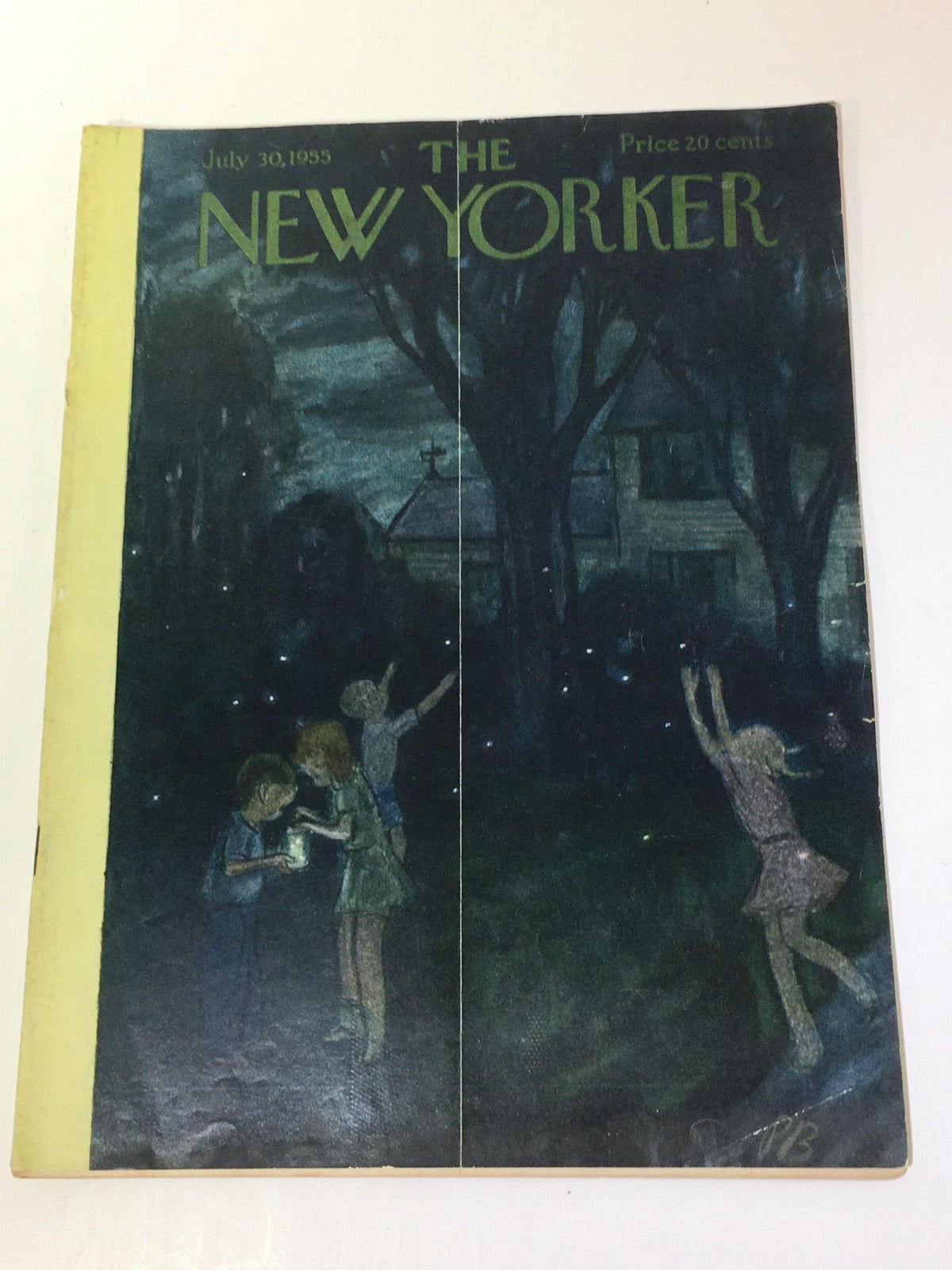

Description
Collector's Note – Why This Issue Matters
The July 30, 1955 issue of The New Yorker featuring a cover by Perry Barlow is a primary document of the publication at the specific mid-decade height of its postwar cultural authority — and a particularly characterful entry in the publication's summer cover tradition. Perry Barlow was one of The New Yorker's most distinctive and most beloved regular contributors, a cartoonist and cover artist whose career with the publication spanned decades and whose specific visual sensibility — domestic, gently comic, warmly observational of middle-class American life — made him one of the most characteristic voices in the publication's visual register. A July 1955 Barlow cover places his specific comedic and observational intelligence in the specific summer seasonal context that the publication's July covers traditionally engaged with most directly: the vacation culture, the suburban and resort social dynamics, and the particular human comedy of American leisure that characterized the mid-1950s summer in the specific social world that The New Yorker's readership inhabited. July 30, 1955 is the final issue of July, the last summer week before August, and Barlow's cover for this specific date would have captured the particular comedic moment that his visual intelligence found most resonant in the late July American summer of one of the most culturally confident and most economically prosperous years of the postwar decade. For collectors building a serious archive of New Yorker cover art and mid-century American visual culture, the New Yorker collection at OriginalMagazines.com provides essential depth across the publication's full run, with the mid-1950s Shawn-era summer issues representing a particularly cohesive and aesthetically fully realized tier within that body of material.
The broader cultural context of July 30, 1955 gives this issue a specific historical resonance for researchers who approach The New Yorker as a document of mid-century American life. The summer of 1955 was occurring in the specific year when the postwar American consumer culture was most fully expressing its particular mid-decade confidence: the suburban expansion was at its most rapid, the automobile culture was defining the American summer vacation in new ways, the television set was establishing itself as the domestic center of American family entertainment, and the specific social rituals of the affluent American middle class — the summer cottage, the country club, the beach resort — were the precise social material that Perry Barlow's visual comedy was most productively engaging. A late-July 1955 Barlow cover is primary documentation of that specific social world in the visual form most immediately accessible to the publication's readership: a single comedic image that distilled the particular human comedy of the mid-1950s American summer into a cover that its audience would have recognized, appreciated, and laughed at simultaneously. The no-label condition confirmed in this listing preserves the Barlow cover in complete visual presentation without subscription label disruption — a meaningful positive for a publication whose cover art is the primary object of collector interest and whose label-free examples are considerably less common than the labeled subscription majority. The full range of 1955 magazines and publications from this year documents American culture at the specific height of its mid-decade postwar confidence and prosperity, and a late-July Barlow New Yorker sits within that body of material as a primary visual and editorial document of the specific social world the publication was most directly serving.
Perry Barlow's position within The New Yorker's visual tradition deserves direct acknowledgment for collectors who approach this issue from an art historical or illustration history perspective. Barlow had been contributing cartoons and covers to the publication for decades by 1955, and his work occupies a specific and beloved register within the broader New Yorker cartoon tradition — the domestic comedy, the gentle satire of middle-class social ritual, the warm but clear-eyed observation of the specific human behaviors that American suburban and resort social life generated. His July 1955 cover represents this tradition at its mid-century mature expression, and its survival in a label-free condition makes it one of the more specifically useful and most visually complete surviving examples for the collecting and art historical communities that focus on the publication's specific visual contributors.
About the Publication
The New Yorker was founded in 1925 and had established itself by 1955 under William Shawn's editorial direction as the most culturally authoritative weekly magazine in the United States, its editorial voice combining literary fiction, long-form journalism, cultural criticism, and the specific visual wit of its cover art and cartoons into a publication that set the standard for American cultural journalism. Perry Barlow was one of the publication's most enduring and most characteristic regular contributors, his decades-long engagement with The New Yorker producing a body of visual work that documented the specific comedic and social dimensions of mid-century American life with the warm intelligence and precise observation that defined the publication's visual tradition at its most domestic and most gently satirical register.
Key Highlights Inside
- Perry Barlow cover — mid-century domestic comedy documented at Shawn-era summer peak — The confirmed Barlow cover is primary visual documentation of one of The New Yorker's most beloved and most characteristic regular contributors applying his specific comedic intelligence to the late-July 1955 seasonal moment, preserving his visual interpretation of the mid-1950s American summer in the specific register — warm, observational, gently satirical — that made his work one of the most recognizable and most appreciated in the publication's cover art tradition.
- No-label edition — full July 1955 Barlow cover preserved in complete presentation — The confirmed no-label condition preserves the Perry Barlow cover illustration in complete visual presentation without subscription label disruption, representing a meaningful positive for a publication primarily distributed by subscription in which label-free examples are considerably less common than the labeled majority of surviving copies.
- Late-July 1955 editorial content — final July week Shawn-era documentation — The July 30, 1955 date places this issue in the final week of July — the last summer week before August — and its editorial content would have reflected the specific cultural and social atmosphere of the late-1950s mid-century summer at its most fully expressed seasonal phase, in the specific intellectual and literary voice that the Shawn-era publication brought to its weekly engagement with American life.
- Mid-1950s New Yorker summer issue — postwar American leisure culture documented — A July 1955 New Yorker preserves primary documentation of the specific social world — suburban, resort, vacation-culture — that the publication's readership inhabited and that its summer covers most directly and most characteristically engaged, captured in the specific visual and editorial intelligence of the publication at its most fully achieved mid-century expression.
- Note: The specific fiction, journalism, and cultural criticism contents of this issue beyond the confirmed Perry Barlow cover have not been independently verified beyond the listing description. The condition description notes edge wear and possible rips and confirms no plastic protective covering. The highlights above reflect what is documentable from the listing and the well-established historical context of The New Yorker's July 1955 publication and Perry Barlow's role in its cover art tradition.
Condition & Rarity
This issue is described as being in good condition with edge wear and possible rips, no address label, and no plastic protective covering — a condition profile that requires honest assessment for collectors evaluating its suitability for specific purposes. The absence of a plastic protective covering means that careful future storage is particularly relevant for long-term preservation: without physical shielding, continued environmental exposure will affect the paper at a rate faster than protected examples stored under comparable conditions. The edge wear and possible rips should be assessed from the accompanying photographs relative to their placement on the Barlow cover illustration and the interior content pages that constitute the issue's primary research and display value. The no-label status is the most significant positive condition attribute, preserving the Barlow cover in complete presentation without the subscription label disruption that characterizes the majority of surviving copies from this era. New Yorker issues from the mid-1950s Shawn era featuring Perry Barlow covers in no-label condition are sought by New Yorker cover art collectors, Barlow illustration specialists, and mid-century American cultural history researchers who recognize these publications as primary visual documents of one of the publication's most characteristic and most beloved visual contributors.
Looking for More Issues Like This?
New Yorker summer issues from the mid-1950s featuring Perry Barlow covers — documenting one of the publication's most beloved visual contributors applying his specific domestic comedic intelligence to the seasonal summer moment at the height of the publication's postwar cultural authority — are sought by New Yorker cover art enthusiasts, Barlow illustration collectors, and mid-century American social history researchers who recognize these publications as primary visual artifacts of the publication's most characteristic and most fully achieved mid-century expression. If this July 30, 1955 issue is no longer available, the New Yorker collection at OriginalMagazines.com is the most comprehensive resource for exploring what else has surfaced from this publication's extraordinary archive. For collectors building a broader documentary record of American cultural journalism and mid-century social life at the height of the postwar decade's confidence, the 1955 magazines collection brings together a wide range of primary source material from that pivotal year.