

Description
Collector's Note – Why This Issue Matters
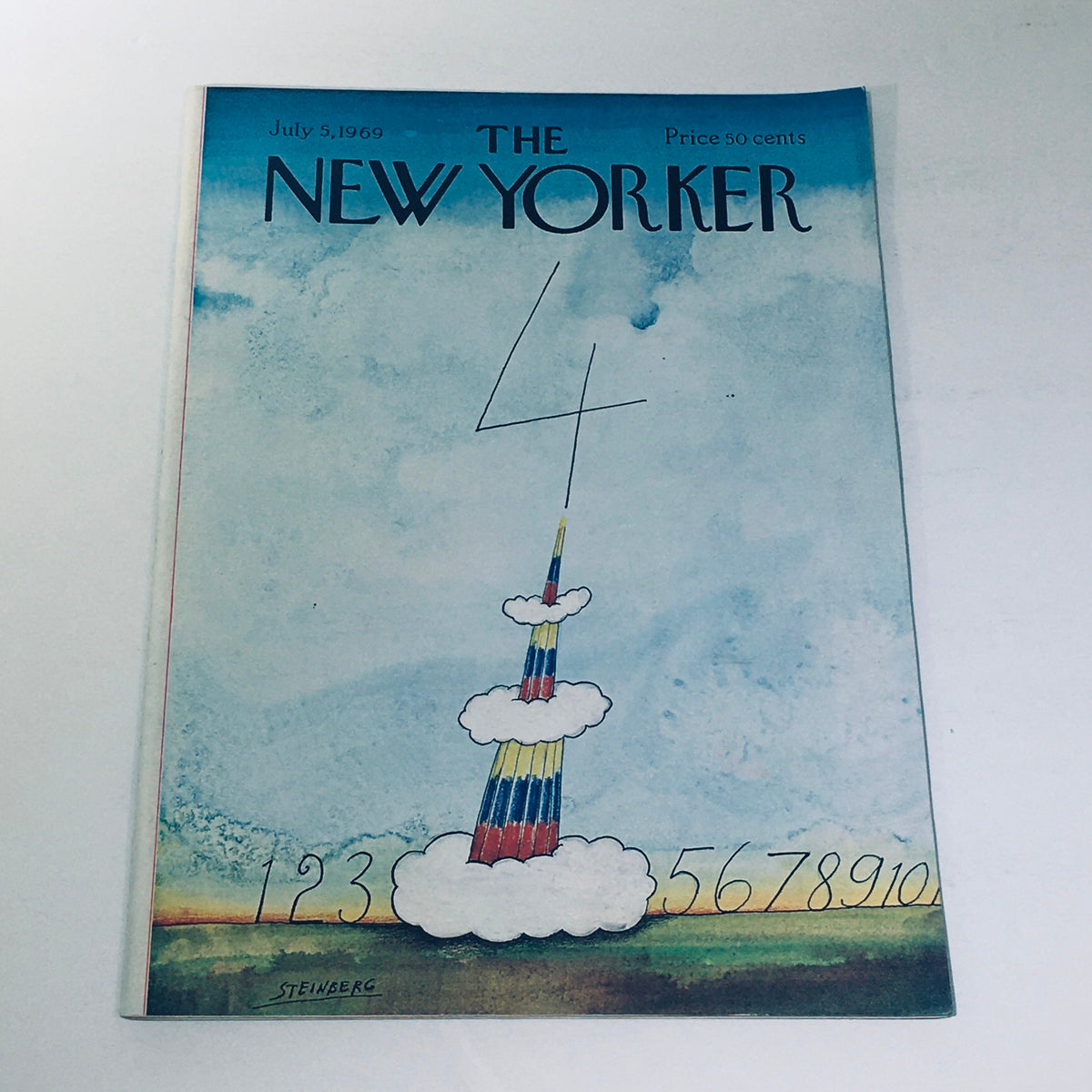
The July 5, 1969 issue of The New Yorker carries a cover by Saul Steinberg — and that attribution alone elevates it into a specific and serious category of magazine collecting. Steinberg contributed covers to The New Yorker across five decades, producing some of the most intellectually ambitious and visually original work the publication ever placed on its front page. His covers were not illustrations in the conventional sense. They were conceptual art objects that happened to appear on a weekly magazine — dense with ideas about perception, language, identity, and the nature of representation itself. An Independence Day cover by Steinberg, appearing on July 5, 1969, would have engaged the holiday with the same layered irony and visual intelligence that characterized everything he produced for the magazine. For collectors building an archive of New Yorker issues with significant cover art, a Steinberg Independence Day cover is a meaningful acquisition — not simply a holiday issue but a document of one of the twentieth century's most distinctive graphic artists at work on one of America's most symbolically loaded occasions.
The date places this issue at an extraordinary moment in American cultural and political life. July 1969 was one of the most compressed months in postwar American history. The Apollo 11 mission launched on July 16 and landed on the moon on July 20 — events that were still two weeks away when this issue reached newsstands, but whose anticipation was saturating public consciousness. The country was simultaneously prosecuting the Vietnam War, navigating the political aftermath of 1968's extraordinary violence and upheaval, and preparing to watch human beings walk on the lunar surface for the first time. An Independence Day issue of The New Yorker appearing in this context carried a particular charge — the holiday's themes of national identity, democratic idealism, and American exceptionalism were all being tested in multiple directions simultaneously. Magazines from 1969 document a year that many historians consider the most turbulent single year of the postwar American experience, and a July 4th-adjacent issue sits at the symbolic center of that turbulence.
About the Publication
The New Yorker, founded by Harold Ross in 1925, was by 1969 the most prestigious general interest magazine in the United States — its combination of long-form journalism, fiction, poetry, criticism, and cover art representing a standard of editorial quality that no competitor matched. Under editor William Shawn, who led the magazine from 1952 to 1987, The New Yorker developed an identity built around depth, precision, and a willingness to publish work of genuine literary and intellectual ambition regardless of its commercial accessibility. Its covers, produced by a roster of artists that included Steinberg, Charles Addams, and many others, were understood by readers and collectors as serious works of graphic art rather than promotional design. A July 1969 issue represents the publication operating under Shawn at the height of its Cold War-era cultural authority.
Key Highlights Inside
- Cover art by Saul Steinberg for Independence Day — a holiday cover by one of The New Yorker's most celebrated and conceptually ambitious contributing artists, produced during a July 4th period of unusual national tension and self-examination.
- Publication date of July 5, 1969 places this issue two weeks before the Apollo 11 moon landing of July 20 — capturing the specific atmosphere of anticipation and national ambivalence that defined the summer of 1969.
- Note: Specific interior articles, fiction, poetry, and criticism beyond what is confirmed in the listing are unverified for this issue. The New Yorker's editorial format of this period consistently included long-form journalism, short fiction, poetry, and cultural criticism, but individual contents for this specific issue are not confirmed here.
Condition & Rarity
The absence of an address label on the front cover is the most significant condition attribute for this issue in collector terms. Subscriber copies of The New Yorker from 1969 were delivered with mailing labels applied directly to the cover, and label-free examples are most reliably identified as newsstand copies — a meaningful distinction for a publication where cover art attribution drives a significant portion of collector interest. Good condition with minor edge wear is honest and appropriate for a magazine now over fifty years old. The confirmed pet-free and smoke-free storage history is a favorable indicator for overall page condition, as tobacco and pet dander exposure are among the most common sources of odor and surface degradation in stored periodicals of this era. When evaluating any surviving copy of this issue, the primary condition factors are cover art surface integrity — Steinberg's graphic work is the primary collectible attribute — spine soundness, and the degree of toning in the interior pages.
Looking for More Issues Like This?
A label-free newsstand copy of a Saul Steinberg Independence Day New Yorker cover from the summer of 1969 is a find that appeals simultaneously to magazine collectors, graphic art enthusiasts, and anyone drawn to the documentary record of that extraordinary year. If this issue has already found a home, the full archive of New Yorker issues spans the publication's entire run and surfaces other significant cover art and editorial moments across its decades of publication. The broader 1969 magazine collection is essential territory for anyone focused on this pivotal year in American history.