



Description
Collector's Note – Why This Issue Matters
The April 12, 1952 issue of The New Yorker with a confirmed cover by Abe Birnbaum is a primary document of the publication at a specific and historically concentrated moment — the early years of William Shawn's editorship and the specific spring of one of the most politically charged years of the postwar decade. Abe Birnbaum was a regular New Yorker cover contributor from the late 1930s through the 1950s, an illustrator whose covers were characterized by their warm, slightly whimsical observation of everyday American life rendered with a gentle humor that was distinctly his own. His work sat in a specific register within the publication's cover art vocabulary — less satirically urban than Peter Arno, less seasonally precise than Arthur Getz, but consistently possessed of a quiet human observation that made his covers immediately welcoming and his specific style recognizable to the publication's regular readership. An April 1952 cover by Birnbaum would have addressed the specific visual moment of early spring — the seasonal transition that was one of his characteristic subjects — with the same careful attention to the particular textures of American daily life that defined his long association with the publication. For collectors building archives of vintage New Yorker magazines, confirmed Birnbaum covers from the early 1950s represent a specific and identifiable strand within the publication's mid-century visual identity.
The April 12, 1952 date situates this issue in a specific and consequential moment in American political and cultural history. The Korean War was in its third year, with armistice negotiations ongoing but stalled, and the 1952 presidential election — which would produce the first Republican president in twenty years with Dwight Eisenhower's victory — was in its early primary phase. Senator Joseph McCarthy's influence was at its peak, and the specific atmosphere of political anxiety, anti-communist suspicion, and Cold War tension that characterized early-1950s American life was the backdrop against which The New Yorker under Shawn was developing its mature editorial voice. April 1952 was the spring before that election year's summer conventions, a moment of political anticipation whose specific character would be superseded by the dramatic events of the following months. A New Yorker issue from this specific week is primary documentation of the publication's engagement with its readership at a moment of acute national uncertainty, and the editorial choices visible in its pages — the fiction, the journalism, the cartoons — are primary evidence of how Shawn's early editorial vision was addressing that uncertainty. Collectors focused on 1952 magazines as documents of American cultural life in the election year of the century's mid-point will find this issue occupying a well-defined historical position.
The April 12, 1952 date also carries a specific significance within The New Yorker's annual calendar. Spring issues were among the publication's most editorially varied — lacking the concentrated seasonal identity of the Christmas and summer issues, they gave editors and contributors the latitude to range widely across fiction, journalism, and cultural commentary without the editorial constraints of a defined seasonal theme. A Birnbaum spring cover for this specific week reflects the kind of assignment the publication gave to its most trusted visual contributors for the issues in which editorial range rather than seasonal concentration was the primary virtue — a commission that honored both the artist's specific observational gifts and the publication's confidence in his ability to find the visual truth of an ordinary April week in a way that would resonate with readers across the country.
About the Publication
The New Yorker was founded in February 1925 by Harold Ross and by April 1952 was in the first full year of William Shawn's editorship following Ross's death in December 1951. Shawn's editorial vision maintained the publication's core commitments to long-form fiction, poetry, criticism, and journalism while deepening its engagement with serious political and social affairs — a development directly relevant to an issue published during the Korean War and the McCarthy era. Its format combined long-form writing with cartoons and covers treated as serious artistic commissions, and its cover artists during this period — Birnbaum among them — were selected with the same editorial care applied to its writers. The April 1952 issue represents the publication in the opening months of the Shawn era, before the editorial identity of those decades had fully declared itself but already bearing the marks of a new hand on the publication's direction.
Key Highlights Inside
- Abe Birnbaum cover — April 12, 1952 — A confirmed original cover by a regular New Yorker contributor whose quietly observational style occupied a specific and well-defined register within the publication's mid-century visual identity, produced for an early-spring issue in the first full year of William Shawn's editorship.
- April 1952 — Korean War and McCarthy era documentation — Published in the third year of the Korean War with armistice negotiations stalled, in the spring before the 1952 presidential election that would end twenty years of Democratic White House control, and at the peak of McCarthy's influence — a specific political atmosphere whose traces are visible in any New Yorker issue from this period.
- First full year of the Shawn editorial era — Published approximately four months into William Shawn's editorship following Harold Ross's December 1951 death, representing the publication at the earliest point of the editorial transition that would define it for the following three decades and making this issue primary documentation of that transition's opening phase.
- No subscription label — confirmed newsstand status — Full unobstructed cover art preserved without address label obstruction, a meaningful positive attribute for a publication whose Birnbaum cover imagery is the primary visual reason for collecting interest and whose early-1950s covers are specifically sought by collectors of the publication's Shawn-era visual archive.
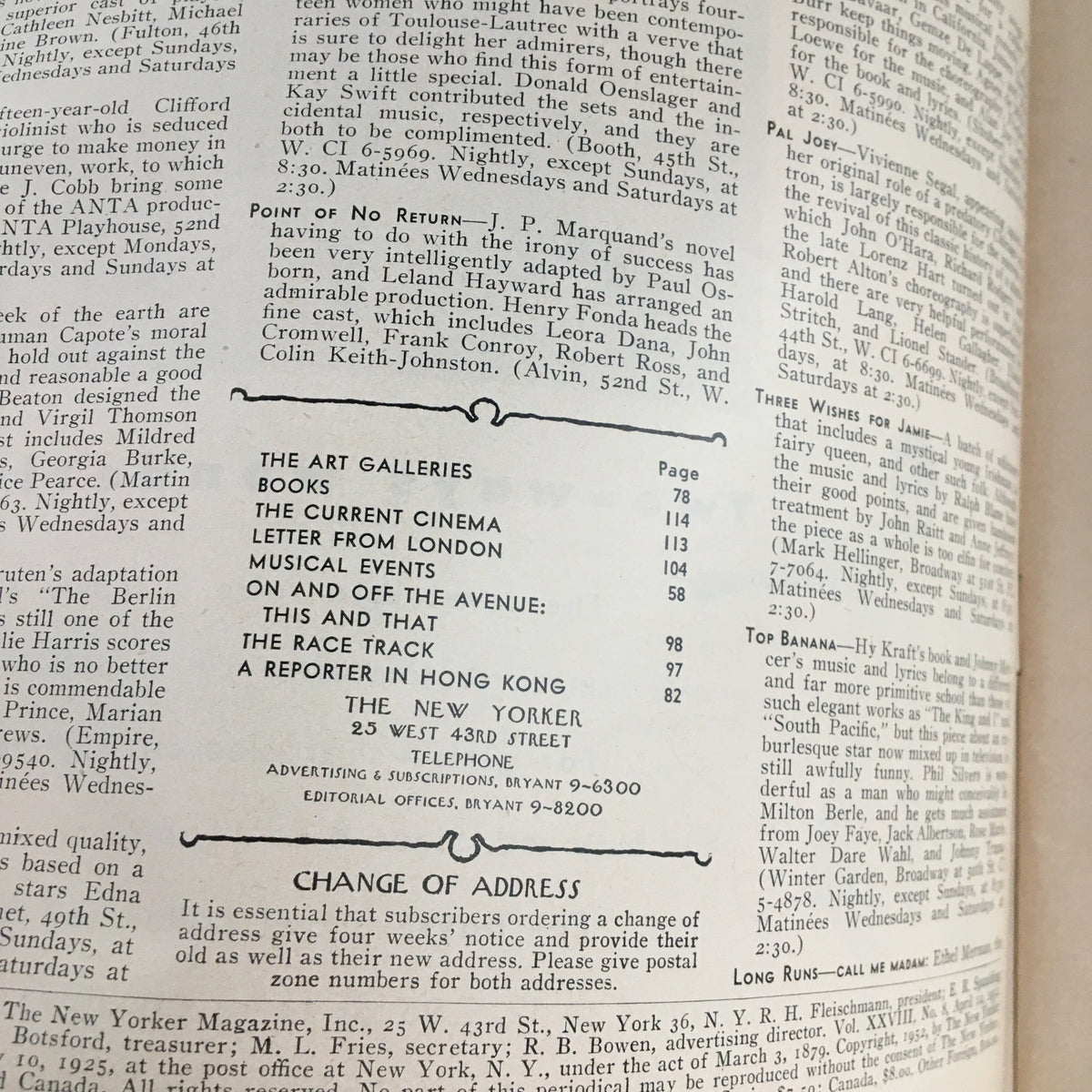
Note: Specific interior fiction, journalism, poetry, and cartoon content confirmed for this issue have not been provided in the available listing. The highlights above reflect only what is verifiable from the listing and well-documented public knowledge about the publication, its cover artist, and the historical moment of publication.
Condition & Rarity
Good condition with minor wear throughout, no subscription label, and plastic protective covering represents a solid mid-grade assessment for a 73-year-old weekly magazine. The confirmed no-label newsstand status is the primary positive visual attribute, preserving the full Birnbaum cover art without address obstruction — a meaningful distinction for display-oriented collectors and for those specifically building collections of unobstructed New Yorker covers from the publication's early Shawn era. Minor wear throughout on a saddle-stitched newsprint weekly of this age is the expected characteristic of a publication that has survived nearly three-quarters of a century of storage rather than an exceptional condition factor — the relevant attributes are whether the cover art is intact and the interior content remains legible and structurally sound. The plastic protective covering indicates deliberate preservation at some point in the issue's history, a positive factor for a weekly of this age. Good condition in a 1952 New Yorker means the issue has survived with its Birnbaum cover and interior content accessible and visually coherent, representing genuine preservation across seven decades.
Looking for More Issues Like This?
Early Shawn-era New Yorker issues with confirmed named cover artists from the publication's mid-century visual stable — and particularly Birnbaum covers from the Korean War and early Cold War period that give this spring 1952 issue its specific historical weight — are a distinct and well-defined collecting category within the publication's broader archive. The complete New Yorker magazine archive at OriginalMagazines.com is the most productive resource for collectors researching other Birnbaum covers and other early Shawn-era issues from the pivotal early-1950s period of the publication's editorial transition. For collectors building a broader picture of American cultural and political life in the election year of the century's midpoint, the full 1952 magazine collection covers the range of titles from the year that marked the transition from the Truman to the Eisenhower era in American political life.