
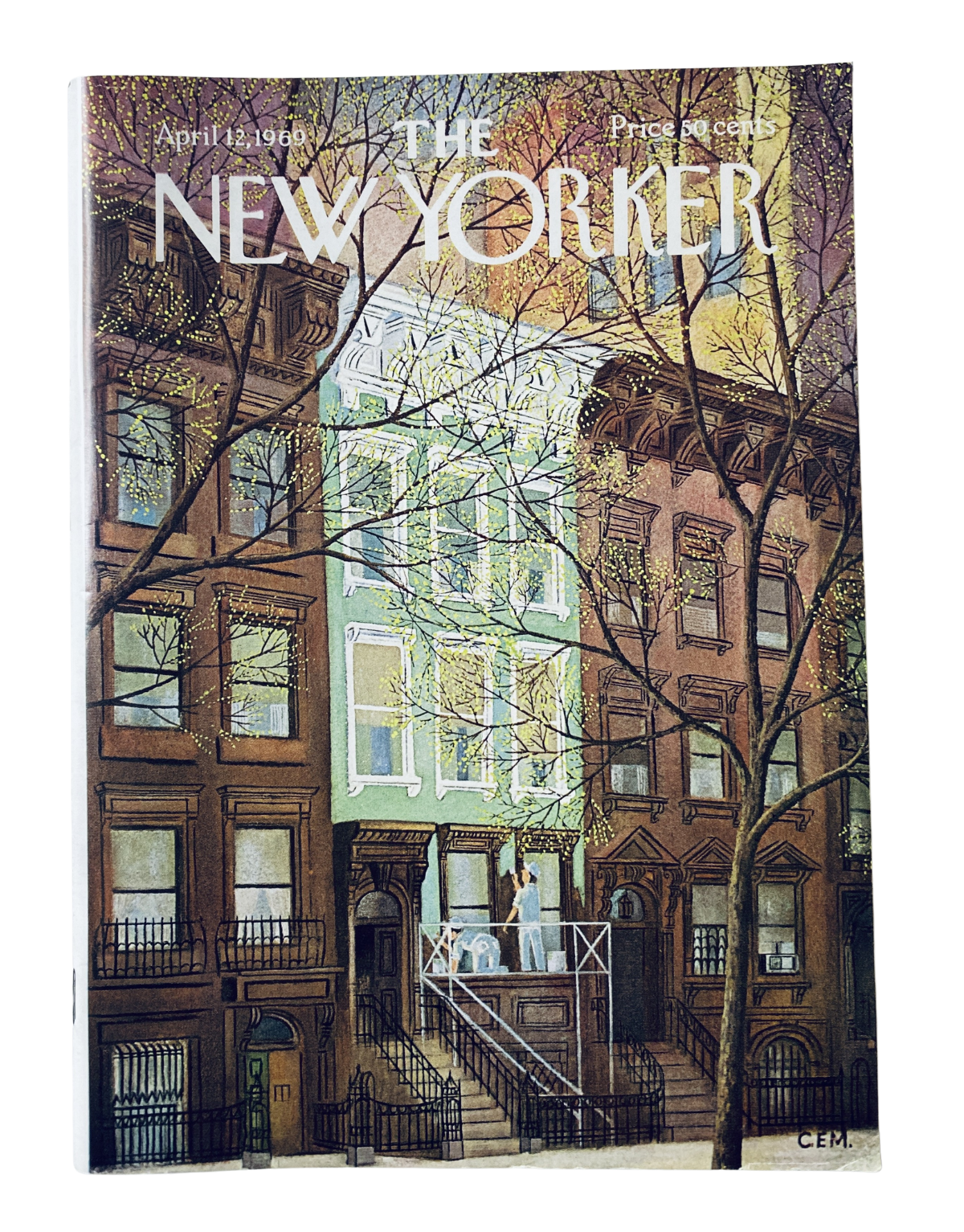



Description
Collector's Note – Why This Issue Matters
April 12, 1969 is a publication date of specific and historically weighted significance, and this New Yorker issue — with a Charles E. Martin spring brownstone balcony cover and a table of contents of exceptional literary and journalistic quality — documents the magazine at one of its most creatively accomplished moments. The E. B. White poem "Chairs in Snow" on page 44 is a primary bibliographic document of White's late-career New Yorker poetry contribution, and its presence in this issue alongside Mavis Gallant's fiction "The Rejection" and St. Clair McKelway's "The Presbyterian Captives" constitutes a literary primary source of the highest order. E. B. White had been associated with the New Yorker since its founding years — his relationship with the magazine was among the most significant in its history — and a 1969 White poem is a precisely dated entry in a body of New Yorker work that spans more than four decades. Mavis Gallant was one of the most accomplished short story writers of the twentieth century, her fiction recognized for its specific precision of social observation and its engagement with exile, displacement, and the subtleties of class — and her appearance in the April 12, 1969 New Yorker constitutes a primary bibliographic record of her fiction in its original publication context. For collectors building an archive of New Yorker issues from the late-Shawn-era sixties, this April 12, 1969 edition is among the most specifically literary significant entries in the publication's spring 1969 catalog.
Henry S. F. Cooper Jr.'s "Reporter at Large (Lunar Landings—II)" on page 53 is a primary source document of extraordinary historical precision. Cooper was the New Yorker's primary space exploration journalist, and his Lunar Landings series was produced in the period of maximum anticipation before Apollo 11's July 1969 moon landing — three months before that historic event, when the preceding Apollo missions were building toward it and the specific technical and human dimensions of lunar landing preparation were the most actively discussed scientific story in American public life. A Cooper New Yorker lunar landing report from April 1969 is a contemporaneous primary source of American space exploration journalism at the precise moment of its most significant anticipatory buildup, produced by the publication's most authoritative voice on the subject. The Robert Shaplen "Letter from South Vietnam" on page 134 is a primary document of the New Yorker's Vietnam War journalism — Shaplen was one of the magazine's most respected foreign correspondents in Southeast Asia, and a South Vietnam letter from April 1969 arrives in the specific post-Tet atmosphere of Nixon's first months and the opening of the Paris peace talks, constituting a primary source of the most serious American magazine journalism on the war at one of its most consequential diplomatic moments. Collectors researching New Yorker issues from 1969 will find this April 12 edition a primary source document of extraordinary breadth across literary fiction, space exploration journalism, and Vietnam War correspondence.
Calvin Trillin's "U.S. Journal: Jeremiah, KY." on page 178 adds a primary document of Trillin's signature series of American community journalism — his U.S. Journal reports from specific American towns and communities were one of the New Yorker's most distinctive contributions to American journalism in this period, and a Jeremiah, Kentucky entry from April 1969 constitutes a primary record of Trillin's engagement with specific American life outside the coastal cultural centers that the New Yorker otherwise most naturally addressed. The Charles E. Martin spring brownstone balcony cover is a primary visual document of one of the New Yorker's most consistently accomplished cover artists of the mid-century period, his observation of New York architectural and seasonal life preserved here in Very Good newsstand condition. The drawing contributors — including Saul Steinberg, William Steig, Charles Saxon, Lee Lorenz, James Stevenson, and nine additional artists — constitute one of the more impressive single-issue cartoon rosters in the New Yorker's late-sixties archive, with Steinberg's presence alone marking this as a visually significant entry in the publication's collection.
About the Publication
The New Yorker was founded in 1925 by Harold Ross and by April 1969 had been publishing for forty-four years under the editorships of Ross and William Shawn, whose tenure since 1952 had deepened the magazine's commitment to long-form journalism, literary fiction, poetry, and cultural criticism of the highest standard. The April 12, 1969 issue represents the Shawn-era publication in its final months of creative peak — the combination of E. B. White poetry, Mavis Gallant fiction, Henry Cooper space journalism, Robert Shaplen Vietnam correspondence, Calvin Trillin's American community reporting, and a Saul Steinberg cartoon contribution in a single issue reflects the extraordinary depth of talent the magazine commanded in this period and the specific quality of editorial judgment that assembled them in a single weekly package.
Key Highlights Inside
- E. B. White "Chairs in Snow" (poem) on page 44 — a primary bibliographic record of White's late-career New Yorker poetry in its original publication context, constituting a precisely dated document of his sustained creative relationship with the magazine that had been one of the most significant author-publication associations in American literary history since the 1920s.
- Mavis Gallant "The Rejection" on page 42 — a primary bibliographic document of one of the most accomplished short story writers of the twentieth century in her original New Yorker publication context, constituting a primary source record of her fiction at a specific late-1960s career moment.
- Henry S. F. Cooper Jr. "Reporter at Large (Lunar Landings—II)" on page 53 — a primary source document of the New Yorker's most authoritative space exploration journalism produced three months before the Apollo 11 moon landing, constituting a contemporaneous primary record of American space exploration at the precise moment of its most significant anticipatory buildup.
- Robert Shaplen "Letter from South Vietnam" on page 134 — a primary document of the New Yorker's most respected Southeast Asian correspondent reporting from Vietnam in April 1969, Nixon's first months and the opening of the Paris peace talks, constituting a primary source of the most serious American magazine Vietnam journalism at one of its most consequential diplomatic moments.
- Calvin Trillin "U.S. Journal: Jeremiah, KY." on page 178 and Edith Oliver theatre criticism on page 131 — primary documents of two of the New Yorker's most distinctive journalism traditions: Trillin's American community reporting series and Oliver's off-Broadway theatrical criticism, both produced in the specific creative atmosphere of late Shawn-era 1969.
- Saul Steinberg, William Steig, Charles Saxon, Lee Lorenz, James Stevenson, and nine additional cartoon contributors — a documented roster from one of the New Yorker's most accomplished single-issue cartoon lineups of the late-sixties period, with Steinberg's presence marking this as a visually significant primary artifact of the publication's cartoon tradition at its most creatively accomplished.
Condition & Rarity
New Yorker issues from April 1969 are approaching their fifty-seventh year of existence, and the condition landscape for surviving copies from this late-Shawn-era period reflects both the general attrition of that age and the specific collector significance of an issue combining E. B. White poetry, Mavis Gallant fiction, Henry Cooper space journalism, Robert Shaplen Vietnam correspondence, Calvin Trillin American community reporting, and a Saul Steinberg cartoon contribution. Very Good condition with only light edge wear is an honest and strong grade for a fifty-six-year-old weekly literary magazine, indicating a copy that retains full structural integrity, displays cleanly, and shows no significant cover damage or interior page loss beyond the minimal evidence of its age. The Charles E. Martin spring brownstone balcony cover is preserved in this grade with the full visual integrity that conveys both the seasonal subject matter and the specific quality of his New York architectural observation. The plastic protective sleeve provides ongoing archival protection for a publication whose paper chemistry benefits from continued careful storage. Collectors evaluating surviving examples of this issue should prioritize the cover image integrity, the completeness of the White poem and Gallant fiction pages, the Cooper lunar landings report, and overall structural soundness as primary condition criteria for a late-Shawn-era New Yorker of this exceptional literary and journalistic density.
Looking for More Issues Like This?
A Very Good copy of The New Yorker from April 12, 1969 with E. B. White poetry, Mavis Gallant fiction, Henry Cooper's pre-Apollo lunar journalism, Robert Shaplen's Vietnam correspondence, Calvin Trillin's U.S. Journal, and a Saul Steinberg cartoon contribution is among the most specifically literary and journalistically significant single issues in the publication's late-sixties archive — the convergence of these specific contributors in a single April 1969 weekly gives this issue a primary source profile extending across American poetry, short fiction, space exploration history, Vietnam War journalism, and community reporting simultaneously. If this issue is no longer available, the full New Yorker collection at OriginalMagazines.com is the most comprehensive place to browse surviving issues from across the publication's history and locate other E. B. White or Mavis Gallant issues, Cooper space journalism, Shaplen Vietnam correspondence, or significant entries from the Shawn era's most creatively accomplished final years. The 1969 magazine collection brings together surviving issues from across that year's major publications for collectors working to document the full breadth of American print culture during the most historically and culturally consequential year of the decade's close.