


Description
Collector's Note – Why This Issue Matters
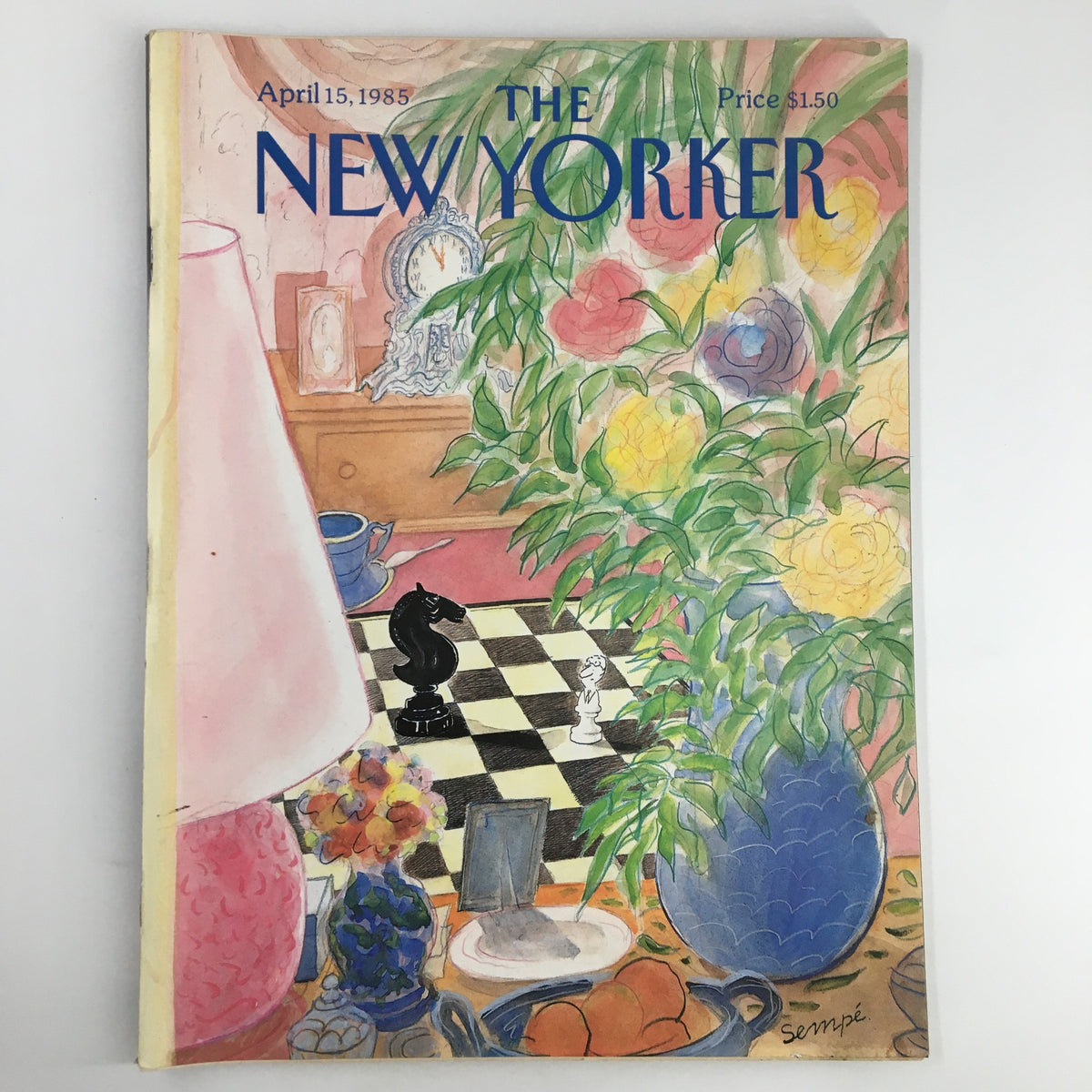
The April 15, 1985 issue of The New Yorker is distinguished above all by its cover — a chess game illustration by Jean-Jacques Sempe, the French cartoonist and illustrator whose work for the magazine had by the mid-1980s become one of the most recognizable and beloved visual signatures in American periodical publishing. Sempe had been contributing to The New Yorker since the 1970s, and his covers are among the most actively collected in the magazine's history, sought out both by dedicated New Yorker archivists and by admirers of his work who may have encountered him first through his illustrations for the Le Petit Nicolas children's book series in France. His style is immediately identifiable: fine, intricate linework, vast architectural or natural spaces dwarfing small human figures, a melancholy wit that never tips into cynicism, and a quality of stillness that makes his covers feel less like snapshots and more like meditations. A chess game, with its connotations of concentration, strategy, and the particular intimacy of two people absorbed in a shared mental world, was a subject ideally suited to his sensibility. Collectors building a focused archive of Sempe's New Yorker cover work will find the full run of The New Yorker at OriginalMagazines.com an invaluable resource for tracking down individual issues.
The mid-1980s represent a distinct and underappreciated chapter in The New Yorker's history. William Shawn, who had edited the magazine since 1952, was in the final years of his tenure — he would be forced out by the magazine's new owner, Advance Publications, in 1987 — and the issues from this period carry the particular quality of a great editorial era in its late flowering. The magazine was still operating by the standards and instincts Shawn had spent three decades refining: rigorous fact-checking, long-form narrative journalism given as much space as it needed, fiction and poetry selected with exacting care, and a visual identity built entirely around original commissioned illustration. April 1985 places this issue in the early spring cultural season in New York — a moment when the city's literary, theatrical, and artistic calendars were in full swing, and when The New Yorker's coverage of that world was still unmatched by any competitor. For collectors interested in the full breadth of mid-decade American print culture, the 1985 magazines collection at OriginalMagazines.com offers a wide range of titles from a year that now reads as a vivid document of its era.
There is also something worth noting about the specific subject matter of Sempe's cover in the context of 1985. Chess occupied an unusual place in the cultural imagination of the mid-1980s. The legendary match between Anatoly Karpov and Garry Kasparov — the most publicized world chess championship in decades — had concluded just months earlier, in November 1984, with Kasparov going on to claim the title in a rematch in 1985. Chess was being discussed in newspapers and magazines across the Western world not merely as a game but as a Cold War proxy, a contest of systems and temperaments that carried geopolitical freight well beyond the board. Whether or not Sempe's illustration was intended as a direct commentary on that context, any chess-themed cover published in early 1985 inevitably arrived in that charged atmosphere. It gives the image a layer of cultural resonance that purely decorative readings of it tend to miss, and it is part of what makes this particular issue a more interesting historical artifact than its quiet, elegant cover might initially suggest.
About the Publication
The New Yorker was founded in 1925 by Harold Ross as a weekly magazine aimed at a cosmopolitan readership that valued precision, wit, and depth over the sensationalism that dominated American print at the time. By 1985, under the six-decade editorial stewardship that had passed from Ross to William Shawn, the magazine had long since established itself as the premier venue in the English-speaking world for long-form journalism, literary fiction, serious criticism, and original illustration. Its editorial format was distinctive and largely unchanged from its early decades: a cover illustration, followed by "The Talk of the Town" — short, unsigned dispatches on city life and current events — then features, fiction, poetry, and criticism, with single-panel cartoons distributed throughout. The magazine carried no photography in its editorial pages during this era, a deliberate choice that placed the full weight of its visual identity on commissioned cover art and interior illustration. Its readership in the 1980s was educated, urban, and broadly culturally engaged — the kind of audience that read each issue closely and kept them, which is part of why surviving copies from this period, particularly those with notable cover art, remain in active collector demand today.
Key Highlights Inside
- Cover illustration by Jean-Jacques Sempe — a chess game scene rendered in Sempe's signature style of intricate linework, intimate human scale, and quietly witty observation. Sempe covers from the 1980s are among the most prized in the magazine's collector market, and this issue is a strong example of his mature work for the publication.
- Cultural context of the chess illustration — published in the immediate aftermath of the Karpov-Kasparov world championship matches of 1984–85, the most internationally scrutinized chess contest in decades, this cover arrived at a moment when the game carried unusual weight in the broader cultural conversation.
- "The Talk of the Town" — the magazine's signature front section of short, unsigned pieces on New York life and current affairs, written during a period when the city was in the midst of a complex and contested economic resurgence after the fiscal crises of the 1970s.
- Long-form features in the late Shawn tradition — issues from this period of William Shawn's editorship consistently contained major works of narrative journalism and criticism, often running at lengths that no other mainstream publication would accommodate. The editorial standards of this era are now regarded as a benchmark that subsequent editors have struggled to maintain.
- Fiction, poetry, and criticism — The New Yorker of the mid-1980s was publishing short fiction and poetry from writers at the height of their careers, alongside criticism covering theater, film, art, and books with a depth and consistency unmatched in American weekly journalism.
- Note on interior specifics: Precise article titles, bylines, and feature content for this individual issue are unconfirmed from available sourcing. The highlights above reflect what is verifiable from the cover artist, publication date, and the magazine's well-documented editorial format and priorities during the Shawn era.
Condition & Rarity
Surviving copies of this issue in collector-grade condition should be evaluated first at the cover, where Sempe's illustration represents the primary visual and market value of the object. Minor wear throughout — light toning, slight softening of the paper stock, minimal handling creases — is entirely consistent with a forty-year-old weekly periodical and does not diminish collectibility in the eyes of experienced buyers, who understand that good condition for a magazine of this age means structural integrity and readability rather than mint-press perfection. The absence of a newsstand address label is a significant positive condition marker. The overwhelming majority of surviving New Yorker copies from any era were subscriber copies, mailed with labels adhered directly to the cover; clean removal without residue or paper damage is rarely achievable, which means unlabeled copies almost certainly originated as newsstand purchases and represent a smaller, cleaner subset of what survives. The presence of a plastic protective covering indicates prior collector handling, which typically correlates with more careful storage — controlled temperature and humidity, reduced light exposure, minimal subsequent handling. For a Sempe cover issue, where the color and linework of the illustration are central to its value as both a collectible and a display piece, cover preservation is the single most important condition criterion. Any surviving copy showing strong cover color, a clean spine, and complete interior pages is a genuinely desirable example of this issue.
Looking for More Issues Like This?
Sempe cover issues of The New Yorker from the 1980s are consistently among the first to move in the vintage magazine market — his reputation among collectors on both sides of the Atlantic means that clean, unlabeled examples don't linger, and this particular issue is no exception. If you're working to build out a collection of his cover work or simply want to explore the magazine's remarkable run across this decade, the The New Yorker collection at OriginalMagazines.com is the best place to browse what's currently available across the full publication history. For collectors with a broader interest in the print culture of the mid-1980s, the 1985 magazines collection spans a wide range of titles from a year that now reads as a rich and surprisingly resonant cultural document.