


Description
Collector's Note – Why This Issue Matters
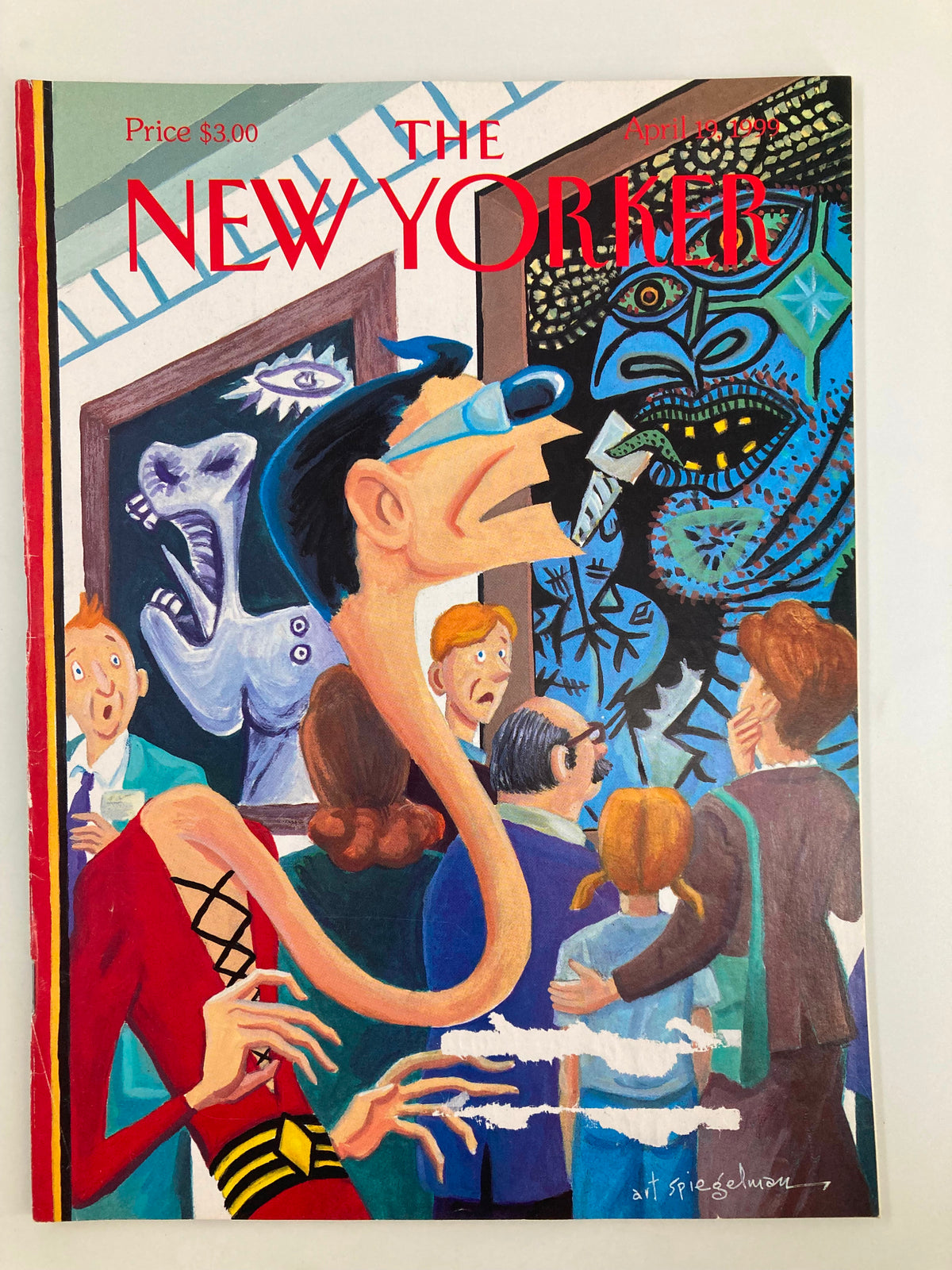
The April 19, 1999 issue of The New Yorker, with cover art and the piece "The Plastic Arts" by Art Spiegelman, documents one of the most significant relationships between a major American magazine and a graphic artist in the publication's modern history. Spiegelman had joined The New Yorker as a contributing editor and cover artist in 1992 — a hiring that reflected the magazine's recognition, under editor Tina Brown, that comics and graphic narrative deserved a place in the most prestigious American literary publication. By 1999 Spiegelman had already produced some of the most discussed New Yorker covers of the decade, including the controversial Valentine's Day 1993 cover depicting an interracial couple kissing and a series of covers responding to major cultural and political events. His engagement with "The Plastic Arts" — a title that simultaneously invokes sculpture, visual art broadly, and the commercial mass-production of plastic consumer goods — reflects the kind of layered conceptual work that distinguished his contributions to the magazine from conventional illustration. For collectors building an archive of New Yorker issues featuring significant cover art and graphic narrative, an April 1999 Spiegelman issue is a primary document of the publication's ongoing engagement with one of the most important figures in American comics and graphic art.
The April 19, 1999 date places this issue in a specific and historically charged moment. The Columbine High School shooting occurred on April 20, 1999 — the day after this issue's publication date — and while this issue therefore predates that event, it exists at the threshold of one of the most traumatic weeks in American cultural memory. More immediately relevant to the issue's content, the late 1990s were a period of intense cultural debate about the status of visual art, commercial imagery, and the boundaries between high and popular culture — debates in which Spiegelman, as the Pulitzer Prize-winning author of Maus and a New Yorker contributor who regularly pushed editorial and visual boundaries, was a central participant. His work consistently engaged the relationship between commercial culture, artistic ambition, and mass reproduction — exactly the territory suggested by "The Plastic Arts." Publications from 1999 document American culture at the end of a decade of significant transformation, and a Spiegelman New Yorker from this year is one of its more artistically considered documents.
About the Publication
The New Yorker in April 1999 was operating under the editorship of David Remnick, who had succeeded Tina Brown in 1998 and was in the early period of what would become one of the longest and most distinguished editorships in the magazine's history. Remnick maintained the publication's commitment to serious literary and cultural journalism while re-establishing some of the editorial tone that had characterized the Shawn years, and Art Spiegelman's continued presence as a contributing artist represented an inherited relationship that Remnick sustained. The magazine's combination of long-form journalism, fiction, poetry, criticism, and visual art gave it a cultural authority that few publications matched, and its cover selections remained significant cultural events.
Key Highlights Inside
- Cover art and "The Plastic Arts" by Art Spiegelman — a contribution by the Pulitzer Prize-winning author of Maus and The New Yorker's most prominent graphic artist contributor, engaging the relationship between visual art, commercial culture, and mass reproduction in a title that operates on multiple levels simultaneously.
- April 19, 1999 publication date — placing this issue on the day before the Columbine High School shooting, at a moment of late-1990s cultural intensity that would be permanently altered by the events of the following day.
- Spiegelman's presence as both cover artist and interior contributor — reflecting his unique position at The New Yorker as a figure whose work engaged the publication's editorial content rather than simply illustrating it, in the tradition of the magazine's most intellectually ambitious visual artists.
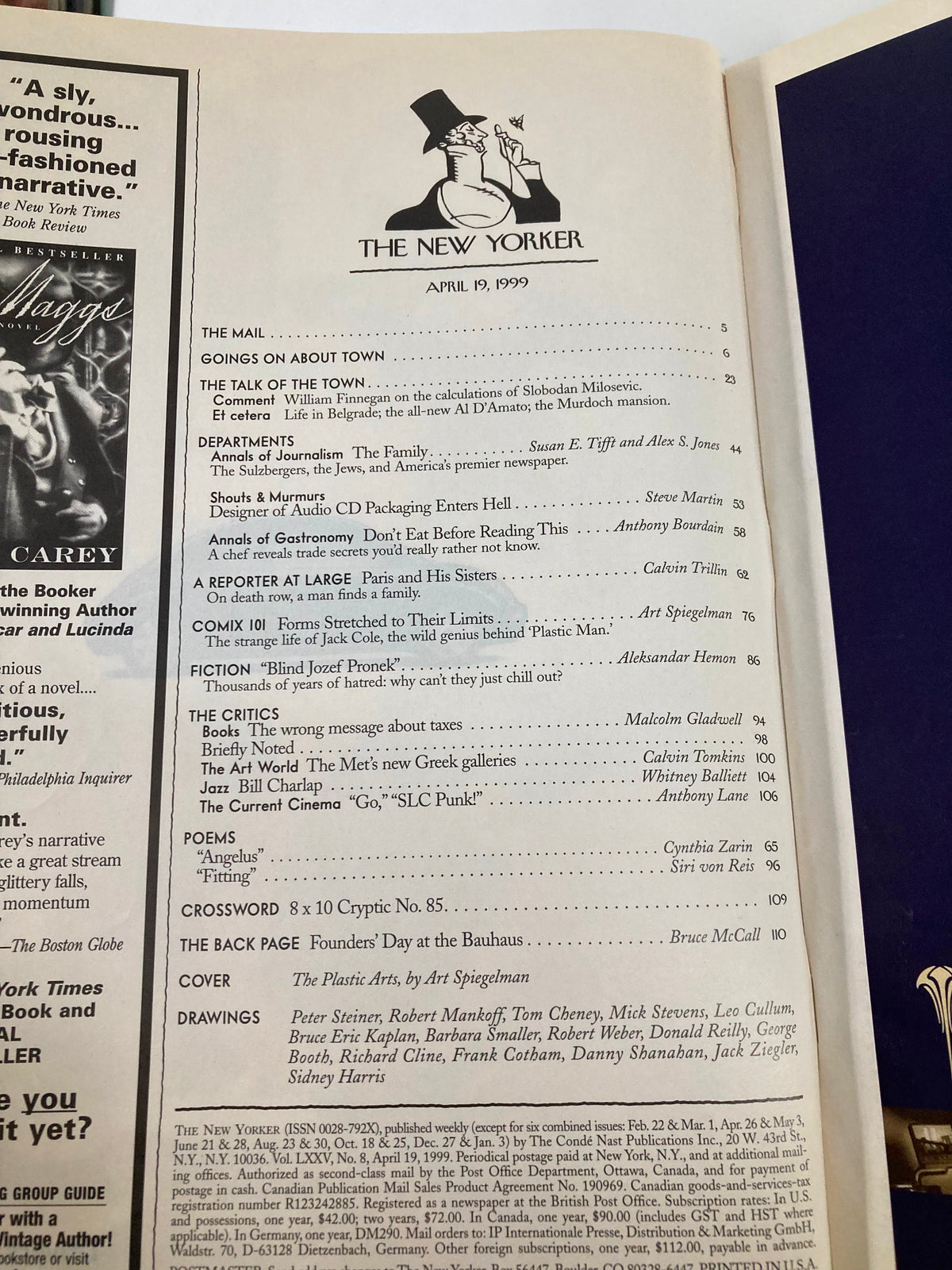
- Note: Specific interior articles, fiction, criticism, and additional features beyond what is confirmed in the listing are unverified for this issue. The above reflects what is documented in the listing and well-established context of Spiegelman's work and role at The New Yorker during this period.
Condition & Rarity
Good condition with minor wear throughout is an appropriate assessment for a magazine now over twenty-five years old. The presence of a mailing label on the front cover identifies this as a subscriber copy — the standard distribution method for The New Yorker during this period — and label presence is the norm rather than the exception for surviving copies of late-1990s issues. Label-free newsstand examples of this specific issue exist but are less commonly encountered. The plastic protective covering indicates deliberate preservation storage. For a glossy-stock weekly publication of this vintage, the primary condition factors to assess in any surviving copy are cover surface brightness and image clarity — Spiegelman's cover art is the primary visual and collectible attribute — spine integrity, and the completeness of interior pages.
Looking for More Issues Like This?
Art Spiegelman New Yorker covers from the 1990s are among the more consistently sought configurations in the publication's modern archive — his contributions were consistently among the most discussed and culturally specific covers of the decade. If this issue has already been claimed, the full archive of New Yorker issues spans the publication's entire run and surfaces other significant Spiegelman contributions and landmark covers from the Remnick and Brown years. The broader 1999 magazine collection offers additional context for this specific and historically charged year in American cultural life.