
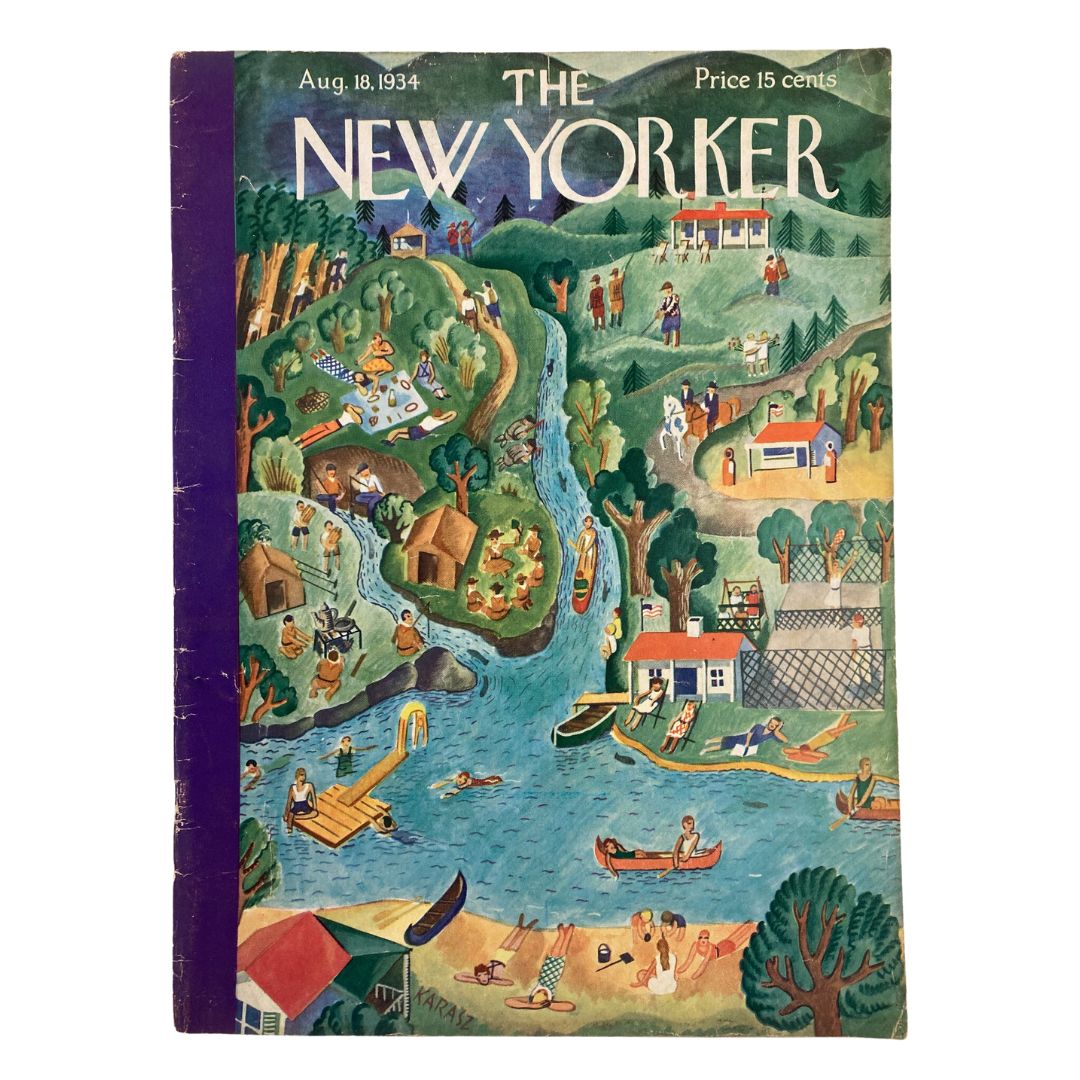
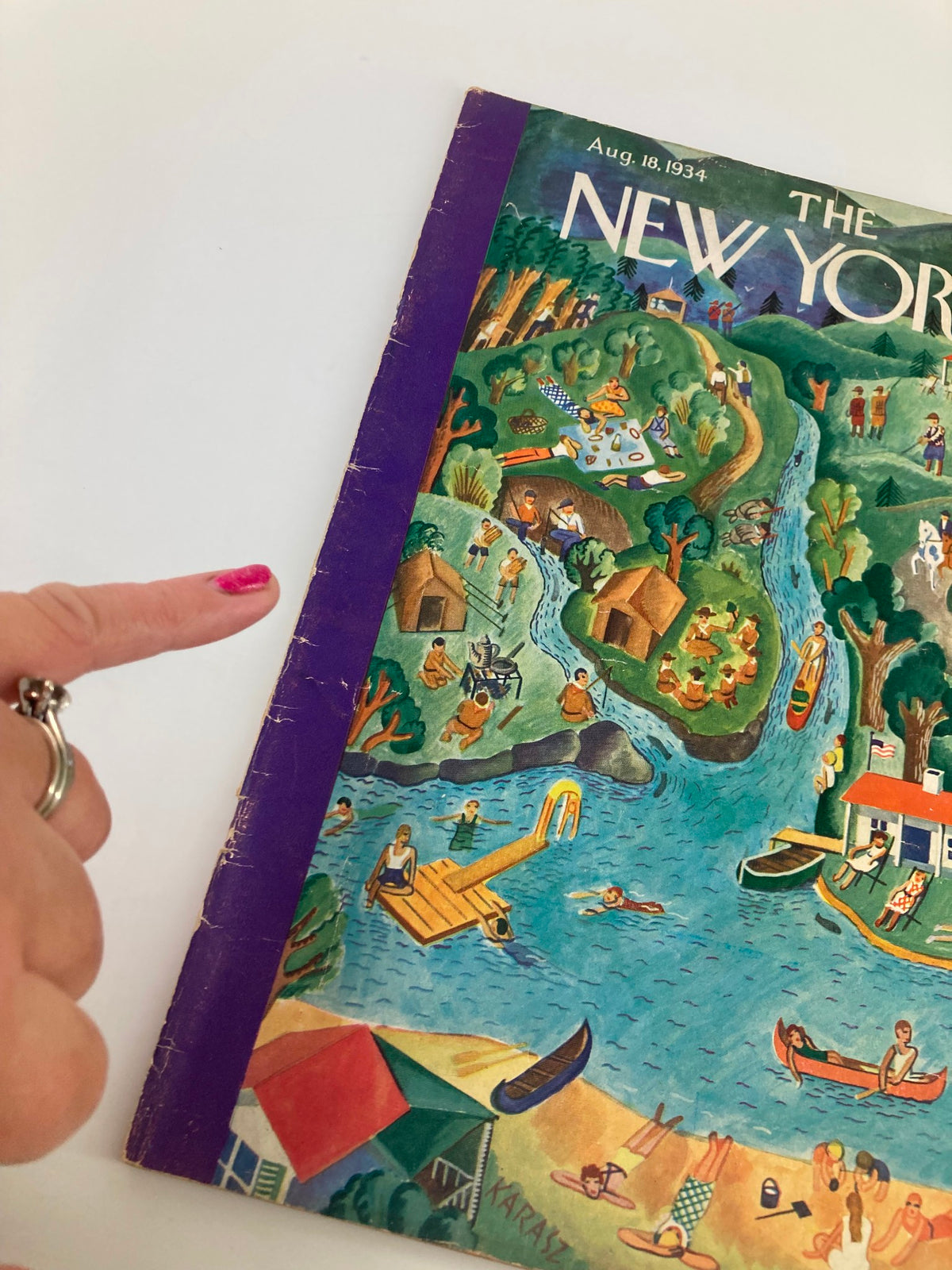
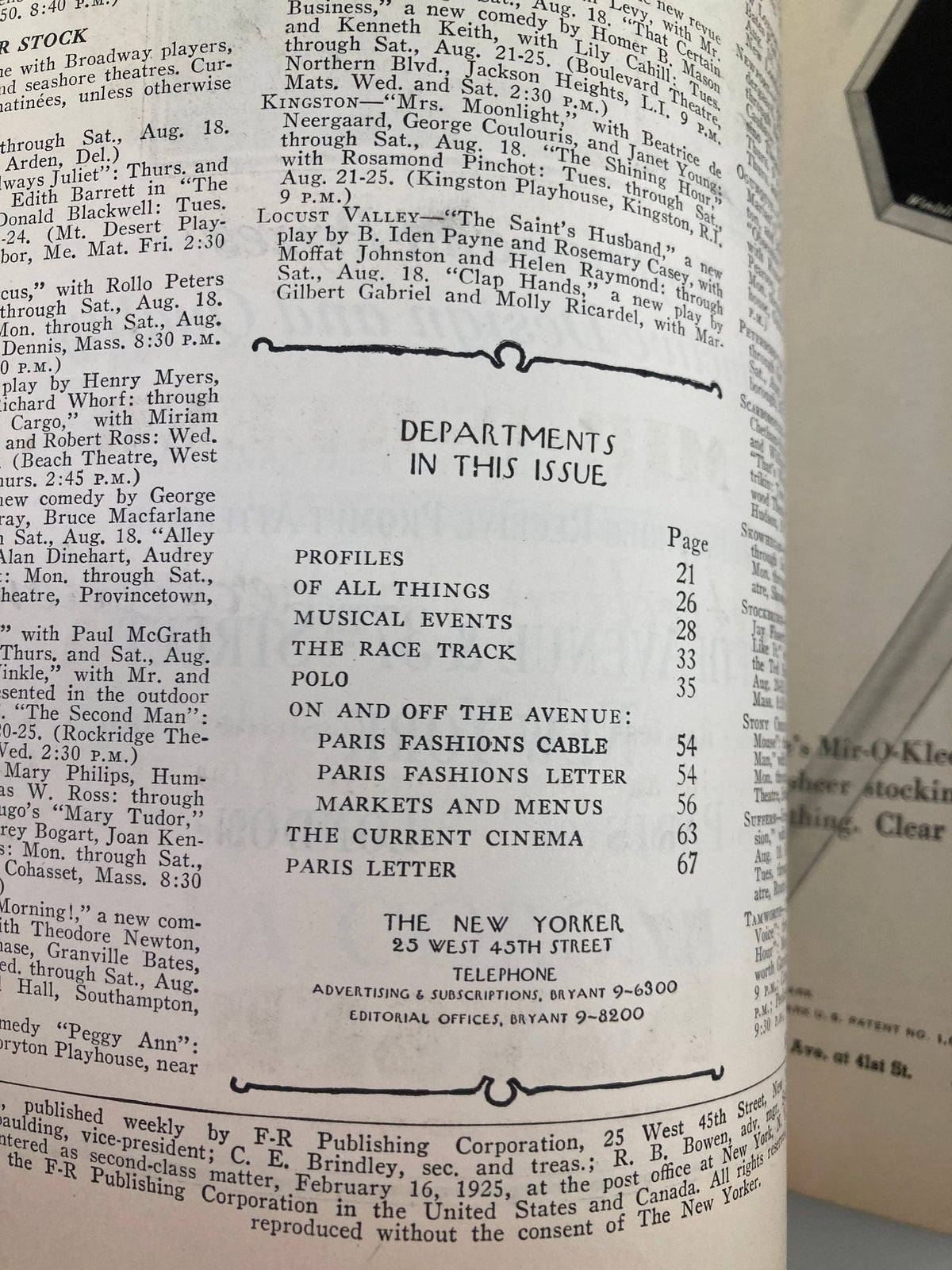


Description
Collector's Note – Why This Issue Matters
August 18, 1934 places this issue of The New Yorker at a specific and historically significant moment in the Great Depression's most complex phase. The summer of 1934 was unfolding against a backdrop of considerable political turbulence — the Night of the Long Knives had taken place in Germany on June 30, just seven weeks earlier, and Hitler had assumed the combined offices of president and chancellor following Hindenburg's death on August 2, just sixteen days before this issue's publication. In the United States, the New Deal was in its second year, generating intense debate about the proper direction of American economic recovery, and the midterm elections of November 1934 were beginning to take shape as the first national verdict on Roosevelt's program. Against this backdrop, a summer camp vacation cover offers a specific kind of cultural document: the magazine's characteristic refusal to let the weight of contemporary events displace the pleasures of seasonal life, the insistence on wit and leisure and the lighter registers of urban experience even in difficult times. For collectors building a serious archive through original magazines from 1934, an August 18 issue sits sixteen days after Hitler assumed absolute power in Germany — a historical precision that the summer camp cover holds in productive tension.
The cover by Ilonka Karasz makes this issue a particularly distinguished object within the magazine's mid-Depression visual archive. Karasz was one of the most remarkable and historically significant artists ever to contribute cover work to The New Yorker — a Hungarian-American modernist whose background in Central European design gave her covers a formal sensibility unlike virtually any of her contemporaries at the publication. Her work was characterized by bold geometric patterns, vibrant color, and a modernist design intelligence shaped by the Central European movements she had absorbed before emigrating to the United States. A summer camp vacation cover from Karasz would bring her distinctive formal sensibility to bear on a characteristically American seasonal subject — the kind of cultural translation between European modernism and American leisure culture that made her covers among the most visually interesting in the magazine's Depression-era archive. For collectors tracing the visual history of the publication through original New Yorker issues, Karasz covers from the mid-1930s are among the most formally distinctive and historically layered objects available.
The listing also notes no labels — a meaningful positive attribute for a 1934 newsstand publication. Label-free copies from this era are genuinely preferable for display, as subscription label adhesive causes irreversible surface damage that is present on the majority of surviving copies from this period. That attribute, combined with the protective covering and Karasz's formally inventive cover art, makes this a particularly appealing survivor of its specific historical moment.
About the Publication
Founded in February 1925 by Harold Ross, The New Yorker was by the summer of 1934 a fully established institution of American cultural life, nine years into its run and operating with growing editorial confidence and literary ambition. Its readership was urban, educated, and expected the combination of wit, critical intelligence, and serious engagement with the world that Ross enforced with unusual editorial discipline. The magazine's format was mature and consistent: "Talk of the Town" commentary opened each issue, followed by reported features, fiction, poetry, and critical reviews spanning theater, books, art, and film, all interwoven with cartoons and spot illustrations that had developed into one of the most celebrated creative traditions in American periodical publishing. Covers were individually commissioned works of illustration, and Karasz's contributions were among the most formally ambitious and visually distinctive in the publication's Depression-era history.
Key Highlights Inside
- Ilonka Karasz summer camp vacation cover: The cover is the defining collectible and artistically significant feature of this issue — original artwork by one of the most formally distinguished artists in The New Yorker's visual history, a Hungarian-American modernist whose geometric, design-forward sensibility brought Central European modernism to bear on a characteristically American summer subject.
- Sixteen days after Hitler assumed absolute power: Published on August 18, 1934 — sixteen days after Hitler assumed the combined offices of president and chancellor following Hindenburg's death on August 2 — this issue appeared at a historically precise moment in the consolidation of Nazi power in Germany, a context its summer camp cover holds in the characteristic tension that defined the magazine's Depression-era voice.
- No address label: The listing confirms no label is present — a meaningful positive condition attribute for a 1934 newsstand publication, as label adhesive causes irreversible cover surface damage that is present on most surviving subscription copies from this era.
- Plastic protective covering: The listing confirms an applied protective covering, indicating custodial care and often correlating with better overall preservation of the cover art and interior content.
- Cultural content of Depression-era summer 1934: The listing notes articles reflecting the cultural climate of the 1930s — content that, for an August 1934 New Yorker, would reflect the magazine's characteristic blend of wit, social observation, and serious engagement with an era of considerable domestic and international complexity.
Note: Specific article titles, bylines, and interior content for this exact issue have not been independently confirmed beyond what appears in the listing. The highlights above reflect only what is verifiable from the cover credit, publication date, condition notes, and the magazine's well-documented editorial format during this period.
Condition & Rarity
The listing describes this issue as in good condition with no labels, minor wear across its entirety, some marks, slight binding wear, and a plastic protective covering applied. In collector-grade terms, good condition for a publication from 1934 indicates honest age-related deterioration consistent with nearly ninety years of existence on acidic paper stock not designed for archival storage — likely including some toning, edge wear, and the binding wear specifically noted in the listing. The absence of a label is a genuine positive that preserves the cover surface integrity. The applied protective covering indicates custodial awareness. The slight binding wear noted in the listing is worth assessing in the provided photographs, as binding condition affects how the issue can be examined and displayed. When evaluating any surviving copy of this issue, the meaningful criteria are the integrity and color fidelity of Karasz's cover art, the completeness of all interior pages, the extent of the noted marks and binding wear, and the absence of moisture damage. At the grade described, this is an appropriate copy for reading, research, display, and general collection purposes.
Looking for More Issues Like This?
An Ilonka Karasz summer camp vacation cover from sixteen days after Hitler assumed absolute power in Germany — with no label, in a protective covering, from the Depression-era magazine's most visually distinctive contributing artist — is a find that rewards the patient collector, and August 18, 1934 is not a date that comes up with any regularity. If this issue is no longer available, the extensive original New Yorker collection at OriginalMagazines.com is one of the deepest archives of the magazine accessible to collectors, spanning many decades of its history. For those drawn to the Depression-era magazine and the particular historical complexity of the mid-1930s, the 1934 magazine collection rewards careful and patient exploration.