


Description
Collector's Note – Why This Issue Matters
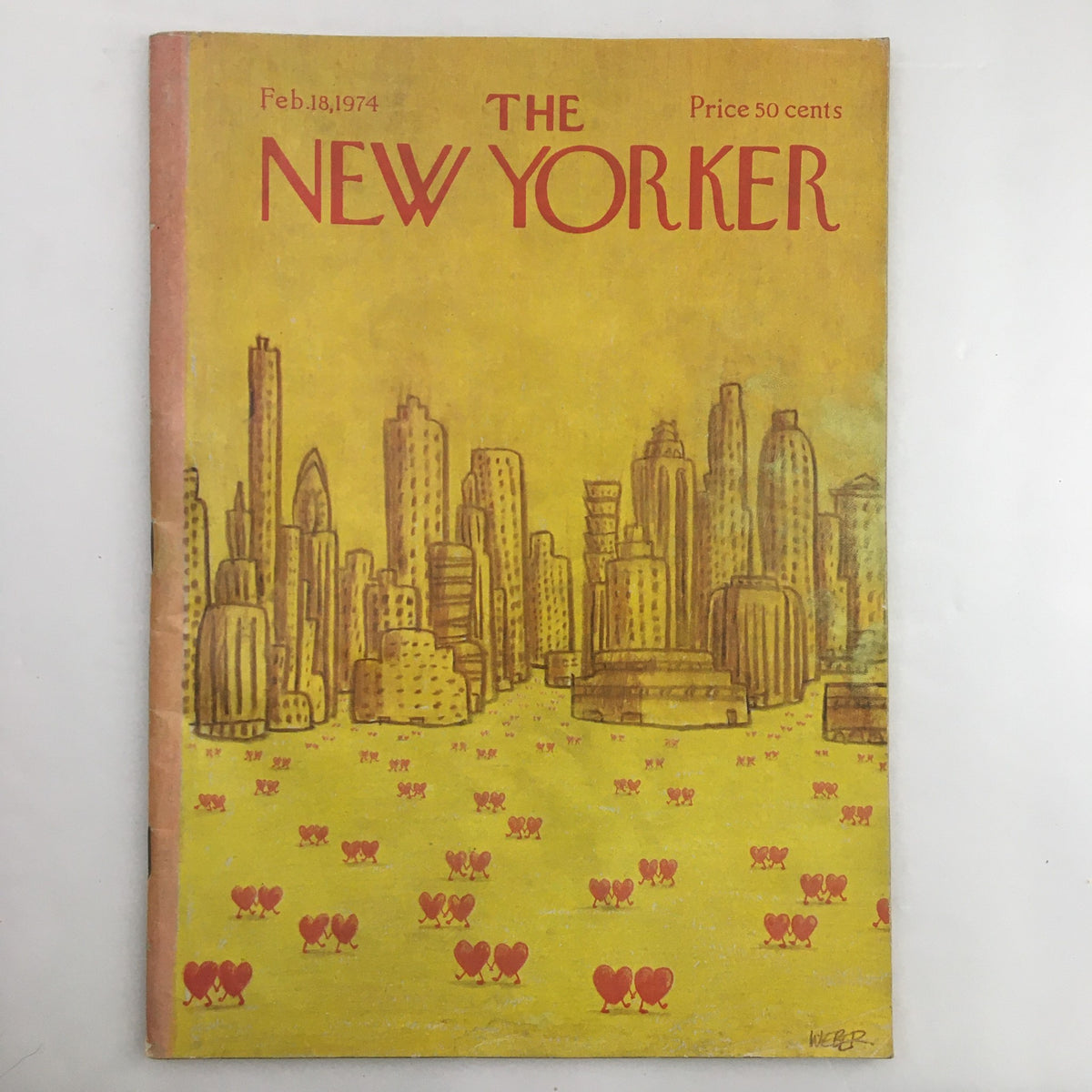
The February 18, 1974 issue of The New Yorker features a cover titled "City of Love" by Robert Weber — and the timing of a romantically themed urban cover in the third week of February is no accident. Weber was one of the magazine's most celebrated and longest-serving cartoonists, contributing both covers and interior cartoons across several decades and earning a reputation as one of the sharpest observers of upper-middle-class American social life the magazine ever published. His covers brought a particular quality of dry, affectionate wit to their subjects, and a Valentine's season cover titled "City of Love" would have given him ideal material — the specific comedy and warmth of romantic life in New York City, rendered with the visual intelligence and tonal precision that made his work so consistently satisfying to the magazine's readership. Weber's covers are among the more actively collected in the New Yorker visual archive, and a February 1974 issue bearing his work is a natural find for collectors who follow the magazine's mid-century and post-mid-century illustrative tradition.
February 1974 places this issue at one of the most turbulent moments in modern American political history. The Watergate scandal was in full crisis — the Saturday Night Massacre had occurred just months earlier, in October 1973, when Nixon fired special prosecutor Archibald Cox rather than comply with a subpoena for the White House tapes; the House Judiciary Committee had begun its impeachment inquiry in February 1974; and the country was living through a constitutional crisis whose outcome was not yet clear. The New Yorker under William Shawn had been one of the most penetrating voices in American journalism throughout the Watergate period, and its coverage of the Nixon administration's unraveling was among the most sustained and serious in the national press. A cover depicting the romantic side of urban life in the middle of this crisis reflects the magazine's characteristic capacity to hold multiple registers simultaneously — the political engagement of its interior content and the visual warmth of its cover art coexisting in the same object without contradiction. For collectors focused on vintage New Yorker issues from the Shawn era's most politically charged years, early 1974 issues carry a historical weight that their covers' apparent lightness only partially conceals.
The broader cultural context of February 1974 adds further dimension for collectors who approach these magazines as historical documents. The oil crisis of late 1973 had produced fuel shortages, long lines at gas stations, and a sudden contraction of the postwar American confidence in unlimited growth and cheap energy that would permanently alter the national mood. Inflation was rising sharply. The Vietnam War was winding toward its conclusion but had not yet ended. The America of February 1974 was a country whose optimism had been severely tested, and the New York that Weber depicted on the cover of The New Yorker was itself a city approaching the fiscal crisis that would bring it to the edge of bankruptcy the following year. A "City of Love" cover in this context is both a genuine celebration of the city's enduring romantic energy and, for the historically attentive collector, a document of that energy persisting under considerable pressure. Among surviving magazines from 1974, issues of The New Yorker from this specific window document a publication and a culture navigating one of the most difficult chapters of the postwar era.
About the Publication
The New Yorker, founded by Harold Ross in 1925 and edited by William Shawn from 1952 onward, was by February 1974 in the twenty-second year of Shawn's editorship — a tenure that had produced some of the most significant journalism in American publishing history and that was still very much in its creative prime. The magazine's Watergate coverage, its literary fiction, its criticism, and its long-form reporting were all operating at a high level in this period, and its visual identity — maintained through the cover art program that Robert Weber contributed to so substantially — remained as strong and recognizable as at any point in its history. Its readership was educated, politically engaged, and broadly distributed, and its February issues, arriving in the depths of winter with their seasonal mix of Valentine's warmth and political urgency, were among the most editorially layered of the annual cycle. Shawn's New Yorker in 1974 was a magazine fully aware of the historical moment it was living through, and its issues from this year reward reading with that awareness in mind.
Key Highlights Inside
- Cover illustration "City of Love" by Robert Weber, one of The New Yorker's most distinguished cartoonists and cover artists — a Valentine's season urban cover published in the middle of the Watergate crisis, capturing the romantic life of New York City with the wit and warmth that characterized Weber's best work.
- A complete issue from the Shawn editorial era during one of its most politically charged periods — the February 1974 installment of a magazine that was providing some of the most serious and sustained journalism about the Nixon administration's unraveling available anywhere in the American press.
- The full editorial format of the Shawn-era New Yorker: fiction, poetry, "Talk of the Town," long-form profiles and reportage, criticism, and cartoons — all reflecting the magazine's distinctive combination of literary seriousness and tonal range.
- Period advertising throughout the issue, documenting the consumer landscape of early 1974 America — a market already feeling the effects of the oil crisis, inflation, and the economic uncertainty that was beginning to reshape the postwar prosperity that New Yorker advertising had long reflected so vividly.
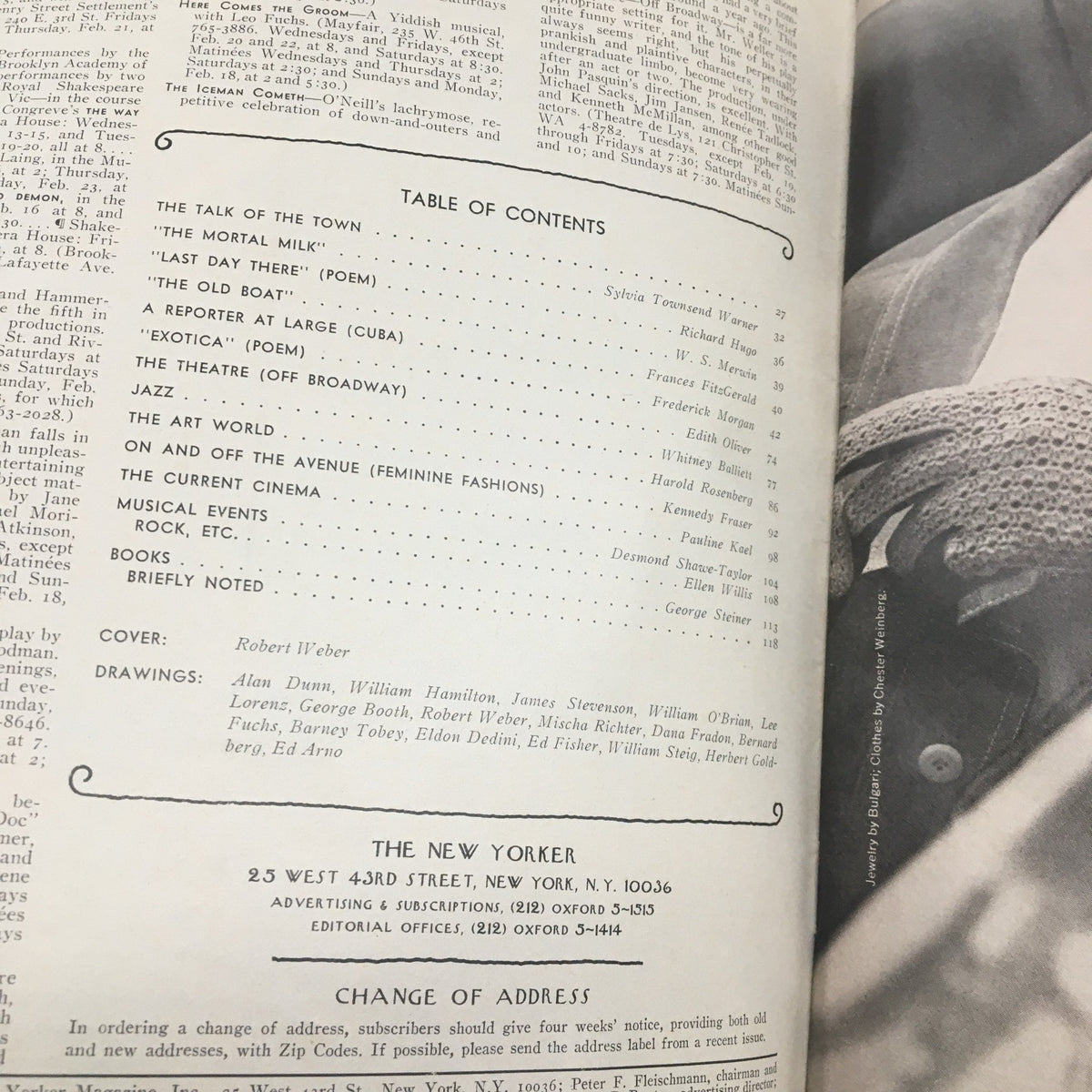
- Note: Specific interior articles, fiction pieces, and named contributors for this issue are unconfirmed beyond what the listing states. The Robert Weber cover is the documented visual centerpiece. Collectors researching the precise editorial contents would benefit from consulting archived New Yorker tables of contents or the magazine's digital archive.
Condition & Rarity
No address label with good condition and minor wear throughout is a solid and honest configuration for a collectible New Yorker from 1974, and the absence of a subscriber label is a meaningful positive — the magazine's subscription-dominant distribution model means that labeled copies significantly outnumber clean newsstand survivors in the market for any given issue from this period, making label-free copies the preferred configuration for display-focused collectors. Good condition with minor age-consistent wear is an accurate grade for a fifty-year-old staple-bound weekly; the coated cover stock and mix of coated and uncoated interior pages that The New Yorker used in the early 1970s ages reasonably well in stable storage but is susceptible to edge softening, surface micro-abrasion on the cover, and some degree of interior page tanning over five decades. A plastic protective sleeve provides meaningful ongoing preservation against dust, humidity fluctuation, and handling damage. When evaluating any surviving copy of this issue, the priority attributes are the color fidelity and surface condition of the Weber cover illustration — the primary visual draw for collectors of this issue — the security and flatness of the spine, the completeness of the page count, and the flexibility and overall condition of the interior pages.
Looking for More Issues Like This?
Robert Weber covers from the Shawn era are warmly sought by collectors of New Yorker visual history, and early 1974 issues carry the particular resonance of the Watergate winter — a moment when the magazine's interior seriousness and its cover art's warmth were in especially vivid contrast. If this issue has already found a home, the New Yorker collection at OriginalMagazines.com spans the full Shawn editorial era and regularly surfaces strong covers from the early 1970s worth serious attention. For collectors building a broader picture of American cultural and political life during one of the most turbulent years of the twentieth century, the 1974 magazine collection covers the year across multiple titles — a historically dense archive that rewards exploration from almost any angle.