

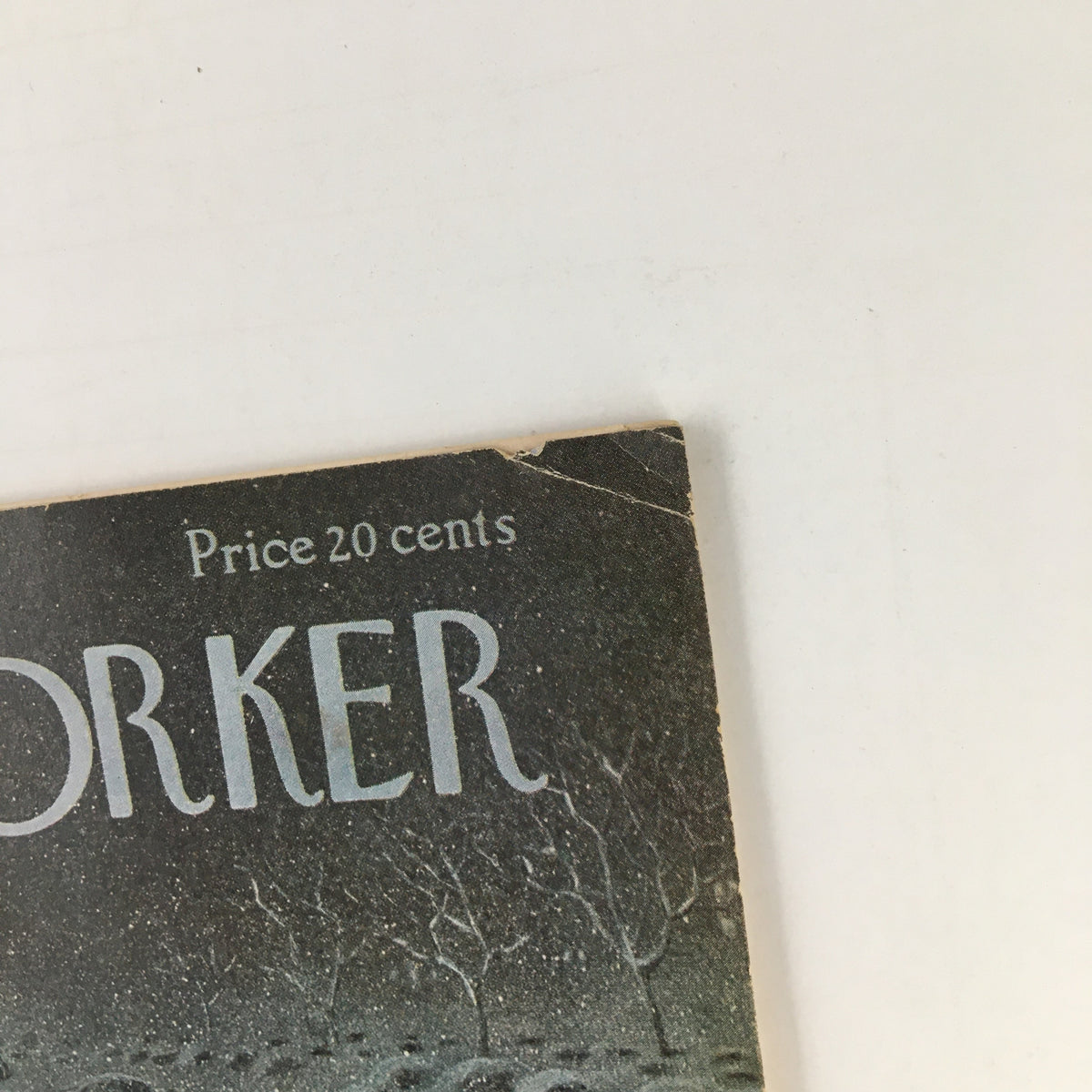


Description
Collector's Note – Why This Issue Matters
This January 19, 1952 issue of The New Yorker carries a cover by Garrett Price, an artist whose relationship with the magazine stretched back to its very founding year in 1925, when he contributed two of the publication's earliest covers during its first months in print. By 1952, Price had been working with The New Yorker for over a quarter century, part of a remarkable association that would ultimately span nearly five decades and produce roughly 100 covers along with hundreds of additional cartoons, making him one of the most prolific and longest-tenured visual contributors in the magazine's history. Price's path to The New Yorker ran through the Chicago Tribune's art department, where he worked through the 1920s, and through friendships formed at the Art Institute of Chicago with fellow future New Yorker cartoonists including Alice Harvey and Helen Hokinson, several of whom, along with Price himself, eventually settled in Westport, Connecticut, a community that became home to numerous New Yorker artists between the 1920s and the 1980s. This January 1952 cover arrives during a particularly mature phase of Price's New Yorker career, well past his early cartoon and comic strip work and squarely within the decades that art critics and historians have specifically highlighted for what one writer described as a "stunning, wistful beauty" characteristic of his later cover work.
Price's New Yorker covers throughout the 1940s and 1950s were noted for a particular emotional resonance that distinguished his work even among the magazine's famously distinctive roster of cover artists, who included figures like Charles Addams and Peter Arno with their own highly recognizable individual styles. Specific Price covers from this general period have been singled out by historians for their quiet, evocative power, including a 1949 image of a boy alone on a spring ball field and a 1951 cover depicting a summer house being closed for the winter, suggesting Price had a particular gift for capturing small, poignant moments of everyday American life within the magazine's sophisticated visual vocabulary. This January 1952 issue, arriving in the dead of winter, would have offered Price an opportunity to work within exactly this kind of evocative seasonal register that defined much of his most memorable work for the magazine during this era. For collectors specifically focused on New Yorker cover art history, an issue from this particular stretch of Price's long tenure offers a representative example of the artist working at the height of his mature, most critically appreciated style.
For collectors, this issue offers genuine value as a representative piece of work from one of The New Yorker's most significant and longest-serving cover artists, captured during a period art historians have specifically identified as showcasing his strongest, most evocative work. That combination of artistic significance and Price's foundational role in the magazine's visual history gives this issue real substance within the broader landscape of The New Yorker magazine collecting, where cover-artist-specific collecting remains a significant and active area of focus.
About the Publication
The New Yorker, founded in 1925 by Harold Ross, established itself from its earliest issues as a magazine defined as much by its distinctive visual identity as by its celebrated long-form journalism, fiction, and criticism. The magazine's cover art tradition became one of its most recognizable features almost immediately, with artists like Garrett Price contributing from the publication's very first year and helping establish the sophisticated, often understated illustrative style that would distinguish New Yorker covers from the more commercially driven cover art of competing general-interest magazines. By the early 1950s, The New Yorker had assembled a roster of cover artists whose individual styles, from the urbane sophistication of Peter Arno to the gothic wit of Charles Addams to Price's own evocative, often quietly emotional imagery, collectively defined the magazine's visual identity for generations of readers. The magazine's format combined these distinctive covers with its signature mix of reporting, fiction, poetry, and cultural criticism, maintaining a consistent editorial voice that distinguished it from virtually every other American magazine of the period. This combination of literary substance and visual sophistication is part of what has made New Yorker covers from this era a significant and ongoing area of interest for collectors and art historians studying twentieth-century American illustration.
Key Highlights Inside
- A cover by Garrett Price, an artist whose New Yorker tenure stretched from the magazine's founding year in 1925 through 1973. Price contributed approximately 100 covers to the magazine over nearly five decades, alongside hundreds of additional cartoons. By 1952, he was working within a mature period of his career that historians have specifically highlighted for its evocative, emotionally resonant imagery.
- Cover artwork consistent with the quiet, often poignant visual register that distinguished Price's work during this period of his New Yorker career. Historians have noted specific covers from this general era for capturing small, evocative moments of everyday American life. This January 1952 cover would have offered Price an opportunity to work within a winter seasonal register characteristic of his strongest period.
- The magazine's signature combination of reporting, fiction, poetry, and cultural criticism characteristic of The New Yorker's format throughout the early 1950s. This consistent editorial mix distinguished the magazine from virtually all of its general-interest competitors during this period. Specific interior contents for this particular issue are not detailed in available listing information.
- Visual continuity with The New Yorker's broader cover art tradition, which by 1952 included contributions from a roster of artists with highly individual styles. Price's work sat alongside that of contemporaries like Peter Arno and Charles Addams within this distinctive visual lineage. This combination of varied artistic voices under one consistent editorial vision was a defining feature of the magazine throughout the mid-twentieth century.
Condition & Rarity
Surviving copies of this issue are generally evaluated using the same standards collectors apply across vintage general-interest magazines: cover gloss and corner sharpness, spine integrity, absence of subscription labels or mailing stickers, and overall page condition free of tears, foxing, or moisture damage. A copy described as being in good condition, with a folded crease in the center front and a few minor creases on the cover, would be considered a representative survivor for a magazine now approaching seventy-five years old. The absence of a newsstand label reflects the issue's original point-of-sale distribution, a trait generally considered desirable among collectors of vintage New Yorker issues. A plastic protective sleeve is a standard and effective safeguard for an issue of this age, helping prevent further handling wear and environmental damage, though it has no bearing on the underlying grade of the magazine itself. It's worth noting that weekly issues of The New Yorker from this period were not limited editions in any meaningful collecting sense, since they were produced as standard newsstand and subscription copies in substantial print runs; their value to collectors rests instead on factors like cover artist significance, condition, and content rather than print scarcity. Given this issue's cover by a historically significant artist like Garrett Price, collectors focused specifically on New Yorker cover art history may weigh the issue's artistic content particularly heavily relative to minor cosmetic creasing. Pages free of brittleness, significant yellowing, or further tearing remain the broader benchmark for a well-preserved copy of any magazine from this era.
Looking for More Issues Like This?
A January 1952 New Yorker issue featuring cover art by Garrett Price, captured during a particularly evocative period of his nearly five-decade tenure with the magazine, offers genuine value for collectors interested in mid-century American magazine illustration. If this particular issue isn't available, it's worth browsing the broader The New Yorker magazine collection for other issues spanning this title's long and historically significant run, including additional covers from Price's extensive body of work for the magazine. Collectors focused on the era itself may also want to look through the full range of 1952 magazines for other issues from that year. Each of these collections offers a different way into the period, whether the interest lies in this specific artist's body of work, the magazine's broader visual history, or the cultural snapshot of a single year. A single year's worth of magazines often tells a fuller story than any one issue alone, particularly for collectors interested in tracing how the magazine's distinctive roster of cover artists evolved across the decades. Browsing by cover artist can also be a productive way to build a more focused collection around a specific aesthetic sensibility within The New Yorker's long visual history. Whichever angle appeals most, these collections are a useful starting point for going deeper into this significant period of American magazine illustration.