


Description
Collector's Note – Why This Issue Matters
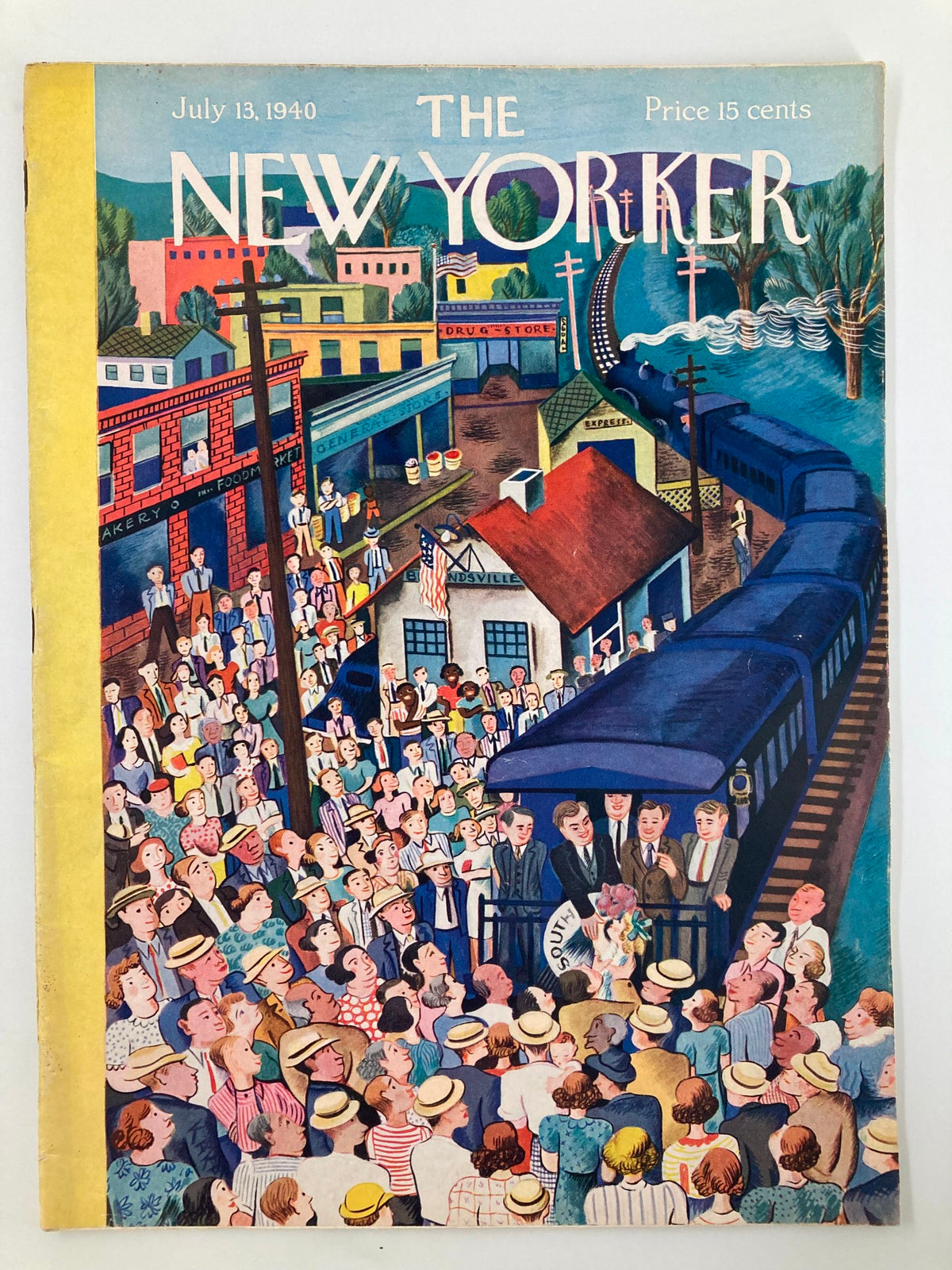
The July 13, 1940 issue of The New Yorker featuring Ilonka Karasz's cover illustration "Campaigning South" arrives at one of the most dramatic and frightening moments in modern history, and reading it against that backdrop transforms what might otherwise appear to be a leisurely summer cover into something considerably more complex and historically charged. By July 1940 the world had changed with a speed that left most observers struggling to absorb what had happened. France had fallen to Germany in June — with Paris occupied and the French government signing an armistice that shocked the Western world — and Britain was entering the period of the Battle of Britain, the sustained German air campaign that would determine whether the last major Western democracy still fighting Hitler would survive. The United States was technically neutral but deeply divided between isolationists who wanted no part of another European war and interventionists who believed American survival was inseparable from Britain's. Franklin Roosevelt was preparing for what would become his unprecedented campaign for a third presidential term, and the Republican Party was in the final stages of choosing its nominee — a contest that produced the surprise selection of Wendell Willkie, the dark-horse internationalist businessman who would give Roosevelt his most formidable general election challenge. The cover title "Campaigning South" places this issue squarely within that electoral and geopolitical context, and a Karasz summer cover published in this specific week carries a historical weight that makes it a primary document of the American home front at one of the most consequential moments of the twentieth century. For collectors building a serious archive of vintage New Yorker magazine issues from the Second World War era, issues from the summer of 1940 — the months of maximum European crisis before American entry into the war — represent some of the most historically resonant the publication produced across its entire wartime publishing window.
Ilonka Karasz's presence as the cover illustrator gives this issue a specific and distinguished place within the visual history of The New Yorker. Karasz was one of the most prolific and celebrated cover artists in the magazine's history, contributing covers across nearly five decades from the late 1920s through the 1970s — a tenure that makes her one of the defining visual voices of the publication alongside Rea Irvin, Charles Addams, and Saul Steinberg. Born in Budapest and trained at the Hungarian Royal School of Arts and Crafts before emigrating to the United States in 1913, Karasz brought a distinctly European modernist sensibility to her cover work — an influence of Art Nouveau and Art Deco design that gave her illustrations a visual sophistication and decorative richness that set them apart from more purely illustrative approaches. Her summer covers in particular — many of them featuring the pleasures and rituals of warm-weather American life rendered with a formal elegance that elevated the ordinary into something quietly beautiful — are among the most celebrated of her contributions to the magazine's visual canon. A July 1940 cover titled "Campaigning South" represents Karasz working at the intersection of the political moment and the summer genre she handled with particular mastery, and the resulting cover art is a document of both her individual artistic achievement and The New Yorker's characteristic approach to engaging with the political world through visual indirection and aesthetic sophistication rather than direct commentary.
The broader context of July 1940 in American literary and journalistic history adds further depth that makes this issue valuable to collectors and researchers working beyond the specific New Yorker and Karasz collecting communities. The summer of 1940 was a period of extraordinary creative and journalistic energy at the magazine, driven in part by the urgency of the European crisis and in part by the extraordinary roster of writers Harold Ross had assembled across the magazine's first fifteen years. New Yorker correspondents in Europe were filing dispatches from the front lines of a war that was reshaping the entire continent in real time, and the magazine's domestic coverage was engaging with the presidential campaign and the isolationist-interventionist debate with a sophistication and wit that made it an essential weekly read for anyone trying to understand what was happening to the world in the summer of 1940. Those assembling a comprehensive archive of 1940 magazines as primary documents of the most consequential year of the Second World War's early phase will find this issue one of the most richly layered and editorially significant pieces in that collection, combining a historically important cover artist at the height of her powers with a publication date that falls at one of the most dramatic single moments of the entire conflict.
About the Publication
The New Yorker, founded by Harold Ross in February 1925 and by 1940 firmly established as one of the most distinctive and literarily ambitious weekly magazines in the English-speaking world, was by the summer of that year operating at a particularly high pitch of editorial energy and historical awareness. Its editorial format combined original fiction of the highest quality, long-form journalism and criticism, poetry, and the magazine's signature cartoons with a weekly survey of New York cultural life — theater, music, art, books — that gave its primarily urban, educated readership an authoritative and sophisticated guide to the cultural landscape of the moment. By 1940 the roster of writers contributing to the magazine's pages included many of the most significant figures in American literature and journalism, and the editorial standards that Ross had established and maintained through fifteen years of sometimes contentious oversight had given the magazine a voice and identity so specific and consistent that it was immediately recognizable to readers across the country and, increasingly, the world. The cover art program, overseen with great care by Rea Irvin as art editor and later by subsequent art directors, had by 1940 established a tradition of commissioning original illustration from some of the most talented artists working in the commercial art world — a tradition that made New Yorker covers, including those by Ilonka Karasz, among the most aesthetically significant magazine cover art produced in twentieth-century America. Issues from the 1940 run represent the magazine at a mature creative peak, engaging with the most consequential events of the century through the combination of literary seriousness, visual sophistication, and characteristic wit that defined its approach to journalism throughout the wartime years.
Key Highlights Inside
- The cover illustration "Campaigning South" by Ilonka Karasz — one of the most prolific and celebrated cover artists in The New Yorker's history, whose nearly five-decade run of contributions represents one of the defining visual legacies in the magazine's visual canon — places this issue within the mature mid-career work of an artist whose modernist European sensibility and formal elegance gave her summer covers a particular distinction within the publication's extensive visual archive.
- The July 13, 1940 publication date places this issue within one of the most dramatically compressed periods of the entire Second World War — published just weeks after France's fall and the signing of the Franco-German armistice, during the opening phase of the Battle of Britain, and in the middle of the American presidential campaign that would produce Roosevelt's unprecedented third term — a combination of European crisis and domestic political drama that gave New Yorker editorial content from this specific week an unusually charged historical context.
- The cover title "Campaigning South" connects the issue directly to the 1940 presidential campaign — the contest between Franklin Roosevelt and Republican dark-horse nominee Wendell Willkie that was unfolding in the summer of 1940 against the backdrop of the European catastrophe — and reflects The New Yorker's characteristic approach to political engagement through visual suggestion and aesthetic indirection rather than direct editorial commentary.
- As a mid-July 1940 issue, the magazine would have carried the full range of New Yorker content — fiction, criticism, reporting, cartoons, and the Talk of the Town — produced by a roster of writers and artists who were working at the intersection of the magazine's literary traditions and the most consequential news environment any of them had experienced since the First World War, giving the interior editorial content a particular urgency and historical density.
- The confirmed absence of an address label on this newsstand copy preserves the Karasz cover illustration in its complete and uninterrupted form — a meaningful condition attribute for a cover whose artistic significance within The New Yorker's visual history makes the integrity of the original cover presentation a genuine collector priority.
- Note: Specific fiction contributors, article titles, cartoon artists, and full interior editorial contents beyond the confirmed cover art and cover artist have not been independently verified for this issue. The above reflects what is documented from the listing description, cover identification, and the well-established historical record surrounding both Ilonka Karasz's work for The New Yorker and the political and geopolitical context of July 1940.
Condition & Rarity
Surviving copies of the July 13, 1940 New Yorker in any collectible condition represent a genuinely small fraction of the original print run, and eighty-five years of existence have been a substantial attrition force on a publication that was designed for weekly reading rather than archival preservation. The New Yorker of this era was printed on paper stock typical of late-thirties and early-forties weekly magazine production — not the lightweight newsprint of daily newspapers, but not modern acid-free archival stock either — and the characteristic aging patterns of issues from this decade are well established in the collector market: noticeable tanning of the outermost pages, possible foxing on interior spreads, softening and possible cracking of the spine binding from decades of storage in varied conditions, and the small tears, marks, and edge wear that accumulate over eight and a half decades of handling and ownership transitions. The listing describes this issue as being in Good condition with minor wear throughout and confirmed newsstand origin without an address label — a characterization that, applied honestly to an eighty-five-year-old weekly magazine, implies that the issue retains its essential structural integrity with the cover attached and legible, the Karasz illustration preserved in its complete form without label damage, and the interior contents accessible and readable throughout, while acknowledging the tanning, surface aging, and physical wear that are universal features of periodicals of this antiquity rather than individual condition defects. The confirmed absence of an address label is the most significant positive condition attribute for display-focused collectors of this issue, as it preserves the cover art in its original and uninterrupted presentation — particularly meaningful for a Karasz cover, where the formal elegance of the illustration is most fully appreciated when viewed complete and without the adhesive damage that subscriber labels of this era routinely inflicted. Protective plastic sleeve storage, applied at whatever point in the copy's history, is the correct archival approach for periodicals of this age and substantially slows the continued oxidation and physical deterioration that affect all paper-based materials of this vintage in long-term storage.
Looking for More Issues Like This?
The July 13, 1940 New Yorker with Ilonka Karasz's "Campaigning South" cover is the kind of find that rewards collectors who understand both the visual history of the magazine and the extraordinary historical moment its publication date documents — a combination of artistic distinction and historical urgency that makes early-forties issues some of the most compelling in the publication's entire run. The vintage New Yorker magazine collection at OriginalMagazines.com spans a carefully assembled range of issues from across the publication's long and distinguished history, and is the essential starting point for anyone building a serious archive of one of the most important literary and cultural magazines ever published in the English language. For collectors drawn to the specific historical intensity of the year that brought the fall of France, the Battle of Britain, and the American presidential campaign that produced Roosevelt's third term, the 1940 magazine collection offers a rich and varied cross-section of that extraordinary year across multiple titles and editorial perspectives — an invaluable resource for understanding the full cultural and political texture of the most consequential single year of the Second World War's early phase.