


Description
Collector's Note – Why This Issue Matters
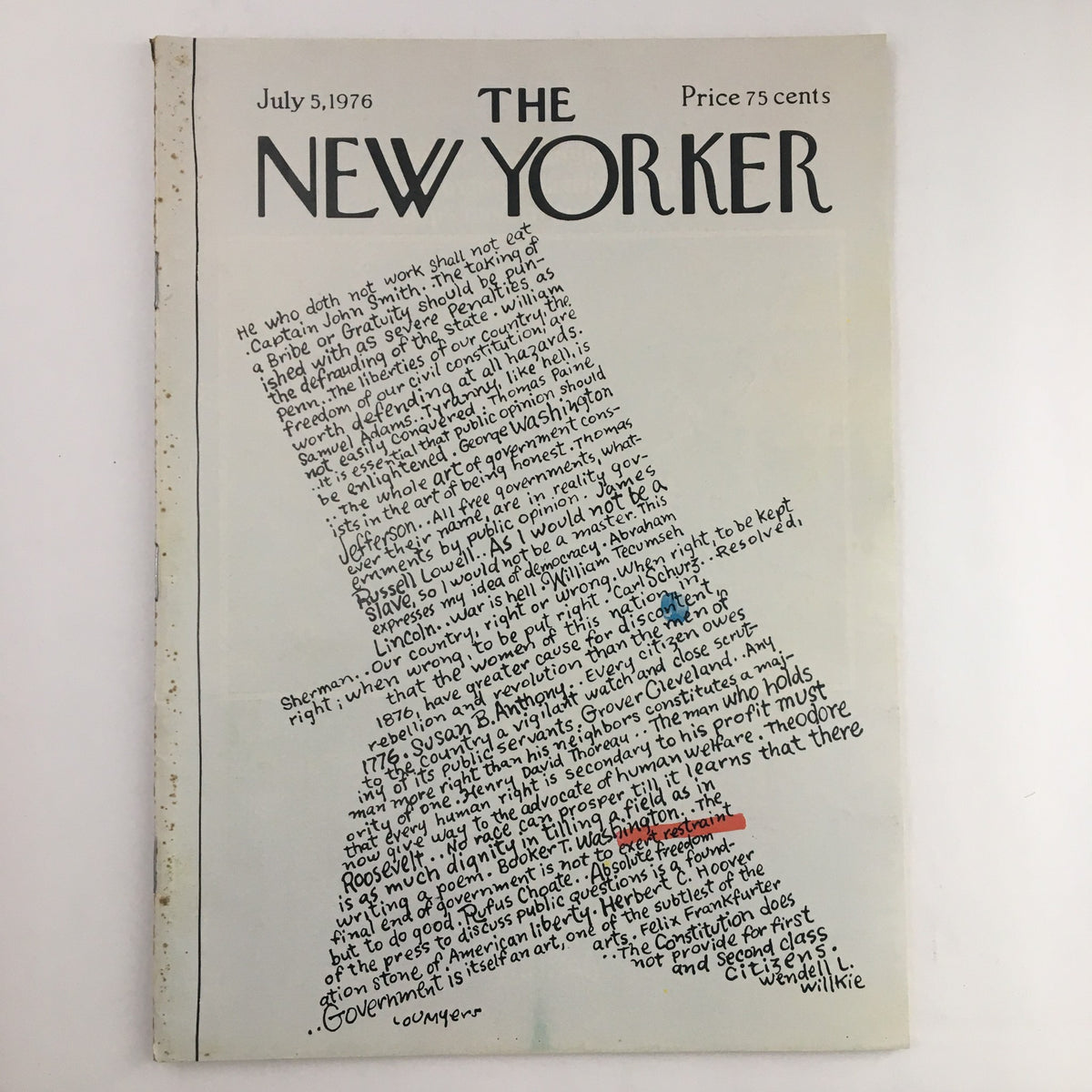
The July 5, 1976 issue of The New Yorker was published immediately after the United States Bicentennial, giving its date and cover imagery unusual historical resonance. The cover, officially credited to Lou Myers, presents a large question mark formed from handwritten statements attributed to figures from different periods of American history. Among the names incorporated into the design is women’s-rights reformer Susan B. Anthony, but the artwork should not be described as a reproduced letter written by Anthony. Instead, her attributed words appear as one element within a larger visual meditation on American principles, political rhetoric, and the continuing meaning of citizenship. The question-mark format suggests reflection rather than uncomplicated celebration, making the cover especially appropriate for a nation assessing two centuries of independence.
Susan B. Anthony’s inclusion connects the design to the long struggle to expand the political rights promised by the American experiment. Anthony was a major leader in the campaign for women’s suffrage, and her name carries particular significance within a cover concerned with citizenship, government, liberty, and public responsibility. She appears alongside political leaders, writers, reformers, and other historical voices, placing the movement for women’s voting rights within a broader national conversation. Myers does not isolate one individual as the complete answer to the cover’s question; instead, the design gathers many statements into a deliberately complex whole. This visual structure gives the issue value to collectors interested in women’s history, Bicentennial imagery, American political thought, and editorial illustration.
The interior continues the Bicentennial theme through commentary, historical reporting, and observations of commemorative events. E. B. White reflects on the condition of the United States at its two-hundredth anniversary, while E. J. Kahn, Jr., looks back at British newspaper coverage on the eve of American independence. Other features examine public celebrations, patriotic symbols, books, film, dance, music, fiction, and poetry. The issue can therefore be read as both a literary magazine and a contemporary document of how Americans interpreted the Bicentennial while it was occurring. Related illustrated issues can be studied through the archive of vintage New Yorker magazines, while the collection of magazines published in 1976 provides a wider view of the country’s Bicentennial-era print culture.
About the Publication
The New Yorker is an American magazine founded in 1925 and historically associated with reporting, commentary, profiles, literary criticism, fiction, poetry, humor, and cartoons. Although closely identified with New York City, its editorial scope has long included national politics, international affairs, history, literature, theatre, cinema, music, architecture, and social observation. Its weekly issues traditionally combine short pieces in “The Talk of the Town” with longer reported articles, essays, reviews, stories, poems, and illustrated humor. The magazine’s covers are particularly distinctive because they generally rely on one self-contained illustration instead of promotional cover lines describing the contents. This format has allowed artists such as Lou Myers to respond indirectly to public events through visual metaphor, satire, and carefully constructed symbolism. By 1976, The New Yorker had already developed more than five decades of literary and journalistic history. Complete physical issues preserve not only the major articles and cover art but also the original advertisements, cartoons, departments, typography, and editorial sequence encountered by contemporary readers.
Key Highlights Inside
- The July 5, 1976 cover is officially credited to Lou Myers and depicts a large question mark composed of handwritten quotations attributed to historical American figures. Susan B. Anthony is one of the named voices included within the image, but the cover is not a reproduction of a personal letter from her.
- E. B. White contributed a Bicentennial “Notes and Comment” essay examining the United States at the time of its two-hundredth anniversary. The piece reflects on national problems, political shortcomings, civic energy, and the complicated endurance of American patriotism.
- E. J. Kahn, Jr.’s “The Eve of Independency” looks at London newspapers immediately before the American Revolution. The article explores how British publications reported, debated, and speculated about the colonial crisis that led to the break with the Crown.
- The issue includes several Bicentennial-related reports concerning commemorative activities and historical memory. These pieces range from a colonial-themed exhibition at Yale to a Hoboken reenactment of an early baseball game and an educational project conducted from a converted barge.
- Ann Beattie’s “The Lawn Party” and Marshall Brickman’s “Instructions” represent the issue’s fiction. Poetry by Charles E. Bolton, John Berryman, and Leslie Ullman adds several different literary voices to the magazine’s Bicentennial-era editorial mixture.
- Cultural criticism includes Arlene Croce on American Ballet Theatre’s production of The Sleeping Beauty, Penelope Gilliatt on The Tenant, Logan’s Run, and The Omen, and John Updike on books by R. K. Narayan and Ruth Prawer Jhabvala. Additional coverage addresses jazz, opera, recent books, and the visual and symbolic role of the American flag.
Condition & Rarity
The magazine is described as being in Good condition, with minor wear and some marks visible across the issue. Such handling evidence is consistent with a weekly periodical that has survived since the Bicentennial year and was originally produced for reading rather than archival storage. Its newsstand origin and absence of a subscriber mailing label leave Lou Myers’s quotation-based cover design unobstructed, an important visual attribute for collectors focused on cover art. The listing does not identify major tears, detached pages, missing contents, moisture damage, or serious binding failure, although those characteristics should be confirmed through inspection of the photographs. Relevant grading points include the security of the staples, cover attachment, page completeness, edge rubbing, spine stress, corner softness, and the location of the reported marks. The marks form part of the issue’s present condition and should be assessed according to whether they affect only the surface or interfere with the artwork and printed text. The accompanying plastic protective covering is a later storage accessory rather than an original component of the magazine, but it can help limit dust, abrasion, and additional handling wear.
Looking for More Issues Like This?
The July 5, 1976 issue occupies a distinctive place in the publication’s history because its Lou Myers cover and interior features respond directly to the American Bicentennial. Exact dated examples with complete interiors and clean, label-free covers may require patience to identify. The broader collection of original New Yorker magazines offers additional examples of the publication’s illustrated covers, historical reporting, fiction, criticism, poetry, and cartoons. Readers studying the surrounding anniversary period can also browse other original magazines from 1976. Examining several publications from that year reveals the many ways American editors, writers, and artists interpreted the nation’s two-hundredth anniversary.