


Description
Collector's Note – Why This Issue Matters
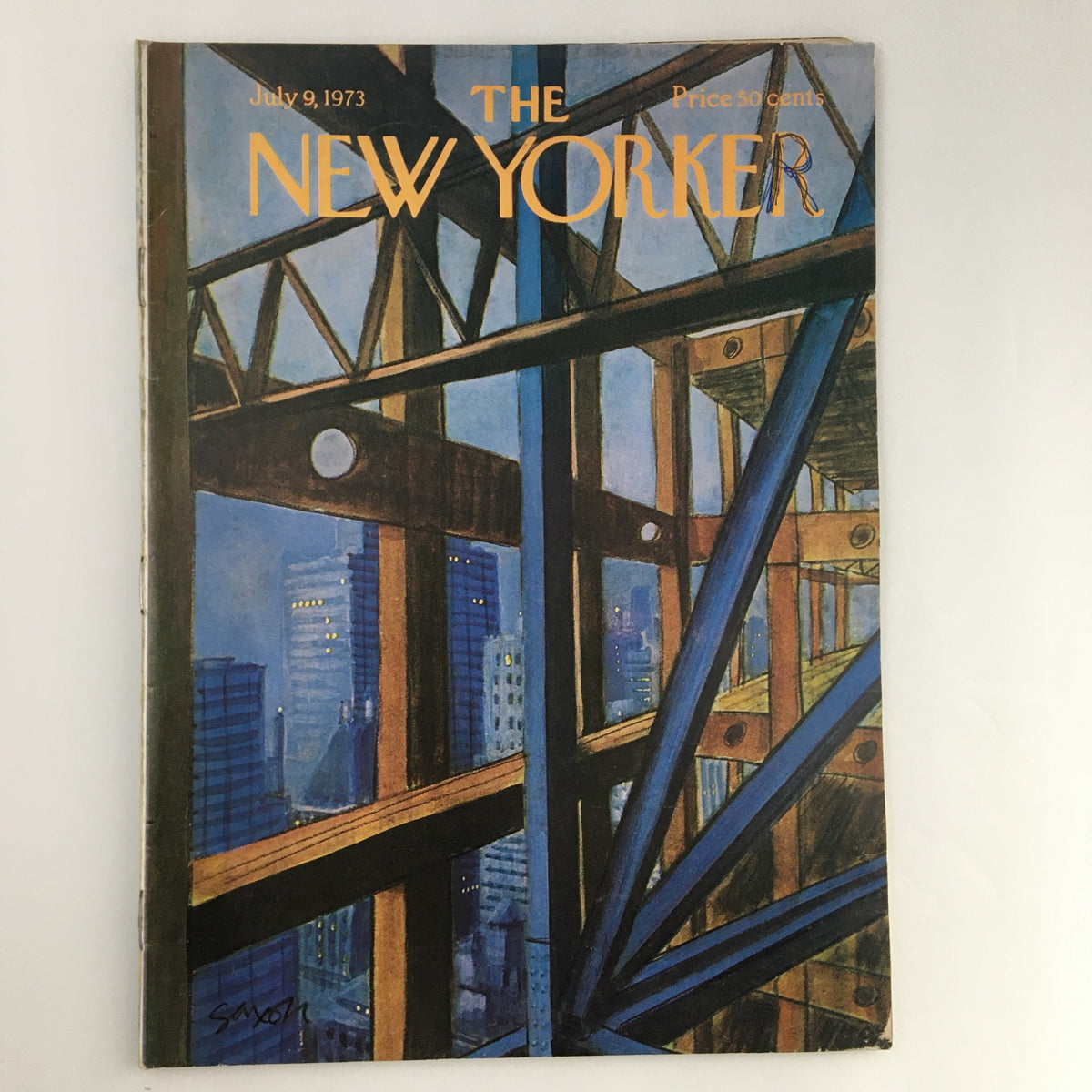
The July 9, 1973 issue of The New Yorker featuring Charles Saxon's cover "Construction Building" is a primary document of the publication at one of the most historically interesting and most editorially complex phases of its modern history — the early Watergate era, the specific summer when the Senate Watergate Committee hearings were being broadcast live on national television and when American public life was in one of its most dramatically charged political phases. Saxon's choice of construction as a subject for a July 1973 cover carries a secondary resonance in this context: the mid-1970s were a period of significant urban construction and physical transformation in American cities, particularly in New York, where the economic dynamics of the mid-decade were generating specific architectural and urban development stories that the publication's readership was living through daily. A construction subject cover from July 1973 can be read both as the straightforward observational urban comedy that Saxon's work characteristically delivered and as an oblique comment on a city and a country in the process of building and rebuilding — at a moment when the political architecture of the American system was itself under the most intense scrutiny it had experienced since Watergate's revelations had begun accumulating. Charles Saxon was one of The New Yorker's most celebrated and most artistically distinctive cartoonists and cover artists, whose specific visual humor — focused on the specific social and professional rituals of upper-middle-class American corporate and domestic life, rendered with a precision of observation and a warmth of comedy that made him one of the publication's most beloved contributors — had developed over two decades into one of the most recognizable visual voices in the publication's history. For collectors building a serious archive of New Yorker cover art, the New Yorker collection at OriginalMagazines.com provides essential depth across the publication's full run, with the early-1970s Shawn-era issues representing a particularly historically resonant tier during one of the most charged political moments in American postwar history.
The specific date of July 9, 1973 places this issue at a remarkable moment within the Watergate chronology. The Senate Watergate Committee hearings had been underway since mid-May 1973, and July 1973 was the month when Alexander Butterfield revealed to the committee the existence of the White House taping system — a revelation that occurred on July 13, 1973, just four days after this issue's publication date. The July 9 issue therefore appeared at the precise threshold of what would prove to be the Watergate scandal's single most consequential disclosure, four days before the revelation that would ultimately lead to Nixon's resignation. Readers who received this issue on or around July 9 were reading it on the eve of one of the most historically significant political disclosures in American history, in the specific cultural atmosphere of a country that was simultaneously absorbed in the daily drama of the committee hearings and attempting to maintain the normal rhythms of summer life. Saxon's urban construction cover was reaching those readers in that specific context, and the specific combination of visual warmth and humorous observation that made his work characteristic of the publication's editorial voice was functioning in that context as a specific kind of cultural steadiness — the publication's specific aesthetic register of intelligent, humorous, civilized engagement with ordinary life maintained through extraordinary political circumstances. The no-label newsstand condition preserves the full Saxon cover design without label disruption. The full range of 1973 magazines and publications from this Watergate year provides essential context for understanding the broader political and cultural moment this issue documents.
Charles Saxon's specific significance as a New Yorker cover artist in July 1973 gives this issue an additional dimension of art historical documentation that serious collectors of the publication's visual tradition will recognize. Saxon had been contributing to The New Yorker since the early 1950s and had developed his specific visual vocabulary — the meticulous rendering of corporate offices, country clubs, suburban living rooms, and professional social rituals, with the specific human comedy of the upper-middle-class American male's relationship to his work and social world — into one of the publication's most formally accomplished and most culturally precise visual registers. His "Construction Building" cover applies that observational precision to the specific human comedy of the urban construction site, and its survival in a no-label newsstand condition makes it one of the more specifically useful and most visually complete surviving examples for the collecting and art historical communities focused on the publication's specific visual contributors.
About the Publication
The New Yorker was founded in 1925 and had established itself by 1973 under William Shawn's editorial direction as the most culturally authoritative weekly magazine in the United States, its editorial voice combining literary fiction, long-form journalism, cultural criticism, and the specific visual wit of its cover art and cartoons into a publication that set the standard for American cultural journalism. By July 1973, the publication was operating during the most politically charged period of the Nixon presidency — the Watergate summer — with the specific editorial independence and cultural seriousness that Shawn's tenure had established and deepened across more than two decades. Charles Saxon had been one of its most celebrated visual contributors since the early 1950s, his specific comedic precision and social observation making him one of the publication's most recognizable and most artistically distinctive voices.
Key Highlights Inside
- Charles Saxon "Construction Building" cover — urban observational comedy at Watergate summer threshold — The confirmed Saxon "Construction Building" cover is primary visual documentation of one of The New Yorker's most celebrated visual contributors applying his specific observational precision and humorous intelligence to the urban construction subject in the specific cultural context of the early Watergate summer, four days before the Alexander Butterfield taping system revelation that would prove to be the scandal's most consequential single disclosure.
- No-label newsstand edition — full Saxon cover art preserved in complete presentation — The confirmed no-label newsstand origin preserves the "Construction Building" cover illustration in complete visual presentation without subscription label disruption, representing a meaningful positive for a publication primarily distributed by subscription in which label-free examples are considerably less common than the labeled majority of surviving copies.
- July 1973 Watergate era editorial content — political crisis and cultural continuity documented — The editorial content of the July 9, 1973 New Yorker would have reflected the specific cultural and political atmosphere of the most charged phase of the Watergate summer, providing the specific combination of literary seriousness, cultural engagement, and intelligent humor that the Shawn-era publication maintained through the extraordinary political drama surrounding its readership's daily life.
- Early-1970s Shawn-era New Yorker — political crisis period visual and editorial culture documented — A July 1973 Saxon New Yorker preserves primary documentation of the publication's specific visual and editorial voice during one of the most politically dramatic periods of the postwar era, capturing the publication's characteristic aesthetic register of intelligent, humorous, civilized engagement with ordinary life maintained through the extraordinary political circumstances of the Watergate summer.
- Note: The specific fiction, journalism, and cultural criticism contents of this issue beyond the confirmed Charles Saxon cover have not been independently verified beyond the listing description. The highlights above reflect what is documentable from the listing and the well-established historical context of The New Yorker's July 1973 publication and Charles Saxon's role in its cover art tradition.
Condition & Rarity
This issue is described as being in good condition with minor wear throughout, no label, and a plastic protective covering — a condition profile that represents a well-maintained survivor of a weekly publication now over fifty years old. Good condition with minor wear indicates consistent storage care that has preserved the publication above the typical survival condition for a newsstand copy of this age and original use context. The no-label newsstand status is the most significant positive condition attribute, preserving the Saxon "Construction Building" cover in complete visual presentation without subscription label disruption. The plastic protective covering indicates deliberate preservation care, correlating with better overall stability than unprotected examples stored under comparable conditions. New Yorker issues from the early-1970s Shawn era featuring Charles Saxon covers in no-label condition are sought by New Yorker cover art collectors, Saxon illustration specialists, and Watergate era cultural history researchers who recognize these publications as primary visual and editorial artifacts of one of the most politically charged and most historically consequential summers in American postwar history.
Looking for More Issues Like This?
New Yorker issues from the early-1970s Watergate era featuring Charles Saxon covers — and particularly this July 9, 1973 "Construction Building" edition published four days before the Alexander Butterfield taping revelation at the most dramatically charged moment of the Watergate summer — are sought by New Yorker cover art collectors, Saxon illustration enthusiasts, and American political and cultural history researchers who recognize these publications as primary documents of the most significant constitutional crisis in postwar American history as it was being lived through in real time. If this July 1973 issue is no longer available, the New Yorker collection at OriginalMagazines.com is the most comprehensive resource for exploring what else has surfaced from this publication's extraordinary archive. For collectors building a broader documentary record of American cultural journalism and political life during one of the most historically charged years of the twentieth century, the 1973 magazines collection brings together a wide range of primary source material from that extraordinary Watergate year.