




Description
Collector's Note – Why This Issue Matters
June 29, 1968 is one of the most historically charged publication dates in The New Yorker's entire run, and this issue — with an Arthur Getz library cover — documents the magazine at the precise center of the most turbulent year of the 1960s. The assassination of Robert F. Kennedy had occurred on June 5, 1968, just twenty-four days before this issue's publication date, following the April 4 assassination of Martin Luther King Jr. just eleven weeks earlier. The Democratic National Convention was still two months away. The Paris student uprising of May 1968 had subsided into the summer but its implications for the American and European left were still being actively processed. The specific atmosphere of the week of June 29, 1968 was one of genuine national grief, political disorientation, and the specific kind of exhausted moral reckoning that follows a second presidential-caliber assassination in the same year. The Arthur Getz library cover — a quiet, interior, book-centered image — carries in this context exactly the kind of reflective counterpoint that the New Yorker's visual tradition had always provided in its most consequential historical moments: the intimate pleasures of reading placed in direct proximity to a world that had just suffered its second enormous loss in less than three months. For collectors building an archive of New Yorker issues from the pivotal 1968 period, this June 29 edition is a primary document of the publication navigating the most emotionally and politically devastating weeks of its most consequential year.
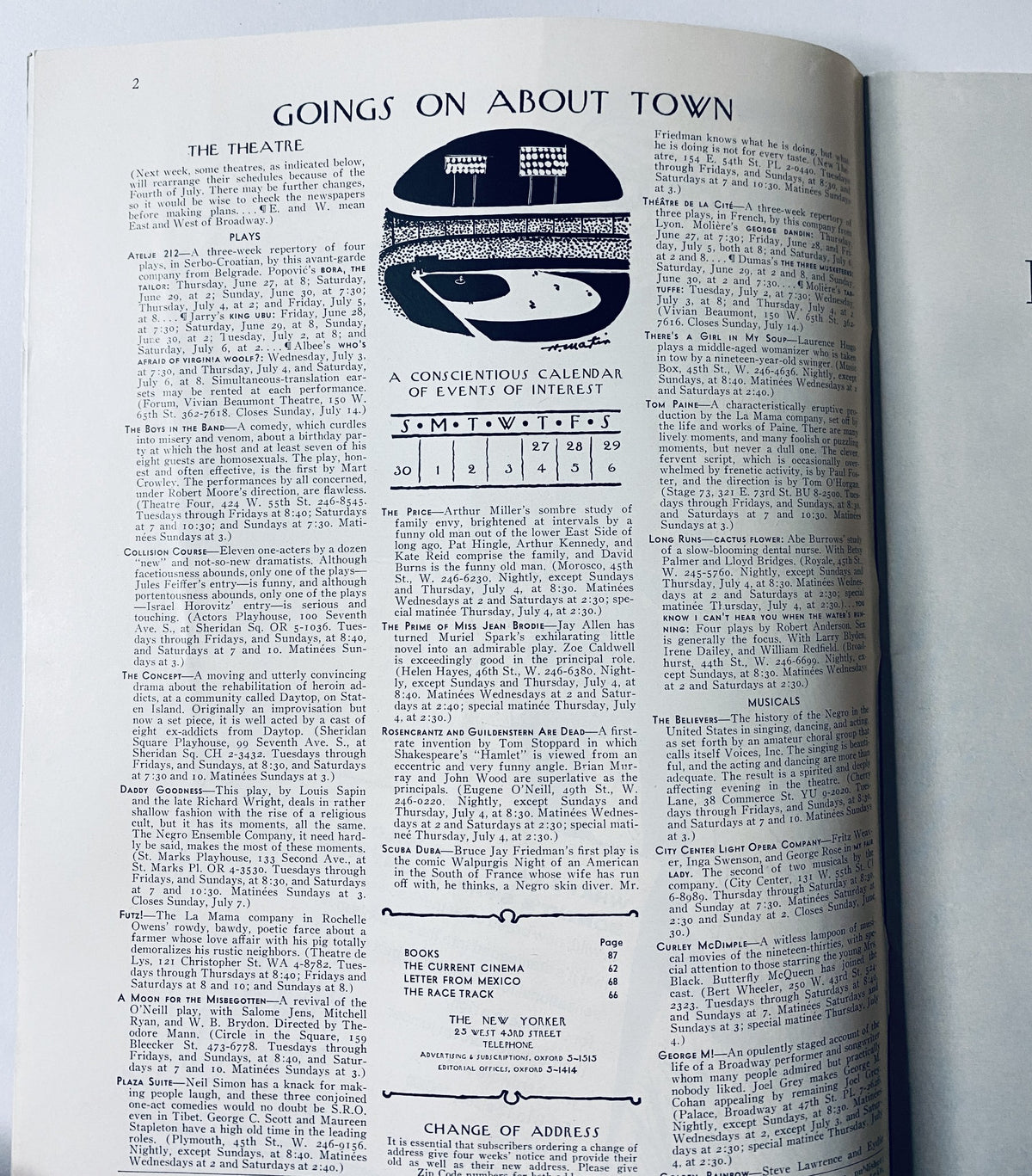
Arthur Getz was one of the New Yorker's most accomplished and most characteristically seasonal cover artists, his library and reading-room covers among the most specifically distinctive expressions of his visual intelligence. A Getz library cover from June 29, 1968 — the intimate world of books as a visual refuge placed specifically in the week after Bobby Kennedy's assassination — carries a documentary charge that transcends its apparent simplicity. The "Letter from Mexico" documented on page 68 is a historically interesting secondary editorial entry: June 1968 in Mexico was itself a moment of significant political tension, with the student movement that would eventually produce the October 2 Tlatelolco massacre building toward its most active phase, and a New Yorker Mexico letter from late June 1968 is a contemporaneous primary document of that gathering crisis in the weeks before it reached its violent conclusion. The Current Cinema on page 62 would have engaged the specific film landscape of late June 1968 — one of the most creatively significant periods in American and international cinema — and the Books department on page 87 documents the literary critical engagement of a publication processing the summer of 1968's specific cultural and political devastation through the lens of its most considered critical tradition. Collectors researching New Yorker issues from 1968 will find this June 29 edition a primary document of the Shawn-era publication at its most historically concentrated and most emotionally consequential moment of the year.
The Race Track department on page 66 adds the specifically characteristic New Yorker editorial quality that gave each Shawn-era issue its particular texture: the persistence of the full breadth of New York life — including the pleasures of summer racing — alongside the most serious engagement with the political and moral crises of the moment. The Getz library cover is itself the fullest expression of that quality: the magazine's insistence on the value of the interior life, the life of reading and reflection, as a necessary counterpoint to the tumult of public events. A cover featuring a library — books, quietness, the accumulated wisdom of human experience — published in the specific week when the nation was absorbing the second assassination of a major political leader in sixty days is not escapism but its opposite: an argument for the sustaining value of the literary and intellectual tradition that the New Yorker had always represented and that its readership had always depended on to make sense of a world that kept generating experiences that exceeded easy comprehension.
About the Publication
The New Yorker was founded in 1925 by Harold Ross and by June 1968 had been publishing for forty-three years under the editorships of Ross and William Shawn, who had led the magazine since 1952 and whose tenure had deepened its commitment to long-form journalism, literary fiction, poetry, and cultural criticism while maintaining the visual humor and illustration tradition that had defined it from the beginning. The June 29, 1968 issue represents the Shawn-era publication at its most historically tested — the specific demands that 1968 placed on any editorial intelligence serious about engaging American public life with honesty and depth were among the most severe in the history of American journalism, and the issue's combination of the Getz library cover, the Mexico letter, and the cinema and books critical departments reflects the publication's characteristic response: the full breadth of intellectual and cultural engagement maintained even in the most devastating historical weeks.
Key Highlights Inside
- Arthur Getz library cover — a primary visual document of one of the New Yorker's most accomplished mid-century cover artists producing his characteristic interior reading-room subject in the specific week following Robert F. Kennedy's assassination, the intimate world of books placed in direct proximity to the most emotionally devastating historical moment of 1968 and representing the publication's editorial argument for the sustaining value of the intellectual and literary tradition.
- "Letter from Mexico" on page 68 — a documented New Yorker correspondent dispatch from Mexico in late June 1968, produced as the student movement that would culminate in the October 2 Tlatelolco massacre was building toward its most active phase, constituting a contemporaneous primary document of Mexican political tension in the weeks before it reached its violent conclusion.
- The Current Cinema on page 62 — a documented New Yorker film criticism entry from late June 1968, one of the most creatively significant and historically turbulent periods in the history of American and international cinema, produced in the specific atmosphere of the post-RFK assassination weeks when the relationship between American film and American political reality was under its most acute examination.
- Books on page 87 — a documented New Yorker literary criticism entry from the summer of 1968, the publication's most considered critical tradition engaging the fall publishing season's opening releases in the specific historical atmosphere of the most devastating weeks of the most turbulent year of the decade.
- Note: Specific article titles within the departments, individual bylines, and confirmed secondary content details have not been individually verified for this issue beyond the documented table of contents entries. The highlights above reflect the New Yorker's well-established editorial format, the verified cover artist and publication date, and the historical context of June 29, 1968.
Condition & Rarity
New Yorker issues from June 1968 are approaching their fifty-eighth year of existence, and the condition landscape for surviving copies from this specific historically concentrated week reflects both the general attrition of that age and the specific collector significance of an Arthur Getz library cover from the publication's most historically charged single year. Very Good condition with only light edge wear is an honest and strong grade for a fifty-seven-year-old weekly literary magazine, indicating a copy that retains full structural integrity, displays cleanly, and shows no significant cover damage or interior page loss beyond the minimal evidence of its age. The Getz library cover image — the primary visual and documentary asset for display-focused collectors — is preserved in this grade with the full visual integrity that conveys both the subject matter and the specific quality of Getz's illustrative intelligence. The plastic protective sleeve provides ongoing archival protection for a publication whose staple-bound format benefits from protection against cover separation and page stress over long-term storage. Collectors evaluating surviving examples of this issue should prioritize the Getz cover image integrity, the completeness of the Mexico letter and cultural criticism departments, and overall structural soundness as primary condition criteria.
Looking for More Issues Like This?
A Very Good copy of The New Yorker from June 29, 1968 with the Arthur Getz library cover — published twenty-four days after Robert F. Kennedy's assassination, with a Mexico letter from the gathering student movement crisis and the full cultural criticism of the Shawn era's most historically tested week — is a specifically dated mid-1968 literary magazine find whose historical context gives it a primary source weight that extends well beyond the standard New Yorker back-catalog entry. If this issue is no longer available, the full New Yorker collection at OriginalMagazines.com is the most comprehensive place to browse surviving issues from across the publication's history and locate other Getz covers, 1968 political crisis issues, or significant dates from the Shawn era's most consequential year. The 1968 magazine collection brings together surviving issues from across that year's major publications for collectors working to document the full breadth of American print culture during the most turbulent year of the decade.