

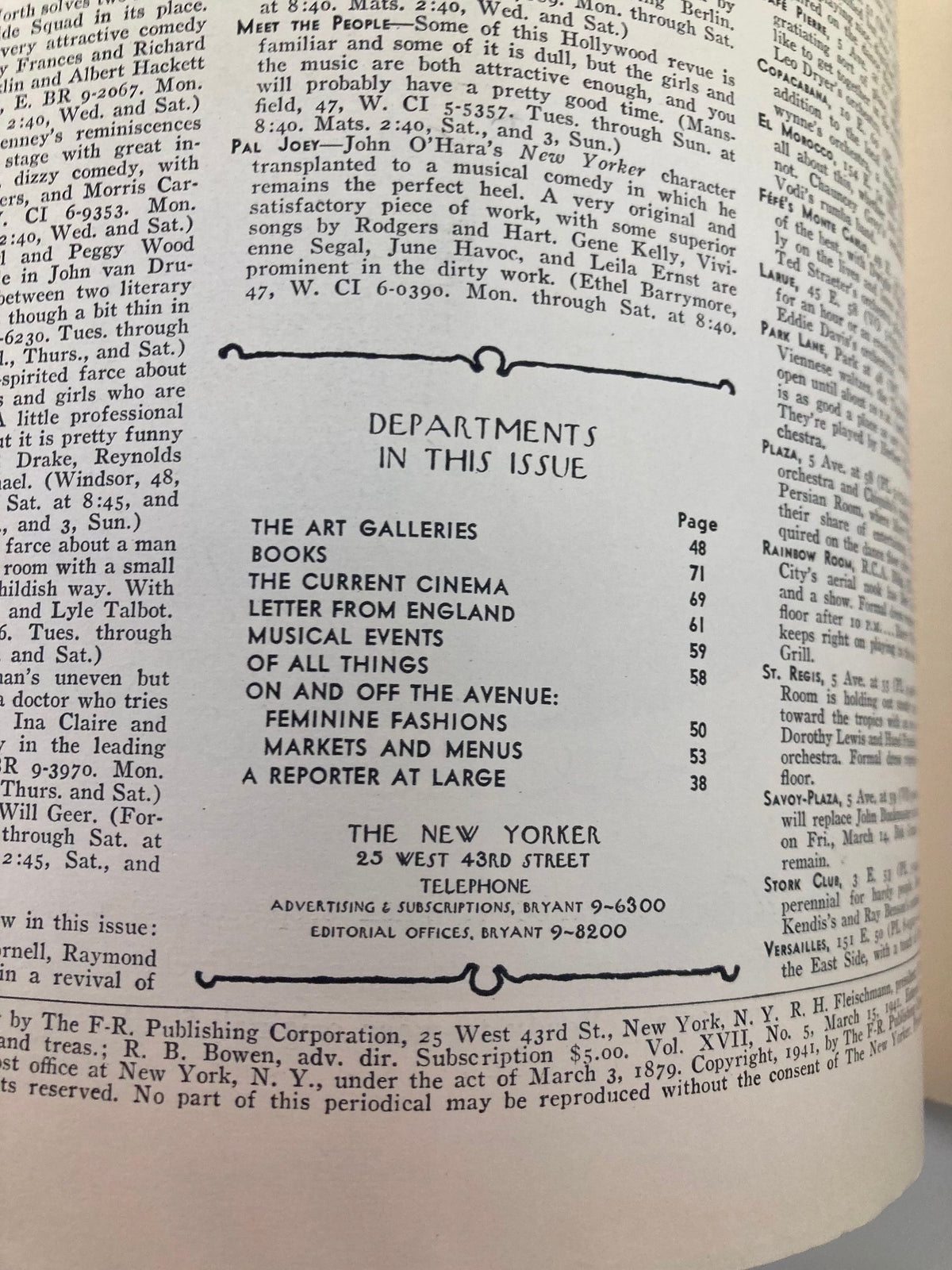


Description
Collector's Note – Why This Issue Matters
This March 15, 1941 issue of The New Yorker features a cover by Constantin Alajalov titled "Income Tax Hands," timed precisely to coincide with the federal income tax filing deadline of the era, which fell in mid-March rather than the April deadline familiar to modern American taxpayers. Alajalov, one of the magazine's most prolific and recognizable cover artists throughout the 1930s and into the following decade, brought his characteristic blend of sharp social observation and visual wit to this seasonally specific subject, reflecting The New Yorker's longstanding tradition of using cover art to comment gently on the recurring rhythms and minor anxieties of contemporary American life. A cover built around the annual ritual of tax filing offers a particularly relatable and universally recognized subject, situating this issue within a long tradition of New Yorker covers finding humor in the shared, mundane experiences of its urban readership.
This issue's publication date carries genuine historical significance beyond its tax-season timing, arriving just days after President Franklin D. Roosevelt signed the Lend-Lease Act into law on March 11, 1941, a pivotal piece of legislation that authorized the United States to supply war materials to Britain and other Allied nations while the country itself remained officially neutral in the conflict already raging across Europe. This period represented a genuinely complex moment in American foreign policy, as the nation edged closer to active involvement in the Second World War through measures like Lend-Lease, even while domestic life continued along its established rhythms, including the entirely unrelated annual obligation of income tax filing reflected in this issue's cover theme. The New Yorker's continued focus on lighter, observational humor during this period offers a notable point of contrast with the increasingly serious international developments unfolding simultaneously.
By March 1941, The New Yorker had been in continuous weekly publication for roughly sixteen years, having long since established the editorial voice and visual identity set in motion at the magazine's 1925 founding. Alajalov's continued contribution to the magazine's covers during this period reflects the kind of editorial and artistic continuity The New Yorker maintained even as the broader international situation grew increasingly consequential, offering readers a familiar and reassuring visual identity during a period of mounting national uncertainty about America's eventual role in the unfolding global conflict.
For collectors of early-1940s American magazine history, this issue offers a meaningful artifact connecting Alajalov's distinctive seasonal cover work to a precisely dated moment shortly after a genuinely significant turning point in American foreign policy. It sits within the context of 1941 magazines and the long editorial run of The New Yorker itself, situating this issue within both a precise calendar moment and the increasingly consequential months leading up to America's full entry into the Second World War later that same year.
About the Publication
The New Yorker was founded in 1925 by Harold Ross and Jane Grant, conceived from the outset as a sophisticated weekly aimed at an urbane, literate readership rather than a mass-market audience. Its editorial format combined long-form journalism, fiction, poetry, and criticism with a distinctive visual identity built around original cover illustration and single-panel cartoons, a structure firmly established by the time of this March 1941 issue, roughly sixteen years into the magazine's publishing history. Unlike most general-interest magazines of its era, The New Yorker rarely used cover photography or cover text, relying instead on commissioned artwork from a roster of distinctive illustrators, with Constantin Alajalov standing among the most prolific contributors to the magazine's cover art throughout this period. By 1941, the magazine had built a well-established reputation for finding wit and observational humor in the recurring rhythms of contemporary American life, a tradition reflected directly in this issue's seasonally timed tax-themed cover. Editorially, each issue followed a consistent rhythm of opening "Talk of the Town" pieces, feature journalism or fiction, criticism, and cartoons interspersed throughout, a structure that had become firmly established by this point in the magazine's history. This March 15, 1941 issue would have followed that same established format, combining Alajalov's cover illustration with the magazine's characteristic blend of urbane commentary and serious literary content during an increasingly consequential period of American foreign policy.
Key Highlights Inside
- A cover illustration titled "Income Tax Hands," credited to Constantin Alajalov and timed to coincide with the federal income tax filing deadline of the era, which fell in mid-March rather than April during this period. This cover reflects The New Yorker's tradition of finding gentle humor in shared, mundane American experiences. It represents a notably specific and seasonally relevant example within Alajalov's broader body of cover work for the magazine.
- Publication just days after President Roosevelt signed the Lend-Lease Act into law on March 11, 1941, situating this issue within a genuinely pivotal moment in American foreign policy preceding the country's full entry into the Second World War. This timing offers a notable point of contrast between the magazine's lighthearted seasonal cover content and increasingly serious international developments. The issue's specific interior engagement, if any, with these unfolding policy developments is not detailed in available listing information.
- Placement roughly sixteen years into The New Yorker's continuous weekly run, reflecting the magazine's well-established editorial voice and visual identity by this point in its history. This issue captures the publication maintaining its characteristic sophistication during a period of mounting national uncertainty about America's eventual wartime role. Its dating offers collectors a precise chronological reference point within the magazine's broader early-1940s publishing history.
- Connection to Constantin Alajalov's broader, prolific body of cover work for The New Yorker throughout the 1930s and into the 1940s. His recognizable style consistently blended sharp social observation with playful visual wit across numerous covers during this period. This issue offers collectors a documented point of reference within that extensive body of work, focused on a particularly relatable seasonal theme.
Condition & Rarity
Condition for a magazine of this age, now approaching nine decades old, is generally assessed through binding integrity, page completeness, cover and interior paper condition, and the overall legibility of printed text and illustration. A copy described as good condition with minor wear throughout reflects wear that is genuinely typical for periodicals surviving from the early 1940s, given that paper stock from this period was not designed for long-term archival stability. The absence of a label is generally viewed favorably among collectors, since unlabeled copies tend to present a cleaner, unobstructed cover image without sticker residue or removal marks, which matters significantly for an issue valued in part for its distinctive Alajalov cover illustration. A protective plastic covering plays a meaningful role in halting further deterioration, guarding against additional humidity exposure and handling wear going forward. Given the magazine's age, surviving examples in generally sound condition represent a solid outcome for a periodical approaching its ninth decade. Collectors evaluating any surviving copy of this issue should weigh overall structural completeness, binding security, and cover clarity as the primary indicators of long-term collectible and reference value, referring closely to available photographs for a precise assessment of the specific item's condition.
Looking for More Issues Like This?
A New Yorker issue from March 1941, featuring a seasonally distinctive cover by Constantin Alajalov and dated to a genuinely pivotal moment in pre-war American foreign policy, represents a notable category of early-1940s magazine collecting. If this exact issue isn't what you're looking for, the broader New Yorker collection spans material from across the magazine's long publishing history, offering a wider range of issues, cover artists, and editorial eras for collectors interested in the title's overall legacy. For those more focused on this specific year, the full range of 1941 magazines brings together material from across that year, spanning multiple publications beyond The New Yorker alone, including other periodicals documenting this critical pre-war period. Browsing the New Yorker collection can be especially useful for collectors building a set around specific cover artists like Alajalov or specific decades of the magazine's editorial history. Browsing by year, on the other hand, suits collectors more interested in capturing a broader cultural and historical snapshot of 1941 across different types of periodicals. Either approach offers a practical way to continue exploring material connected to this issue's particular combination of era and editorial identity. Both collections represent solid starting points for finding comparable issues from this period in The New Yorker's publishing history.