



Description
Collector's Note – Why This Issue Matters
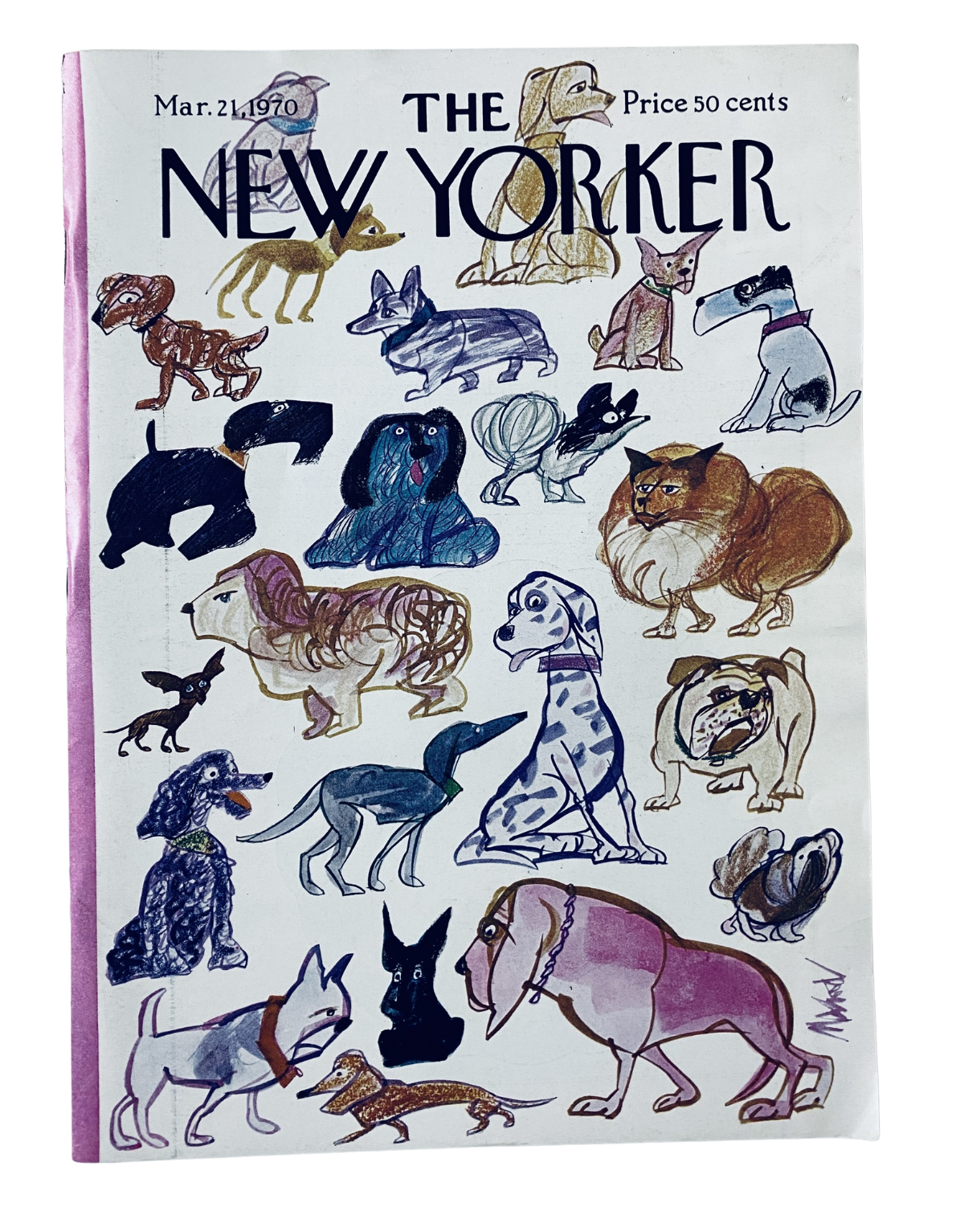
March 21, 1970 is a publication date of specific historical significance, and this New Yorker issue — with a Kenneth Mahood dog sketch cover and a table of contents of exceptional journalistic and literary quality — documents the magazine at a historically charged early-seventies moment. The Isaac Bashevis Singer story "The Mentor" on page 40 is a primary bibliographic document of the future Nobel laureate's New Yorker fiction in its original publication context — Singer would receive the Nobel Prize in Literature in 1978, and his sustained presence in the New Yorker through the late sixties and early seventies is one of the most significant bodies of fiction primary source material in the publication's history. The Ved Mehta "Profiles (Calcutta)" on page 47 is a primary document of one of the New Yorker's most accomplished long-form journalists — Mehta's Profiles series for the publication, sustained across decades, is among the most significant bodies of nonfiction in American literary journalism, and a March 1970 Calcutta profile carries the specific historical weight of Indian urban poverty and postcolonial crisis at a moment when Calcutta's specific circumstances were generating international attention that would culminate in the 1971 Bangladesh crisis and refugee emergency. For collectors building an archive of New Yorker issues from the early-seventies period, this March 21, 1970 edition is a specifically literary and journalistically significant entry in the publication's transition-decade catalog.
John McPhee's "The Sporting Scene (Canoeing)" on page 126 is a primary bibliographic document of McPhee at a specific moment of his long-form journalism career — canoeing was one of the outdoor subjects that McPhee would develop across multiple New Yorker pieces and books, and a March 1970 canoeing sporting scene constitutes a precisely dated entry in the body of work that would eventually produce The Survival of the Bark Canoe (1975) and the broader outdoor environmental journalism tradition that made him one of the most significant American nonfiction writers of the century. Richard H. Rovere's "Letter from Washington" on page 148 is a primary document of the New Yorker's most trusted Washington political correspondent engaging the Nixon administration in March 1970 — the specific political atmosphere of early 1970, with the Vietnam War's continuation generating the anti-war activism that would culminate in the Kent State shootings just six weeks later in May 1970, gives a Rovere Washington letter from this date a specific and historically concentrated political primary source value. Pauline Kael's cinema column on page 161 adds a primary document of her most productive New Yorker film criticism period, and Genêt's Letter from Paris on page 141 engages the specific French political and cultural landscape of early 1970 from the most authoritative American journalistic voice on French affairs. Collectors researching New Yorker issues from 1970 will find this March 21 edition a primary source document of unusual breadth across fiction, long-form journalism, political correspondence, and cultural criticism.
Calvin Trillin's "U.S. Journal: Provo, Utah" on page 120 adds a primary document of his signature American community journalism series — Provo in March 1970 was in the specific early phase of its identity as a Mormon university city navigating the cultural upheavals of the late sixties, and Trillin's specific engagement with its community life constitutes a primary record of the kind of American domestic social observation that gave his U.S. Journal series its lasting value. The Kenneth Mahood dog sketch cover is a primary visual document of a New Yorker cover artist whose work contributed to the publication's visual tradition in the early seventies, and the drawing roster — including William Steig, Edward Koren, Charles Saxon, Lee Lorenz, and eleven additional artists — constitutes one of the more accomplished single-issue cartoon lineups in the New Yorker's early-seventies archive. Kennedy Fraser's "On and Off the Avenue: Feminine Fashions" on page 134 adds a primary document of one of the New Yorker's most accomplished fashion critics, whose work in this period was developing the analytical intelligence that would eventually establish her as one of the most significant voices in American fashion journalism.
About the Publication
The New Yorker was founded in 1925 by Harold Ross and by March 1970 had been publishing for forty-five years under the editorships of Ross and William Shawn, whose tenure had deepened the magazine's commitment to long-form journalism, literary fiction, poetry, and cultural criticism while maintaining the visual humor and illustration tradition that had defined it from the beginning. The March 21, 1970 issue represents the Shawn-era publication at a specific transitional moment — the late-sixties decade's political and cultural upheavals were actively reshaping the landscape within which the magazine's editorial identity operated, and the combination of Singer fiction, Mehta India journalism, McPhee outdoor reporting, Rovere Washington correspondence, and Kael film criticism in a single March 1970 issue reflects the extraordinary depth of talent and editorial judgment that the publication commanded in this specific transition period between the sixties and the decade to come.
Key Highlights Inside
- Isaac Bashevis Singer "The Mentor" on page 40 — a primary bibliographic document of the future Nobel laureate's New Yorker fiction in its original publication context, constituting a precisely dated entry in one of the most significant bodies of short fiction primary source material in the publication's history and a primary record of Singer's sustained creative presence in the New Yorker through the period leading to his 1978 Nobel Prize recognition.
- Ved Mehta "Profiles (Calcutta)" on page 47 — a primary document of one of the New Yorker's most accomplished long-form journalists engaging Indian urban poverty and postcolonial crisis in March 1970, published at a historically charged moment just over a year before the Bangladesh crisis and refugee emergency that would bring Calcutta's specific circumstances to international attention with maximum urgency.
- John McPhee "The Sporting Scene (Canoeing)" on page 126 — a primary bibliographic record of McPhee's developing long-form outdoor journalism in March 1970, constituting a precisely dated entry in the body of canoeing and environmental writing that would eventually produce The Survival of the Bark Canoe and establish his specific nonfiction tradition.
- Richard H. Rovere "Letter from Washington" on page 148 — a primary document of the New Yorker's most trusted Washington correspondent engaging the Nixon administration in March 1970, just six weeks before the Kent State shootings that would mark the most acute moment of the anti-Vietnam War domestic crisis, constituting a primary record of the pre-Kent State political atmosphere from the most authoritative American journalistic voice on Washington affairs.
- Pauline Kael "The Current Cinema" on page 161, Genêt "Letter from Paris" on page 141, and Calvin Trillin "U.S. Journal: Provo, Utah" on page 120 — three of the New Yorker's most distinguished contributors simultaneously documented in a single March 1970 issue, Kael at her film criticism peak, Genêt engaging early-seventies Paris, and Trillin applying his American community reporting intelligence to a specific Utah city.
- Kenneth Mahood dog sketch cover, Kennedy Fraser feminine fashions on page 134, Brendan Gill and Edith Oliver theatre criticism on pages 115-116, and drawing contributors including William Steig, Edward Koren, Charles Saxon, Lee Lorenz, and eleven additional artists — the full visual, fashion critical, theatrical, and cartoon range of a March 21, 1970 New Yorker documented with the attribution specificity that makes this table of contents one of the more completely catalogued primary sources in the early-seventies Shawn-era archive.
Condition & Rarity
New Yorker issues from March 1970 are approaching their fifty-sixth year of existence, and the condition landscape for surviving copies from this early-Shawn-era-transition period reflects both the general attrition of that age and the specific collector significance of an issue combining Singer fiction, Mehta India journalism, McPhee canoeing, Rovere Washington correspondence, Kael cinema, and Genêt Paris in a single weekly. Very Good condition with only light edge wear is an honest and strong grade for a fifty-five-year-old weekly literary magazine, indicating a copy that retains full structural integrity, displays cleanly, and shows no significant cover damage or interior page loss beyond the minimal evidence of its age. The Kenneth Mahood dog cover is preserved in this grade with full visual integrity. The plastic protective sleeve provides ongoing archival protection for a publication of this age and paper chemistry. Collectors evaluating surviving examples of this issue should prioritize the completeness of the Singer fiction, Mehta Calcutta profile, and Rovere Washington letter alongside the Kael and McPhee entries as primary condition criteria for a March 1970 New Yorker of this exceptional journalistic and literary density.
Looking for More Issues Like This?
A Very Good copy of The New Yorker from March 21, 1970 with Isaac Bashevis Singer fiction, a Ved Mehta Calcutta profile, John McPhee's canoeing sporting scene, Richard Rovere's pre-Kent State Washington letter, and simultaneous Kael cinema and Genêt Paris coverage is among the most specifically literary and journalistically significant single issues in the publication's early-seventies archive — the convergence of these specific contributors in a single March 1970 weekly gives this issue a primary source profile extending across Nobel laureate fiction, South Asian journalism, outdoor environmental writing, Washington political correspondence, and film criticism simultaneously. If this issue is no longer available, the full New Yorker collection at OriginalMagazines.com is the most comprehensive place to browse surviving issues from across the publication's history and locate other Singer or McPhee issues, Rovere Washington letters, Kael cinema entries, or significant dates from the Shawn era's early-seventies transition. The 1970 magazine collection brings together surviving issues from across that year's major publications for collectors working to document the full breadth of American print culture during the opening year of the decade that would most completely transform both American politics and American literary journalism.