

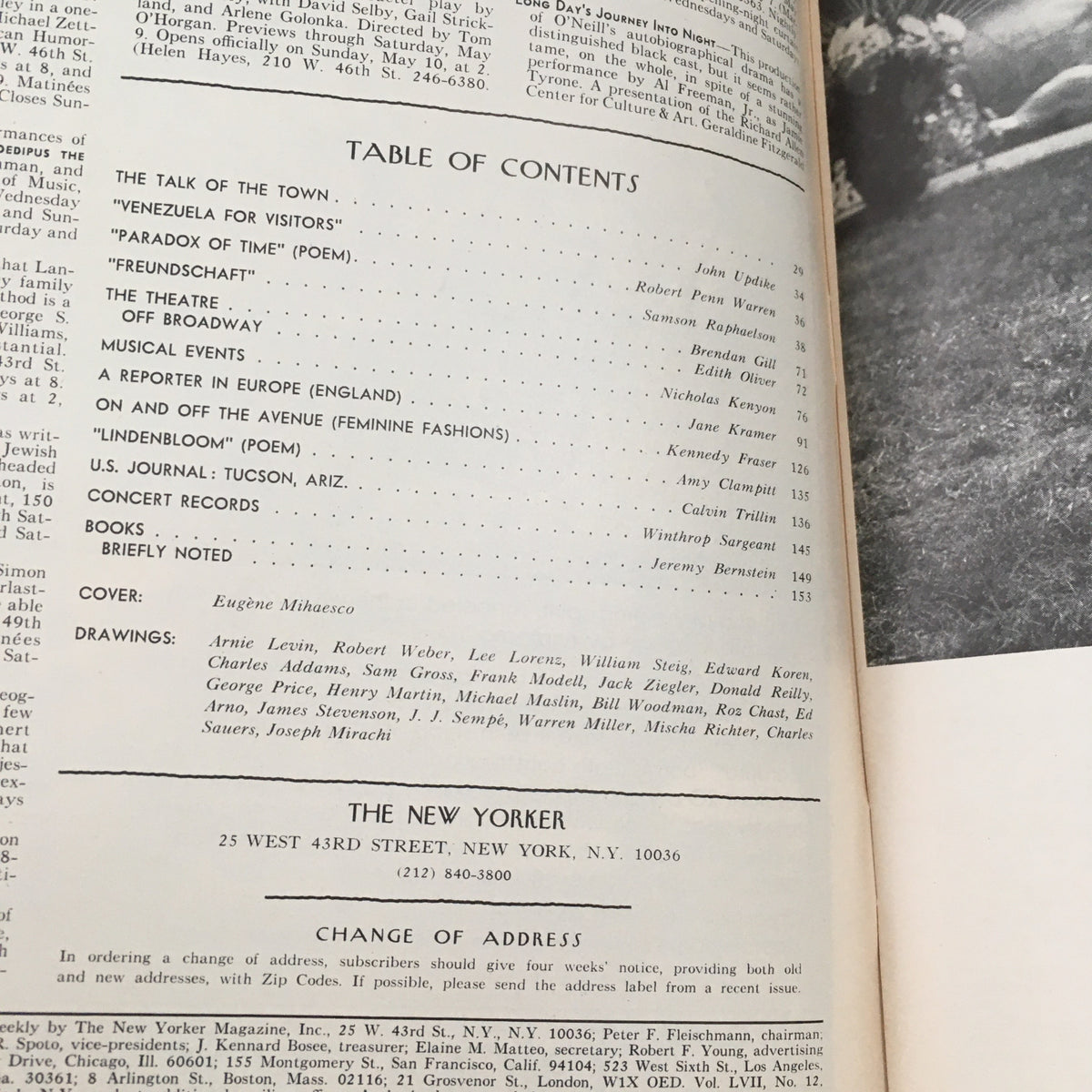


Description
Collector's Note – Why This Issue Matters
The May 11, 1981 issue of The New Yorker is anchored by a theme art cover credited in the listing to Eugene Mihaesco. For collectors of illustrated periodicals, that cover attribution is a key reference point because The New Yorker has long been valued for the way its covers combine visual style, cultural observation, humor, and editorial restraint. A dated issue with a credited cover artist allows collectors to place the magazine within the larger sequence of The New Yorker cover art, where individual artists often become part of the publication’s historical identity. Mihaesco’s credited presence gives this issue a clear cataloging point for collectors who track the magazine by artist, date, and visual theme.
This issue appeared in the early 1980s, a period when weekly print magazines still played a major role in shaping literary, artistic, and cultural conversation. The listing describes the issue as reflecting the vibrant cultural landscape of the era, with engrossing stories and themes connected to the spirit of the time. For readers researching vintage issues of The New Yorker, the May 11, 1981 date places the magazine within a mature phase of the publication’s weekly rhythm, when cover art, cartoons, essays, fiction, criticism, and commentary worked together as a complete editorial package. It also reflects the pre-digital nature of magazine culture, when a weekly issue preserved writing, illustration, advertising, and design in a single physical object.
Within the broader context of 1981 magazines documenting art, literature, and American culture, this issue is best understood through its confirmed details: the publication title, the date, the Eugene Mihaesco cover credit, the no-label newsstand presentation, the Good condition grade, and the noted protective plastic covering. The listing does not provide specific article titles, contributors, cartoons, fiction pieces, or reviews, so the interior contents should be described only in general terms. That distinction keeps the reference entry grounded in documented facts rather than assumptions about unverified contents. For serious collectors, this kind of restraint is essential because it preserves the difference between confirmed issue data and broader historical context.
About the Publication
The New Yorker is a long-running American magazine known for literary journalism, essays, criticism, fiction, poetry, humor, cartoons, cultural commentary, and distinctive illustrated covers. Its readership has traditionally included people interested in literature, politics, the arts, urban life, satire, and serious magazine writing. By 1981, the magazine had already established one of the most recognizable editorial formats in American publishing, combining long-form prose with cartoons, reviews, fiction, and cover illustration into a cohesive weekly publication. For collectors, individual issues are often cataloged by date, cover artist, visual theme, condition, year, and publication context. A complete issue from this period also preserves the physical character of pre-digital magazine culture, including its cover design, page layout, advertising, editorial pacing, and printed presentation. That makes an issue like this useful not only as a reading copy, but also as a reference object for studying how a major American weekly packaged culture in the early 1980s.
Key Highlights Inside
- May 11, 1981 issue of The New Yorker, a major American magazine known for literature, criticism, commentary, cartoons, and illustrated covers.
- Features a theme art cover credited in the listing to Eugene Mihaesco, making the issue relevant to collectors who track The New Yorker cover artists.
- Represents early-1980s The New Yorker publishing, when the magazine continued to pair literary culture with distinctive visual presentation.
- Noted as a newsstand/no-label issue, an important presentation detail for collectors who prefer unobstructed cover art.
- The listing describes engrossing stories and themes connected to the spirit of the time, though specific article titles and contributors are not confirmed.
- Relevant to collectors who organize The New Yorker issues by cover artist, publication date, visual theme, condition grade, or year.
- Condition notes include Good condition, minor wear throughout the magazine, and a plastic protective covering for preservation.
- Useful as a period artifact for studying how illustrated weekly magazines preserved cultural tone before online archives and digital publishing became dominant.
- Interior details beyond the general description in the listing are unconfirmed, so no specific essays, stories, cartoons, reviews, or features are assumed here.
Condition & Rarity
Collector evaluation for the May 11, 1981 issue should focus on cover presentation, page completeness, spine stability, corner wear, edge wear, surface marks, and the overall clarity of the Eugene Mihaesco cover art. The listing describes the magazine as being in Good condition, with minor wear throughout the magazine. It is also identified as a newsstand issue with no label, which is meaningful because subscription labels can interrupt the visual field of a The New Yorker cover, especially when the cover artist is a central collector interest. The protective plastic covering is relevant for preservation because it helps reduce further dust exposure, handling wear, and surface abrasion. For a cover-art-focused issue, an intact and unobstructed front cover carries strong reference value even when ordinary age-related wear is present. A complete, readable example remains useful as both a cultural artifact and a visual record of the magazine’s 1981 cover-art sequence. Minor wear is expected for a weekly magazine of this age, but missing pages, severe staining, detached covers, or heavy cover obstruction would have a stronger effect on its usefulness as a collector reference.
Looking for More Issues Like This?
This May 11, 1981 issue is a tough find for collectors who focus on dated The New Yorker issues, Eugene Mihaesco cover art, and early-1980s magazine illustration. Readers researching related examples may want to browse The New Yorker magazine collection for additional issues from the same publication. That collection is the most natural place to compare cover artists, issue dates, visual themes, and the magazine’s evolving design language across different years.
Collectors who want to place this issue within its broader publishing year may also find useful context in 1981 magazines. Comparing surrounding issues from the same year can help show how literature, commentary, illustration, cartoons, and American magazine design were preserved in print during the early 1980s. For reference-minded collectors, those surrounding issues can also help situate one Eugene Mihaesco-covered The New Yorker within the larger magazine culture of 1981.