
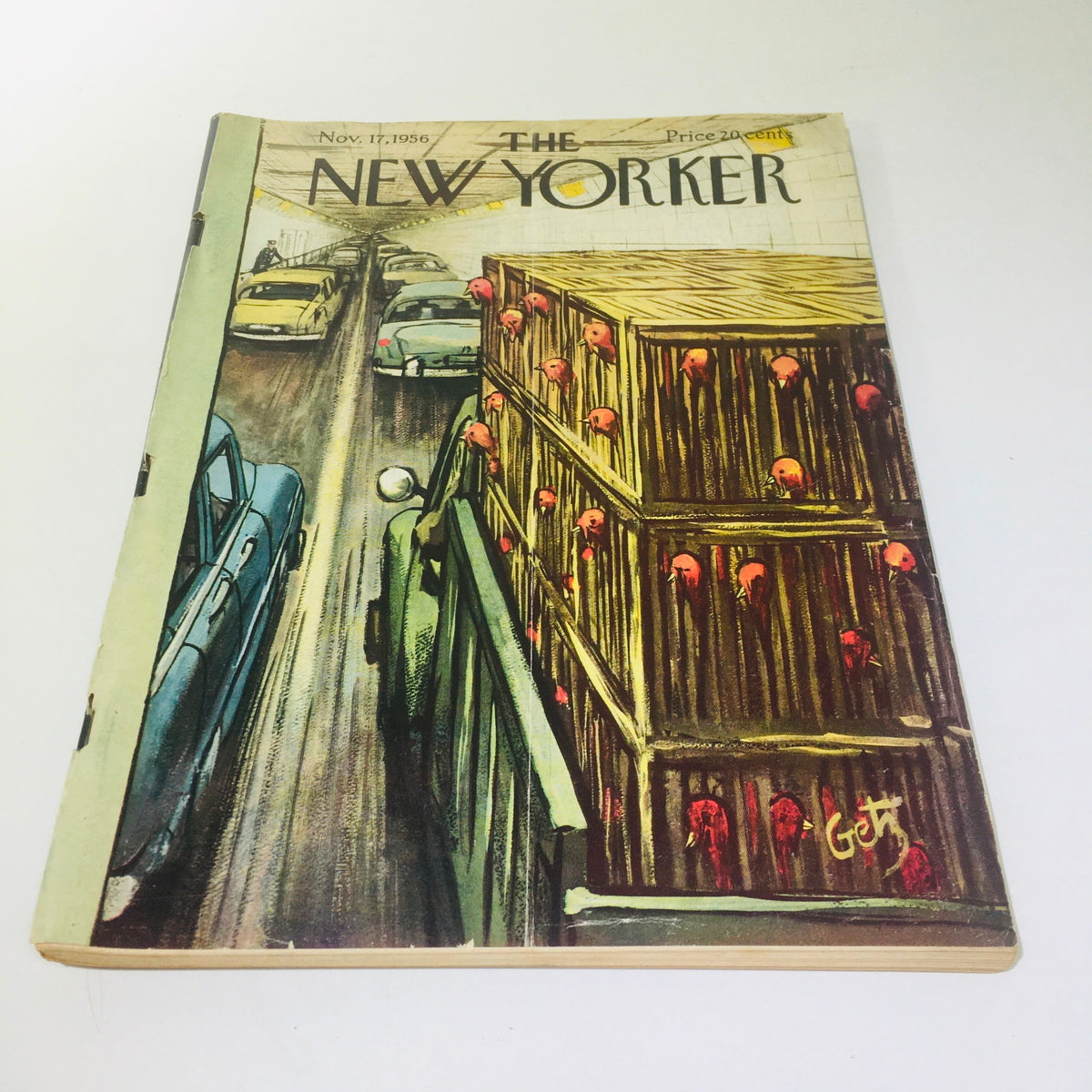

Description
Collector's Note – Why This Issue Matters
The November 17, 1956 issue of The New Yorker featuring a cover by Arthur Getz is a document of the publication at a historically charged and editorially significant moment — and a particularly meaningful one within the context of Getz's own long creative relationship with the magazine. By November 1956, Getz had been contributing covers to The New Yorker for sixteen years, and his autumn and early-winter covers had become among the most anticipated and most recognized in the magazine's annual visual cycle. His mid-November covers in particular engaged with the specific visual and emotional quality of the American urban autumn in its final phase — the transition from the color of October toward the colder, grayer, more interior quality of late November and the approach of winter — and he treated this seasonal moment with the precise observational intelligence and graphic warmth that had made his work one of the most beloved components of the publication's visual identity. For collectors who focus on vintage New Yorker issues featuring significant mid-century cover art, a November Getz cover from 1956 represents the artist working in his most characteristic seasonal register during a period of full professional maturity.
The November 17, 1956 date carries a specific historical weight that gives this issue a context beyond its seasonal occasion. The autumn of 1956 was one of the most geopolitically consequential of the entire Cold War decade — the Hungarian Revolution had erupted in late October and was being brutally suppressed by Soviet military forces even as this issue was reaching newsstands, and the Suez Crisis had produced a simultaneous confrontation between Britain, France, Israel, Egypt, and the United States that threatened to fracture the Western alliance at its most dangerous moment. The Eisenhower reelection — one of the most decisive presidential victories of the twentieth century — had occurred on November 6, just eleven days before this issue's cover date, providing a moment of domestic political resolution even as the international situation remained acutely unstable. The New Yorker under William Shawn was engaging with this world in its characteristic manner — with literary precision, cultural intelligence, and the particular combination of domestic warmth and geopolitical seriousness that defined the magazine's editorial identity in the Cold War years. A Getz autumn cover at this precise moment is a document of the publication's characteristic gift for holding the pleasures of the seasonal moment alongside the weight of the surrounding world. Collectors building archives around the magazines of 1956 will find this November issue a document of American cultural and editorial life at one of the Cold War decade's most dramatically charged and historically significant moments.
Arthur Getz's November covers from the mid-1950s represent some of his most accomplished and most collected seasonal work, and the November 17, 1956 issue is a prime example of that achievement. By this point in his career, Getz had developed an unmatched visual vocabulary for the specific emotional quality of the American urban late-autumn — the particular light, the particular social textures, the particular combination of anticipation and melancholy that characterizes the season's final weeks before the winter holidays impose their own distinct mood. His covers from this period bring to that subject a combination of technical precision and genuine feeling that distinguishes the best work of his middle career from both his earlier, more experimental pieces and his later, more broadly familiar productions. The November 17, 1956 issue captures him at a moment of assured and fully realized creative authority.
About the Publication
The New Yorker, founded by Harold Ross in 1925 and edited from 1952 by William Shawn, had by November 1956 accumulated thirty-one years of cultural authority as the most literarily ambitious and editorially distinctive general-interest magazine in the United States. Its cover art tradition, sustained by a rotating roster of accomplished artists of whom Getz was among the most beloved and most prolific, was understood as applied art of genuine significance — individual covers were treated as commissioned artworks, and the magazine's autumn issues in particular had developed into some of the most visually distinctive and most collected publications of the year. The magazine's readership was concentrated among the most educated and culturally engaged segment of the American public, and its mid-November issues — capturing the specific emotional and visual character of the season's final weeks — were among the most carefully anticipated of the annual cycle.
Key Highlights Inside
- A cover illustration by Arthur Getz — one of the most beloved and most consistently accomplished contributors to The New Yorker's visual tradition, working in the mid-November seasonal register that was among his most celebrated recurring subjects, produced during a period of full creative maturity sixteen years into his tenure at the publication and at one of the most historically charged moments of the Cold War decade.
- Fiction, criticism, poetry, and reported journalism consistent with The New Yorker's editorial standards under William Shawn — the November 17, 1956 issue would have contained the mixture of long-form content that defined the magazine's format, produced against the extraordinary backdrop of the Hungarian Revolution, the Suez Crisis, and the Eisenhower reelection that had all occurred in the preceding three weeks.
- Interior cartoons and spot illustrations from The New Yorker's mid-1950s visual roster — a period when the magazine's stable of cartoon contributors was producing work that combined the wit and social observation of the long American cartoon tradition with the specific preoccupations and anxieties of the Eisenhower era.
- Advertising content reflecting the consumer culture of mid-November 1956 — the advertisements targeting the magazine's affluent, educated readership at the approach of the holiday season constitute a significant secondary document of the era's commercial aesthetics and aspirational culture, produced during one of the most geopolitically turbulent autumns of the postwar decade.
Note: Specific article titles, fiction contributors, bylines, and additional interior details beyond the cover artist are unconfirmed for this issue from available sources. The highlights above reflect verifiable historical context drawn from the cover artist, publication date, and the well-documented editorial character of The New Yorker under William Shawn during this period.
Condition & Rarity
This copy is identified as a no-label newsstand edition in good condition with minor wear throughout — a meaningful provenance and condition profile for a magazine now approaching seventy years old. The no-label status preserves the Getz cover art without the subscription label adhesive damage or postal handling wear that characterizes the more commonly encountered subscription-processed copies of mid-1950s New Yorker issues — a substantive distinction for a cover whose visual quality is the primary collectible and display consideration. The minor wear throughout is consistent with a newsstand copy of this vintage that has been stored rather than actively handled, and falls within the expected range for good condition without compromising the essential integrity of the publication. The listing notes that this copy does not include a plastic protective sleeve, making immediate archival sleeving strongly advisable upon acquisition — paper stock of nearly seventy years of age is increasingly vulnerable to ongoing light exposure, humidity damage, and edge brittleness under unprotected storage conditions. For a November Arthur Getz cover from this historically charged autumn of 1956, a no-label newsstand copy in good condition with intact cover art and readable interior pages represents a well-preserved and purposeful acquisition for serious collectors of both the magazine's visual history and the Cold War era it documented.
Looking for More Issues Like This?
A no-label Arthur Getz November cover New Yorker from 1956 is a specific and historically resonant find for collectors who take the magazine's mid-century visual tradition seriously — Getz's autumn covers from the mid-1950s are among the most accomplished of his career and surface in clean no-label condition with less frequency than their importance warrants. If this November 17 issue has already found a home, the broader vintage New Yorker collection at OriginalMagazines.com is an excellent resource for other significant Getz covers and editorial landmarks from the magazine's remarkable Shawn-era publishing run. Collectors focused on the cultural, literary, and geopolitical atmosphere of 1956 — one of the most consequential and dramatically eventful years of the Cold War decade — will find it well worth exploring the full 1956 magazine archive, which brings together publications from a year whose combination of Suez, Hungary, and the Eisenhower reelection makes it one of the most historically significant and actively collected of the postwar era.