


Description
Collector's Note – Why This Issue Matters
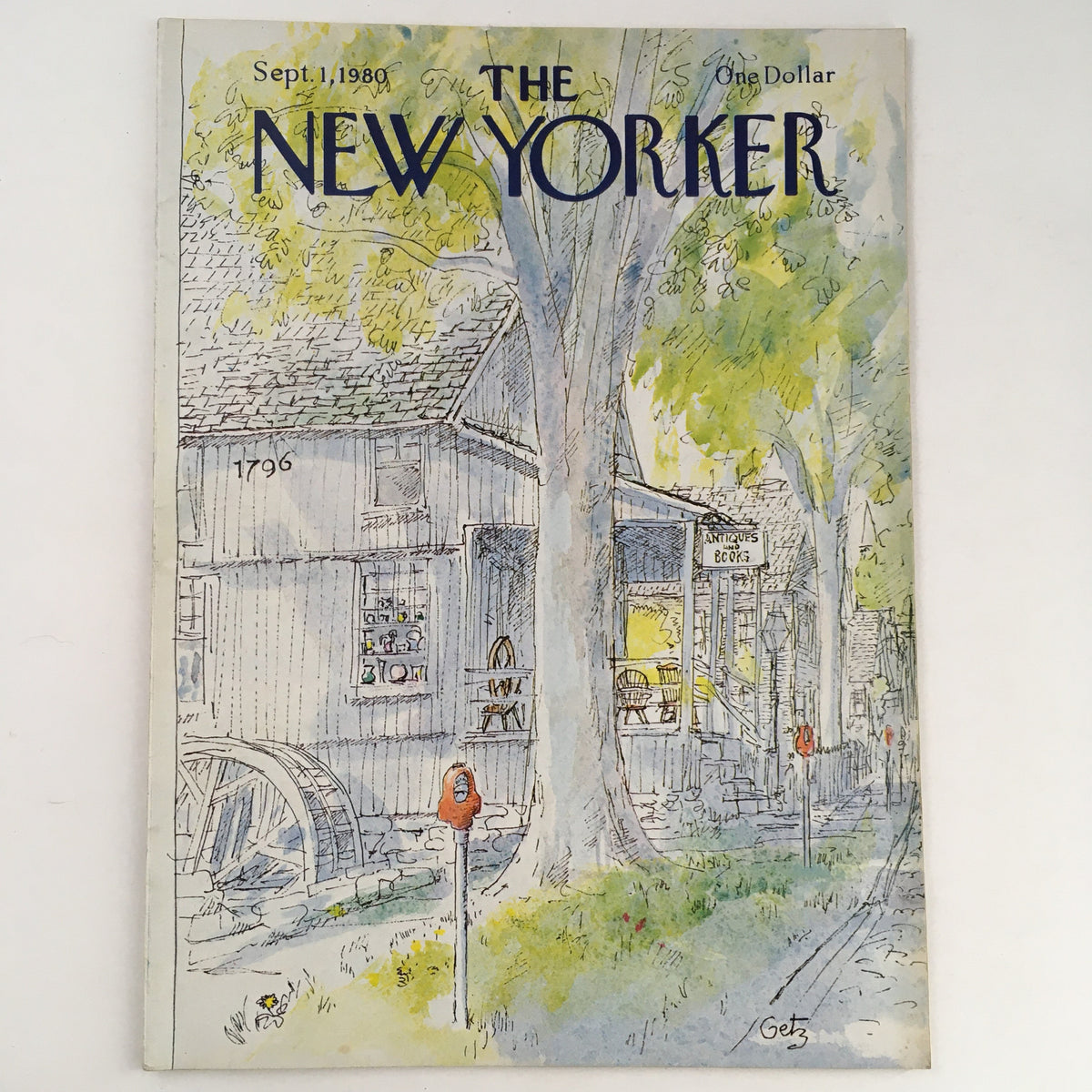
This September 1, 1980 issue of The New Yorker carries a cover by Arthur Getz, the single most prolific cover artist in the magazine's history, who contributed 213 covers to the publication across a fifty-year span from 1938 to 1988. By 1980, Getz had been a regular New Yorker contributor for over four decades, and his work had undergone a notable thematic shift roughly a decade earlier: after relocating from New York City to rural Sharon, Connecticut, in 1969, his covers moved away from the city-centered scenes that had defined his earlier career and toward depictions of the countryside, appealing to the growing population of commuters and weekenders who made up a meaningful share of the magazine's readership. A New Yorker cover from this exact period of Getz's career reflects that mature, rural-inflected phase of his work, distinct from the Manhattan-focused paintings that had earned him comparisons to Guardi's depictions of Venice earlier in his career.
This issue also falls within a particularly interesting institutional moment for the magazine itself. By 1980, longtime editor William Shawn had been at the helm for nearly three decades, having taken over from founder Harold Ross in 1952, and just two years earlier, in 1978, Shawn had announced an intention to retire that he would ultimately rescind, continuing in the role for several more years. The magazine's advertising base, which had peaked in the late 1960s, was already in the early stages of a gradual decline that would continue through the 1980s, even as The New Yorker's editorial identity, with its traditional mix of cartoons, fiction, and long-form journalism, remained largely unchanged from the formula Shawn had cultivated for decades. An issue from this exact year captures the magazine at a point of institutional stability shadowed by early signs of the commercial pressures that would eventually reshape it later in the decade.
For collectors of New Yorker cover art specifically, Getz's standing as the most prolific contributor in the magazine's history makes any issue bearing his work a meaningful entry point into that broader collecting category. A 1980 magazine with a Getz cover represents one data point within a remarkably large and well-documented body of work, one that art historians and collectors alike have studied for its evolution from urban subject matter to rural landscape over the course of Getz's five-decade tenure. That makes this issue a useful reference for anyone tracing the later, countryside-focused chapter of Getz's New Yorker output specifically, as distinct from the city scenes most closely associated with his earlier years at the magazine.
About the Publication
The New Yorker has been published continuously since 1925, and by 1980 it remained under the editorship of William Shawn, who had succeeded founder Harold Ross in 1952 and would continue leading the magazine until 1987. Throughout this era, the magazine maintained its traditional format of illustrated covers, cartoons, fiction, and increasingly substantive reporting, deliberately avoiding photographs and overt promotional material in favor of a consistent visual and editorial identity that had remained largely unchanged for decades. The magazine's cover artists during this period formed a notable and closely associated group, with figures like Arthur Getz, Charles Addams, and others contributing illustrated artwork that became as central to the publication's identity as its written content. Specific editorial details unique to this particular issue beyond its cover are not independently confirmed here, but the magazine's general format and editorial direction during this period are well documented.
Key Highlights Inside
- Theme art cover illustrated by Arthur Getz, the most prolific cover artist in The New Yorker's history, who contributed 213 covers to the magazine between 1938 and 1988. By 1980, Getz's work had shifted toward the rural, countryside-focused style he developed after relocating to Connecticut in 1969. This issue is a useful reference point for collectors specifically tracking the later, rural-influenced period of Getz's New Yorker output.
- Published in September 1980, a period when longtime editor William Shawn remained at the helm of the magazine, two years after a 1978 retirement announcement he would ultimately rescind. This places the issue within a well-documented stretch of institutional continuity at the magazine, prior to the larger ownership and editorial changes that would arrive later in the decade.
- Reflects a period when The New Yorker's advertising base, having peaked in the late 1960s, was in the early stages of a gradual decline that continued throughout the 1980s, even as the magazine's core editorial format remained largely consistent with earlier decades. This broader institutional context is a useful backdrop for understanding the publishing environment this issue emerged from.
- Beyond the cover itself, the specific theme, subject matter, and interior contents of this particular issue, including its articles, fiction, and cartoons, are not confirmed here. The New Yorker issues of this era typically combined multiple cartoons, fiction, and cultural commentary alongside their cover art. Collectors interested in the complete contents should plan to verify them directly against the physical issue.
Condition & Rarity
Issues of this type are generally evaluated by collectors against a few key benchmarks: whether the copy is a newsstand edition or a subscription copy, whether a mailing label is present on the cover, and the overall condition of the cover, spine, and interior pages. A newsstand edition without a label is typically considered more desirable than a labeled subscription copy, since the unmarked cover preserves the original illustrated artwork exactly as it appeared on the rack, an especially relevant factor for a magazine whose covers, particularly those by a noted artist like Arthur Getz, are valued as standalone pieces of illustration in their own right. A grade of "good" with minor, age-appropriate wear reflects a presentable copy that falls short of the crisp, archival-quality condition that the most dedicated collectors of New Yorker cover art tend to seek out, but remains entirely suitable for display and casual collecting purposes. Magazines from this era were produced on relatively standard newsstand paper stock, meaning condition factors like cover gloss retention, spine integrity, and any creasing or discoloration become more pronounced as a copy approaches its fifth decade. Protective plastic sleeving is a common and recommended storage method for vintage periodicals like this one, helping to guard against further handling wear without altering the item itself. Collectors evaluating any surviving copy of this issue should examine the sharpness and color retention of the Getz cover illustration closely, along with the overall structural integrity of the spine and pages, since these are the factors most likely to affect both display quality and long-term value.
Looking for More Issues Like This?
A New Yorker issue featuring a cover by Arthur Getz, the magazine's most prolific cover artist across its entire history, is a solid entry point for anyone building a collection focused on vintage New Yorker cover art specifically. If you're chasing more from this era of the magazine, our New Yorker collection is a great place to keep browsing, and our broader 1980 magazines collection offers a wider look at everything else that hit newsstands that year. Either is a strong starting point whether your focus is on Getz specifically, on classic New Yorker cover illustration more broadly, or simply on 1980 as a year in American magazine publishing.