


Description
Collector's Note – Why This Issue Matters
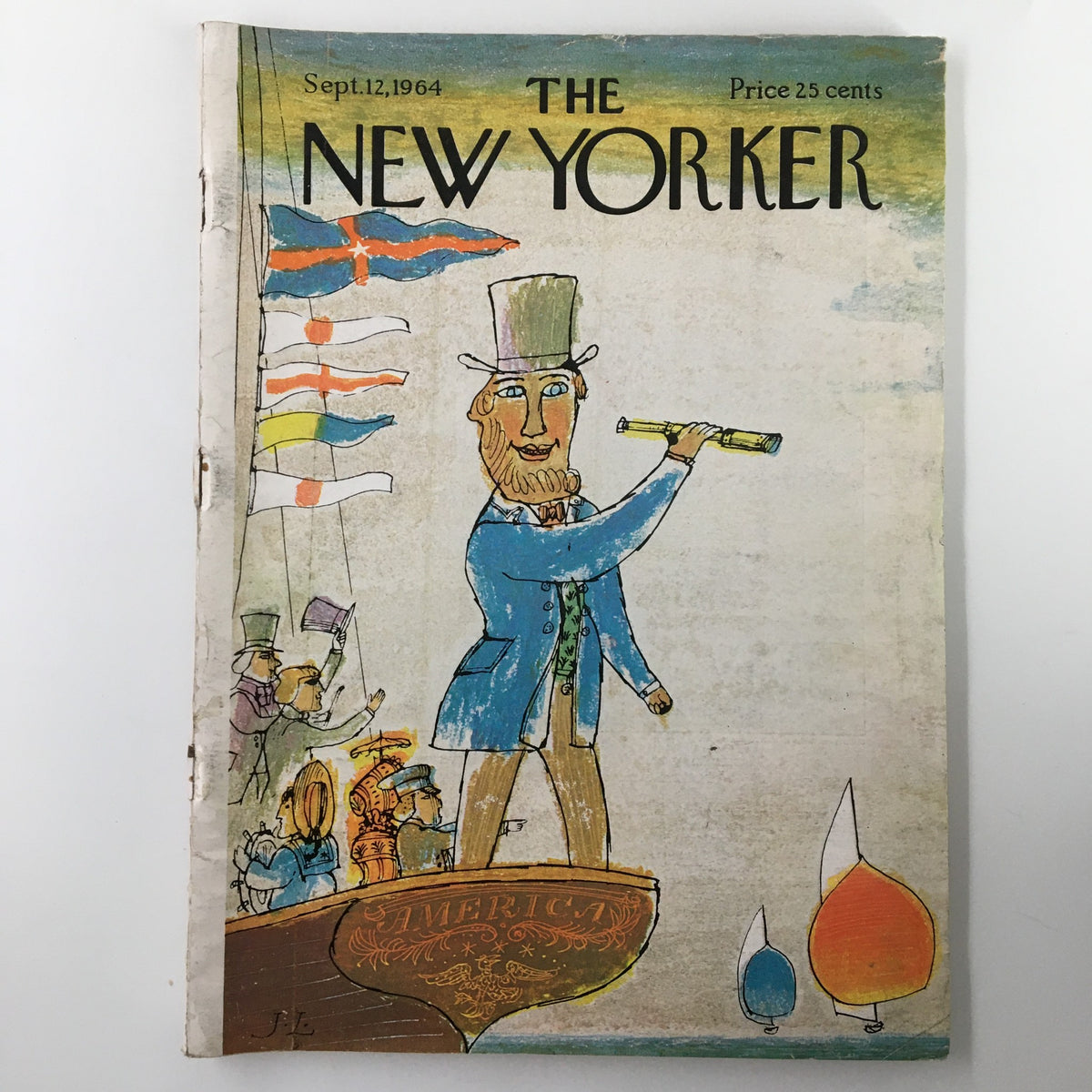
September 12, 1964 places this issue of The New Yorker at one of the most charged and consequential moments in postwar American history. The country was less than a year removed from the assassination of John F. Kennedy, Lyndon Johnson was in the process of shepherding the Civil Rights Act through its final implementation, and the presidential campaign between Johnson and Barry Goldwater was entering its final stretch — a contest whose outcome would define the ideological direction of American politics for a generation. The New Yorker of this period was publishing some of its most significant political and cultural journalism, with contributors who understood the weight of the historical moment they were documenting and brought to it the combination of literary seriousness and sharp observation that made the magazine essential reading for the American intellectual class. A cover featuring an Abraham Lincoln cartoon by Joseph Low in September 1964 was not a casual seasonal choice — invoking Lincoln in the middle of a civil rights revolution and a presidential campaign being fought partly over questions of racial equality carried a specific and deliberate resonance that The New Yorker's editors and its readership would have understood immediately. Collectors building a documentary archive of magazines from 1964 will find this issue a culturally layered and historically significant example of the publication at a genuinely important moment.
Joseph Low was a distinctive presence in American graphic art and illustration whose work appeared across books, prints, and periodicals throughout the mid-twentieth century. His style combined a deceptively simple line quality with genuine wit and compositional intelligence, producing work that rewarded careful attention in the way that the best New Yorker cover art always did. A Lincoln cartoon by Low in September 1964 would have drawn on the visual and cultural iconography surrounding the sixteenth president with the kind of oblique, humor-inflected approach that characterized the magazine's engagement with historical and political subjects — neither reverent hagiography nor blunt satire, but something more interesting and harder to categorize. For collectors focused on the visual history and cover art tradition of The New Yorker magazine, Low's contributions represent an underappreciated strand of the magazine's mid-century illustration roster — one whose quality and cultural resonance make surviving issues featuring his work genuinely worth seeking out.
The invocation of Lincoln in 1964 also carries a specific literary and political history that deepens the significance of this cover in ways that a casual reader might not immediately register. Lincoln had been a recurring touchstone in American political discourse throughout the civil rights era, claimed by multiple sides of the debate over racial equality and consistently deployed as a symbol whose meaning was actively contested. In the summer and fall of 1964 — following the passage of the Civil Rights Act in July, which Johnson had explicitly framed in Lincolnian terms of fulfilling the nation's unfinished promise — a Lincoln cover in The New Yorker participated in that ongoing national conversation about history, obligation, and the gap between American ideals and American reality. That the vehicle for this commentary was humor rather than polemic is entirely characteristic of The New Yorker's approach, and it is precisely that quality of intelligent indirection that makes the magazine's covers from this period so durably interesting as cultural documents.
About the Publication
The New Yorker, founded by Harold Ross in 1925 and edited from 1952 by William Shawn, was in September 1964 operating at what many critics and historians regard as the apex of its cultural authority and editorial ambition. Shawn's editorship had by this point produced some of the most significant long-form journalism in American publishing history — James Baldwin's "Letter from a Region in My Mind" had appeared in the magazine in 1962, Hannah Arendt's "Eichmann in Jerusalem" in 1963, and the publication's coverage of the civil rights movement and Cold War politics was setting standards for engaged, literary journalism that would influence American nonfiction writing for decades. The magazine's audience was the educated, culturally engaged professional class that looked to it not merely for entertainment but for a reliable orientation toward the most important intellectual and cultural questions of the moment. Its cover art program, which commissioned original illustration from a rotating roster of distinctive artists rather than using photography, gave each issue a visual identity as considered and individual as its editorial contents, and the covers from this mid-1960s period are now studied as significant works of American graphic art in their own right.
Key Highlights Inside
- Cover illustration of Abraham Lincoln by Joseph Low — a whimsical and thought-provoking cartoon that engages with one of America's most iconographically loaded historical figures at a moment when Lincoln's legacy was being actively invoked in the national debate over civil rights and racial equality.
- Editorial and cultural content reflecting the extraordinary political atmosphere of September 1964, with the Johnson-Goldwater presidential campaign in full force and the Civil Rights Act's passage just months behind — a combination that made The New Yorker's political commentary and cultural observation particularly pointed and historically significant during this period.
- Fiction, poetry, and criticism consistent with William Shawn's editorship at its most ambitious, a period during which the magazine was publishing work that would be recognized as among the most important American writing of the twentieth century.
- "Talk of the Town" section and cartoon content reflecting The New Yorker's mid-1960s engagement with the social and political transformations reshaping American life, delivered in the magazine's characteristic register of intelligent humor and precise observation.
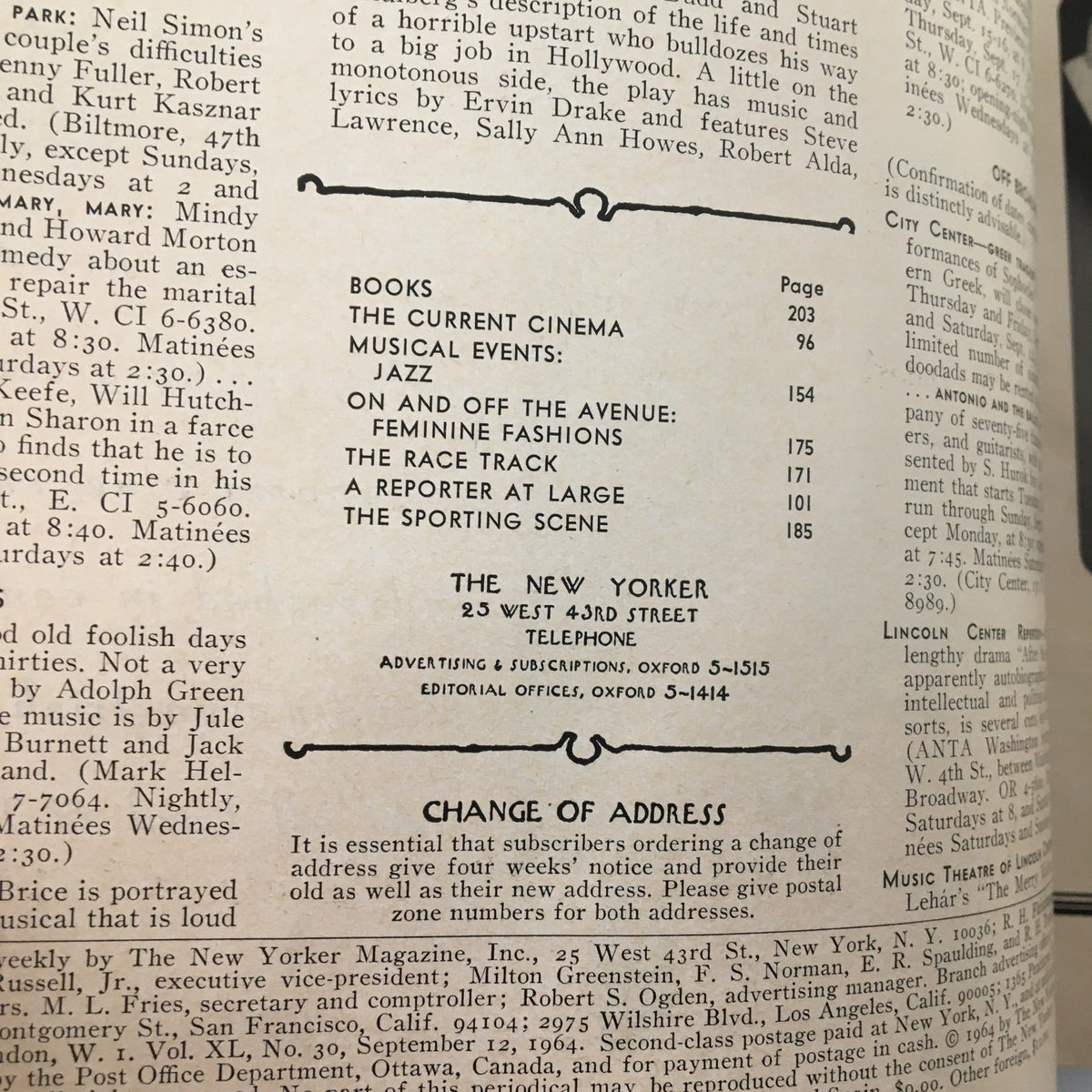
- Note: Specific article titles, fiction contributors, and complete table of contents details for this issue have not been independently confirmed beyond what the cover and listing describe. The highlights above are drawn from the named cover artist, publication date, and The New Yorker's well-documented editorial format and practices during this period.
Condition & Rarity
This issue is a no-label copy, meaning the cover survives without the address markings and postal labels that obstruct the cover illustration on subscriber copies and reduce both their visual integrity and their standing in the collector market — a meaningful distinction for an issue whose Joseph Low cover art is central to its appeal as a display and collector's object. The condition is described as good, with minor wear throughout and some marks visible on the magazine, consistent with a publication now more than sixty years old that has circulated outside archival storage conditions. These surface characteristics are standard for unrestored newsstand copies of this vintage and do not materially affect the issue's value as a historical document or display piece. A protective plastic sleeve has been applied, providing an ongoing barrier against further dust accumulation, environmental exposure, and handling wear. When evaluating any surviving copy of this issue, collectors should prioritize the legibility and surface condition of the Low cover illustration, the completeness of interior pages, and spine integrity, treating minor marks and age-related wear as expected and accepted attributes of an unrestored copy from the mid-1960s rather than as meaningful reductions in the issue's historical or artistic significance.
Looking for More Issues Like This?
Mid-1960s New Yorker issues with original cover art by named illustrators are consistently sought by collectors working across American literary history, mid-century graphic art, and political history — and a Joseph Low Lincoln cover from the charged autumn of 1964 draws from all three of those collector communities simultaneously. If this particular September 1964 issue is currently unavailable, the New Yorker collection at OriginalMagazines.com is the most comprehensive resource for collectors tracing the magazine's cover art tradition and editorial legacy across its remarkable publishing history. The broader 1964 magazine archive is equally worth exploring for anyone building a multi-publication record of that pivotal and historically dense year in American life.