


Description
Collector's Note – Why This Issue Matters
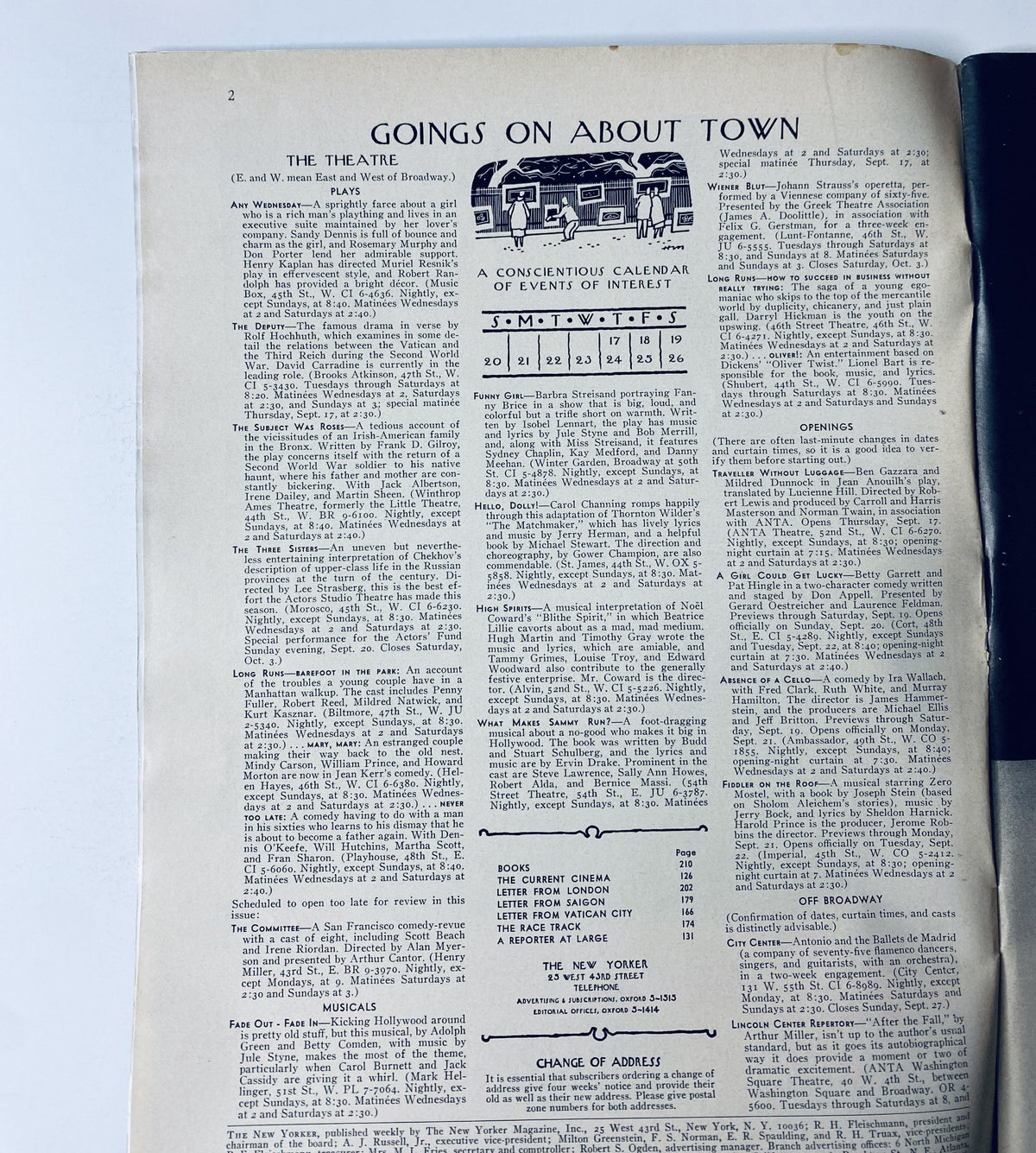
September 19, 1964 is a publication date of considerable historical weight for The New Yorker, arriving in the specific weeks following two of the most consequential events in the magazine's relationship with American public life. The Warren Commission Report on President Kennedy's assassination had been released on September 24, 1964 — just five days after this issue's publication date — and the country was in the immediate pre-release period of maximum anticipatory attention to its findings. But perhaps more directly relevant to the specific issue in hand: the New Yorker had published Hannah Arendt's "Eichmann in Jerusalem" in five parts in February and March 1963, and James Baldwin's "The Fire Next Time" in a single extended essay in January 1963, and both works were still generating sustained intellectual and moral debate in the fall of 1964. The "Letter from Saigon" documented in this issue's table of contents is a primary document of particular significance: September 1964 was exactly one month after the Gulf of Tonkin Resolution had been passed by Congress on August 7, dramatically escalating American military involvement in Vietnam, and a New Yorker dispatch from Saigon in this specific September is a contemporaneous primary document of American presence in Vietnam at the precise moment of the war's official escalation. For collectors building an archive of New Yorker issues from the pivotal mid-sixties period, this September 19, 1964 edition is a primary document of the publication navigating one of the most historically charged moments in postwar American history.
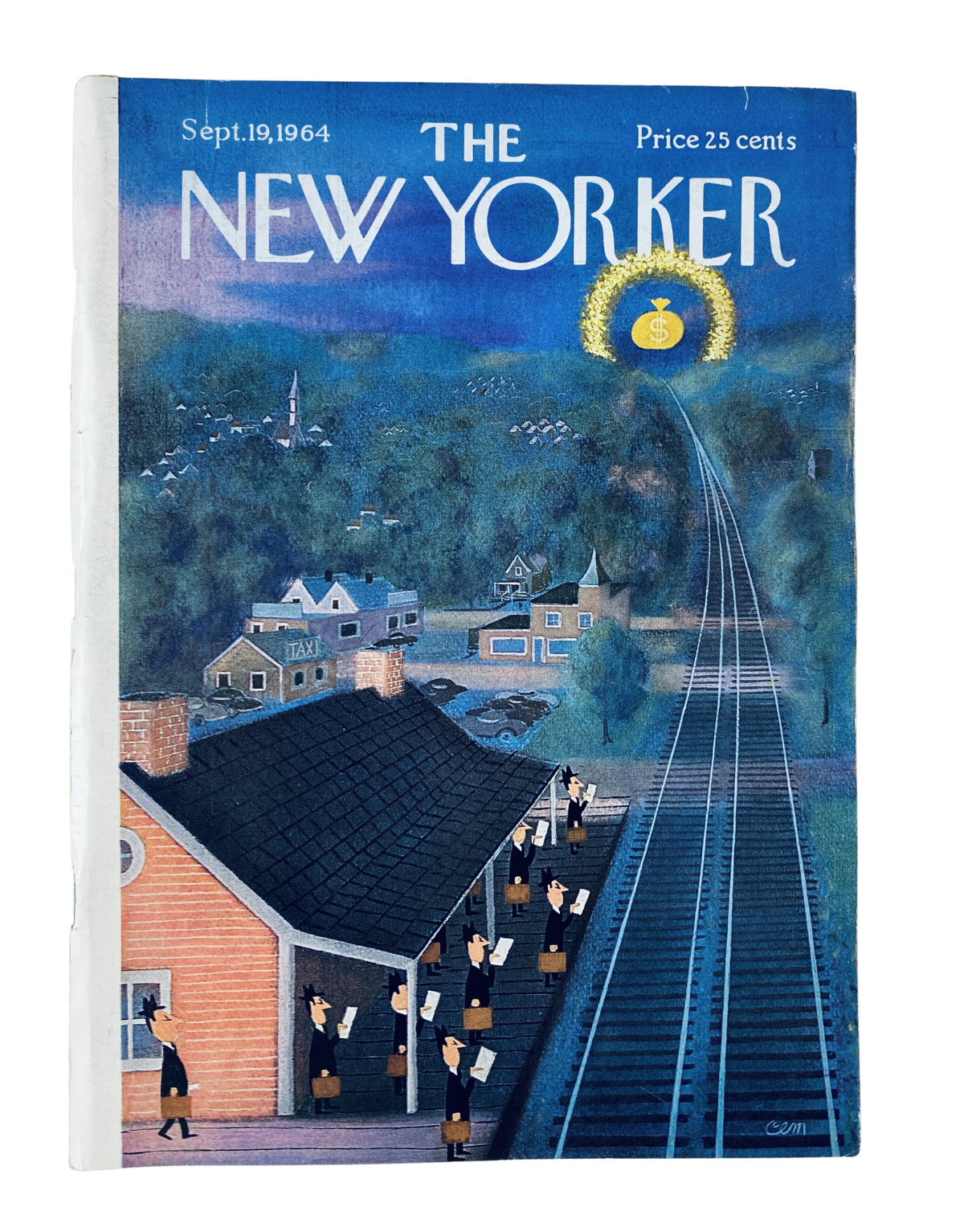
The train station commuter cover — an image of everyday American urban life at its most recognizable — carries a specific resonance in the September 1964 context that rewards attention. The commuter experience of American cities in the early-to-mid sixties was itself at a historically interesting moment: the automobile's dominance of American transportation planning was generating the specific urban crisis that Jane Jacobs had documented in The Death and Life of Great American Cities (1961), and the New Yorker cover's engagement with train station commuting reflected the magazine's consistent visual attention to the urban life of its readership at a moment when that life was being actively contested and reshaped. The "Letter from Vatican City" documented in the table of contents adds a further historically specific dimension: September 1964 was during the Second Vatican Council's third session, which was addressing some of the most consequential questions in twentieth-century Catholicism including ecumenism, religious liberty, and the Church's relationship with the modern world. A New Yorker letter from Vatican City in September 1964 is a primary document of Vatican II journalism at one of its most intellectually active moments. The "Letter from London" rounds out the international correspondence package that gave the New Yorker's mid-sixties readers a specific and authoritative engagement with the full range of world affairs that distinguished it from all competitors. Collectors researching New Yorker issues from 1964 will find this September 19 edition a precisely dated primary document of the publication navigating an extraordinary convergence of international and domestic historical crises.
The "Reporter at Large" section on page 131 is a bibliographically significant entry that deserves collector attention. The New Yorker's Reporter at Large feature in this period was the primary venue for its most ambitious long-form domestic journalism, and a September 1964 Reporter at Large was produced in the specific atmosphere of the Civil Rights Act's passage in July 1964, the Gulf of Tonkin escalation in August, and the approaching presidential election that would pit Lyndon Johnson against Barry Goldwater in November. Whatever its subject, a Reporter at Large from this specific September constitutes a primary document of New Yorker domestic journalism at the most historically dense single season of mid-sixties American political life. The cinema column and books reviews round out the cultural criticism package that gave each issue of the mid-sixties New Yorker its characteristic engagement with the full range of American and international cultural production.
About the Publication
The New Yorker was founded in 1925 by Harold Ross and by September 1964 had been publishing for thirty-nine years under the editorships of Ross and William Shawn, who had led the magazine since 1952 and whose tenure had deepened its commitment to long-form journalism, literary fiction, and cultural criticism while maintaining the humor tradition that had defined it from the beginning. Shawn's New Yorker in September 1964 was at a specific editorial peak — its engagement with civil rights, the Kennedy assassination's aftermath, Vietnam's escalation, and the Vatican Council was producing some of the most significant journalism and criticism in the magazine's history. The mid-sixties New Yorker under Shawn represents the publication's most fully realized version of what a serious American cultural weekly could be, and individual issues from this period carry the documentary weight of that achievement.
Key Highlights Inside
- "Letter from Saigon" on page 179 — a primary document of New Yorker correspondence from Vietnam published in September 1964, exactly one month after the Gulf of Tonkin Resolution dramatically escalated American military involvement, constituting contemporaneous journalism from the war zone at the specific moment of the conflict's official escalation and representing exactly the kind of eyewitness reporting from consequential locations that distinguished the New Yorker's mid-sixties foreign correspondence from all competition.
- "Letter from Vatican City" on page 166 — a documented New Yorker dispatch from Rome during the Third Session of the Second Vatican Council in September 1964, when the Council was actively debating religious liberty, ecumenism, and the Church's relationship with modernity in ways that would reshape global Catholicism for the following decades, constituting a primary document of Vatican II journalism at its most intellectually active phase.
- "Letter from London" on page 202 — the New Yorker's London correspondence from September 1964, providing the British perspective on the American political landscape of a presidential election season and the broader transatlantic engagement with the mid-sixties crises of civil rights, Vietnam, and Cold War geopolitics that characterized the publication's international journalism in this period.
- "A Reporter at Large" on page 131 — a long-form New Yorker domestic journalism piece from September 1964, the most historically dense single season of mid-sixties American political life, produced in the specific atmosphere of the Civil Rights Act's recent passage, Gulf of Tonkin's recent escalation, and the approaching Johnson-Goldwater presidential election.
- The Current Cinema on page 126, Books on page 210, and The Race Track on page 174 — the full cultural and sports criticism architecture of a September 1964 New Yorker, providing the comprehensive engagement with American and international cultural production that gave each mid-sixties issue its characteristic breadth and that constitutes a primary source record of the cultural landscape of early fall 1964.
Condition & Rarity
New Yorker issues from September 1964 are approaching their sixty-second year of existence, and the condition landscape for surviving copies from this mid-sixties period reflects both the general attrition of that age and the specific collecting significance of issues from the Shawn-era's most historically charged years. Very Good condition with only light edge wear is an honest and strong grade for a sixty-one-year-old weekly literary magazine, indicating a copy that retains full structural integrity, displays cleanly, and shows no significant cover damage or interior page loss beyond the minimal evidence of its age. The train station commuter cover image — produced by one of the New Yorker's mid-sixties cover artists in the seasonal tradition of September urban life documentation — is preserved in this grade with sufficient visual clarity for both display and research purposes. The plastic protective sleeve provides ongoing archival protection for a publication whose staple-bound format benefits from protection against cover separation and page stress over long-term storage. Collectors evaluating surviving examples of this issue should prioritize cover integrity, the completeness of the Saigon and Vatican City correspondence, and overall structural soundness as primary condition criteria most relevant to this issue's documentary value.
Looking for More Issues Like This?
A Very Good copy of The New Yorker from September 19, 1964 — with its Letter from Saigon arriving one month after the Gulf of Tonkin Resolution, its Vatican Council correspondence, and the full Reporter at Large domestic journalism — is among the more historically layered single issues in the magazine's mid-sixties archive, and surviving copies from the Shawn era's most historically charged years in confirmed strong condition attract consistent interest from researchers and collectors across multiple simultaneous subjects. If this issue is no longer available, the full New Yorker collection at OriginalMagazines.com is the most comprehensive place to browse surviving issues from across the publication's history and locate other mid-sixties correspondence issues, significant Shawn-era journalism, or specific dates from the magazine's most historically consequential decade. The 1964 magazine collection brings together surviving issues from across that year's major publications for collectors working to document the full breadth of American print culture during the most historically dense year of the decade.