
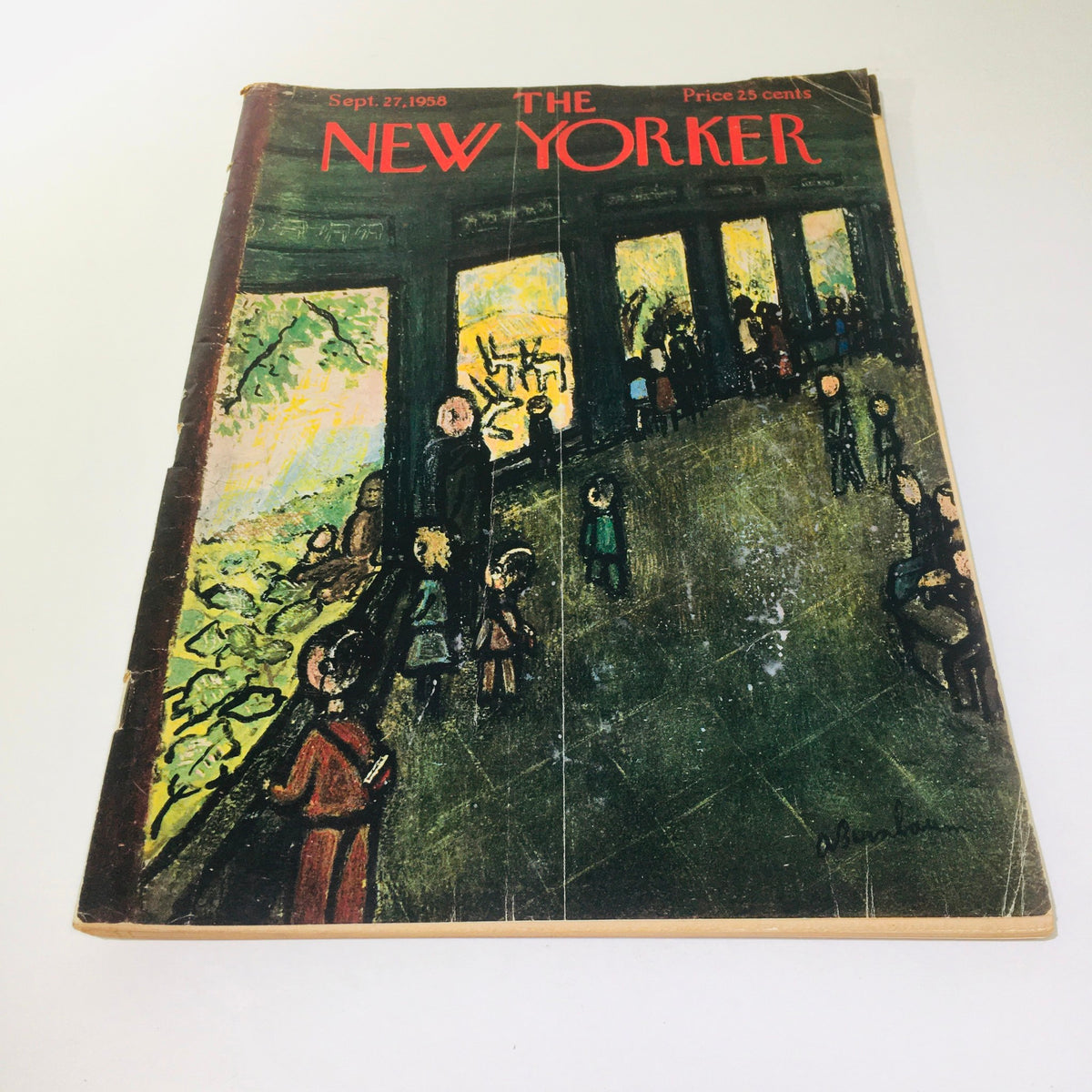


Description
Collector's Note – Why This Issue Matters
The September 27, 1958 issue of The New Yorker featuring a cover by Abe Birnbaum arrives at a specific and historically significant moment in both the magazine's publishing history and the broader cultural landscape of late-1950s America. Abe Birnbaum had been contributing covers and cartoons to The New Yorker since the early 1940s, and by September 1958 his relationship with the publication spanned nearly two decades of consistent creative engagement. He was among the artists who had helped sustain the magazine's visual tradition through the transition from the Ross era to the Shawn era, bringing a distinctive graphic sensibility and a warm, precise observational intelligence to his seasonal covers that made them particularly valued in the magazine's annual visual calendar. A late-September cover — the opening of true autumn, the first full week of the fall season — placed Birnbaum in one of the seasonal registers that had become most closely associated with his best work: the specific quality of early October's approach, the resumption of urban cultural life, the particular social and atmospheric character of New York in the last days of September. For collectors who focus on vintage New Yorker issues featuring significant mid-century cover artists, a Birnbaum September cover from 1958 represents a document of the publication's visual tradition at one of its most accomplished and most historically interesting mid-century moments.
The September 1958 date carries specific and substantial historical weight that gives this issue a context beyond its seasonal occasion. The year 1958 was defined by the Sputnik aftermath — the Soviet satellite launched in October 1957 had triggered a national crisis of confidence in American scientific and educational institutions that was still actively reshaping American domestic and foreign policy throughout 1958. The National Defense Education Act had been signed in September 1958, just weeks before this issue's cover date, representing the federal government's most significant investment in education since the GI Bill and a direct response to the perceived Soviet technological challenge. The Cold War anxieties, the cultural self-examination, and the particular combination of prosperity and unease that characterized the late Eisenhower years were all present in the atmosphere that this September 1958 New Yorker inhabited. Birnbaum's cover — whatever its specific subject — existed within and offered a characteristically gentle counterweight to those larger anxieties, the magazine's visual tradition at its most characteristically New Yorker: observational, warm, and maintaining its aesthetic standards regardless of the turbulence of the surrounding world. Collectors building archives around the magazines of 1958 will find this September issue a document of American cultural life at a specific and historically charged moment in the late Eisenhower era.
The listing notes a notation on the back of the magazine — a detail that collectors who approach New Yorker issues as complete physical artifacts should assess carefully in the provided photographs. Writing or notations on magazine backs from this era can originate from various sources — a previous owner's personal record, a gift inscription, a library or institutional stamp — each carrying its own implications for provenance and display. For collectors whose primary interest is the Birnbaum cover art and the editorial content of the issue, a back notation does not affect the front cover presentation or the interior pages; for those who prioritize display of both front and back cover surfaces, the notation's nature and extent is worth evaluating. This kind of physical mark, as the listing notes, adds an element of human history to the artifact — the evidence of previous ownership and use that makes surviving copies of old magazines genuine historical objects rather than merely commercial products.
About the Publication
The New Yorker, founded by Harold Ross in 1925 and edited from 1952 by William Shawn, had by September 1958 accumulated thirty-three years of cultural authority as the most literarily ambitious and editorially distinctive general-interest magazine in the United States. Its cover art tradition, sustained by a rotating roster of accomplished artists of whom Birnbaum was a consistently valued contributor, was understood as applied art of genuine significance — individual covers were treated as commissioned artworks, and the magazine's early-autumn issues in particular had developed into some of the most visually distinctive and most anticipated publications of the year. The late-1950s New Yorker was in the confident middle phase of the Shawn era, maintaining the editorial standards and visual ambitions that had defined it since the transition from the Ross years while deepening its commitment to the long-form journalism and serious literary fiction that would come to define its greatest decade.
Key Highlights Inside
- A cover illustration by Abe Birnbaum — a contributor whose nearly two-decade relationship with The New Yorker had made him one of the more accomplished and most consistently valued visual voices in the publication's mid-century roster, here producing a late-September seasonal cover during a historically charged autumn whose specific combination of Cold War anxiety, post-Sputnik national soul-searching, and late-Eisenhower social confidence gave the season's cultural moment an unusual quality of tension and self-examination.
- Fiction, criticism, poetry, and reported journalism consistent with The New Yorker's editorial standards under William Shawn — the September 27, 1958 issue would have contained the mixture of long-form content that defined the magazine's format, produced in the specific atmosphere of an autumn whose policy significance — the National Defense Education Act had just been signed — was shaping the national conversation about education, science, and American competitive standing in the Cold War.
- Interior cartoons and spot illustrations from The New Yorker's late-1950s visual roster — a period when the magazine's stable of cartoon contributors was producing work that reflected the specific social observations and cultural preoccupations of the post-Sputnik Eisenhower era while maintaining the quality and wit that had always distinguished the publication's visual tradition.
- Advertising content reflecting the consumer culture of late September 1958 — the advertisements targeting the magazine's affluent, educated readership at the opening of the autumn cultural season constitute a significant secondary document of the era's commercial aesthetics and the specific aspirational culture of a readership navigating the decade's combination of material prosperity and Cold War anxiety.
Note: Specific article titles, fiction contributors, bylines, and additional interior details beyond the cover artist are unconfirmed for this issue from available sources. The highlights above reflect verifiable historical context drawn from the cover artist, publication date, and the well-documented editorial character of The New Yorker under William Shawn during this period. Collectors should assess the back-page notation described in the listing against the provided photographs.
Condition & Rarity
This copy is identified as a no-label newsstand edition in good condition with minor wear throughout, without a plastic protective sleeve. The no-label status preserves the Birnbaum cover art without subscription label adhesive damage, which is a meaningful provenance attribute for a publication now approaching seventy years old. The minor wear throughout is consistent with a stored newsstand copy of this vintage and falls within the expected range for good condition without compromising the essential integrity of the issue. The absence of a plastic sleeve makes immediate archival sleeving strongly advisable upon acquisition — paper stock of nearly seventy years of age is increasingly vulnerable to light exposure damage, surface oxidation, and edge brittleness under unprotected storage conditions. The noted back notation should be assessed in provided photographs to determine its nature, extent, and impact on the issue's physical completeness and display presentation. For an Abe Birnbaum September cover from 1958, a no-label newsstand copy in good condition with the front cover art intact and readable interior pages represents a legitimate and historically meaningful collectible for serious collectors of the magazine's mid-century visual tradition.
Looking for More Issues Like This?
A no-label Abe Birnbaum September cover New Yorker from 1958 is a specific and rewarding find for collectors who follow the magazine's mid-century visual tradition — Birnbaum's late-autumn and early-autumn covers are among his most accomplished work, and clean no-label examples from the late 1950s surface with less frequency than their quality warrants. If this September 27 issue has already found a home, the broader vintage New Yorker collection at OriginalMagazines.com is an excellent resource for other significant Birnbaum covers and editorial landmarks from the magazine's remarkable late-1950s run. Collectors focused on the post-Sputnik atmosphere, the late Eisenhower cultural moment, and the artistic character of 1958 will find it well worth exploring the full 1958 magazine archive, which brings together publications from one of the more consequential years of the Cold War decade.