

Description
Collector's Note – Why This Issue Matters
The March 8, 1976 issue of The New Yorker reflects a moment in American cultural and intellectual life when journalism, literature, and visual art intersected in uniquely influential ways. The mid-1970s were marked by a post-Watergate atmosphere of introspection and skepticism, alongside a flourishing of creative expression across media. The New Yorker, already well established as a leading voice in long-form journalism and commentary, served as a platform where these currents were explored with nuance and precision. Each issue from this period contributes to a broader understanding of how the magazine documented and interpreted the evolving cultural landscape.
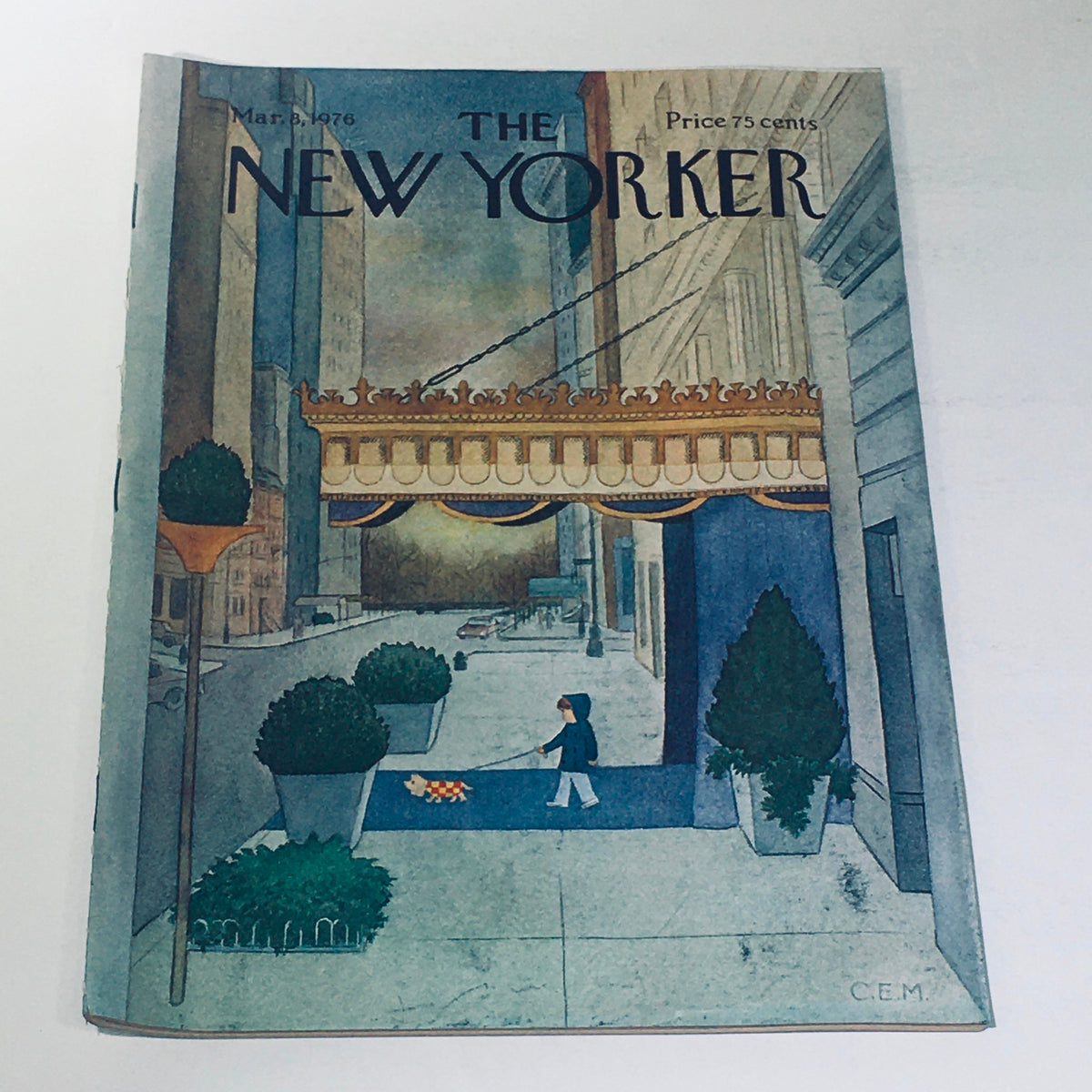
At the forefront of this particular issue is the cover artwork by Charles E. Martin, whose illustrations were known for their subtle storytelling and ability to capture everyday moments with a distinctive visual style. Cover art in The New Yorker has long been an essential part of the magazine’s identity, often functioning as both commentary and aesthetic statement. Martin’s contribution here reflects the publication’s tradition of pairing literary depth with visual sophistication, reinforcing the importance of illustration as an integral component of the reading experience.
For collectors and researchers, this issue represents a convergence of editorial excellence and artistic expression. Within the broader context of The New Yorker magazine archive spanning decades of cultural commentary and magazines from 1976 reflecting mid-1970s thought and design, it stands as a representative artifact of how the publication captured both the tone and texture of its time.
About the Publication
Founded in 1925, The New Yorker quickly became one of the most respected and enduring magazines in American publishing, known for its blend of fiction, essays, reporting, criticism, and cartoons. Its readership has traditionally included a highly engaged audience interested in literature, politics, culture, and the arts. By the 1970s, the magazine had solidified its reputation for meticulous editing, distinctive voice, and commitment to high-quality writing, making it a cornerstone of intellectual and cultural discourse.
Key Highlights Inside
- Cover artwork by Charles E. Martin reflects the magazine’s tradition of visually distinctive and narrative-driven illustration. His work often captured everyday scenes with subtle storytelling and emotional nuance. In this issue, the cover contributes to the broader visual identity that has defined The New Yorker across decades.
- Editorial content is consistent with The New Yorker’s blend of long-form journalism, essays, and cultural commentary. The magazine’s structure during this period emphasized depth, clarity, and literary quality. Readers would expect a mix of reporting, criticism, and thoughtfully crafted prose representative of its editorial standards.
- The issue reflects mid-1970s perspectives on society, culture, and intellectual life. This was a time shaped by political reflection, artistic experimentation, and shifting public attitudes. The content provides insight into how contemporary issues were interpreted and presented to an engaged readership.
- The integration of literary and artistic elements defines the publication’s editorial identity. Writing and illustration were treated as complementary forms of storytelling rather than separate components. This approach reinforced the magazine’s reputation as both a literary journal and a visual publication.
Condition & Rarity
Copies of this issue are typically evaluated based on edge wear, cover quality, and page integrity. A magazine described in good condition with minor edge wear suggests standard handling for its age, while still maintaining structural soundness and readability. The absence of an address label is a notable feature, as label-free copies are often preferred by collectors for their clean presentation, particularly when the cover artwork is a focal point. Well-preserved examples from this era remain desirable, especially when the issue retains both visual appeal and complete interior content.
Looking for More Issues Like This?
Issues from the 1970s offer a rich perspective on how The New Yorker documented a changing cultural and political landscape. For those interested in exploring similar material, the The New Yorker magazine collection provides access to a wide range of issues spanning decades of influential writing and illustration, while magazines from 1976 help place this issue within the broader context of its time. Together, they offer a deeper appreciation of the era this issue represents.