

Description
Collector's Note – Why This Issue Matters
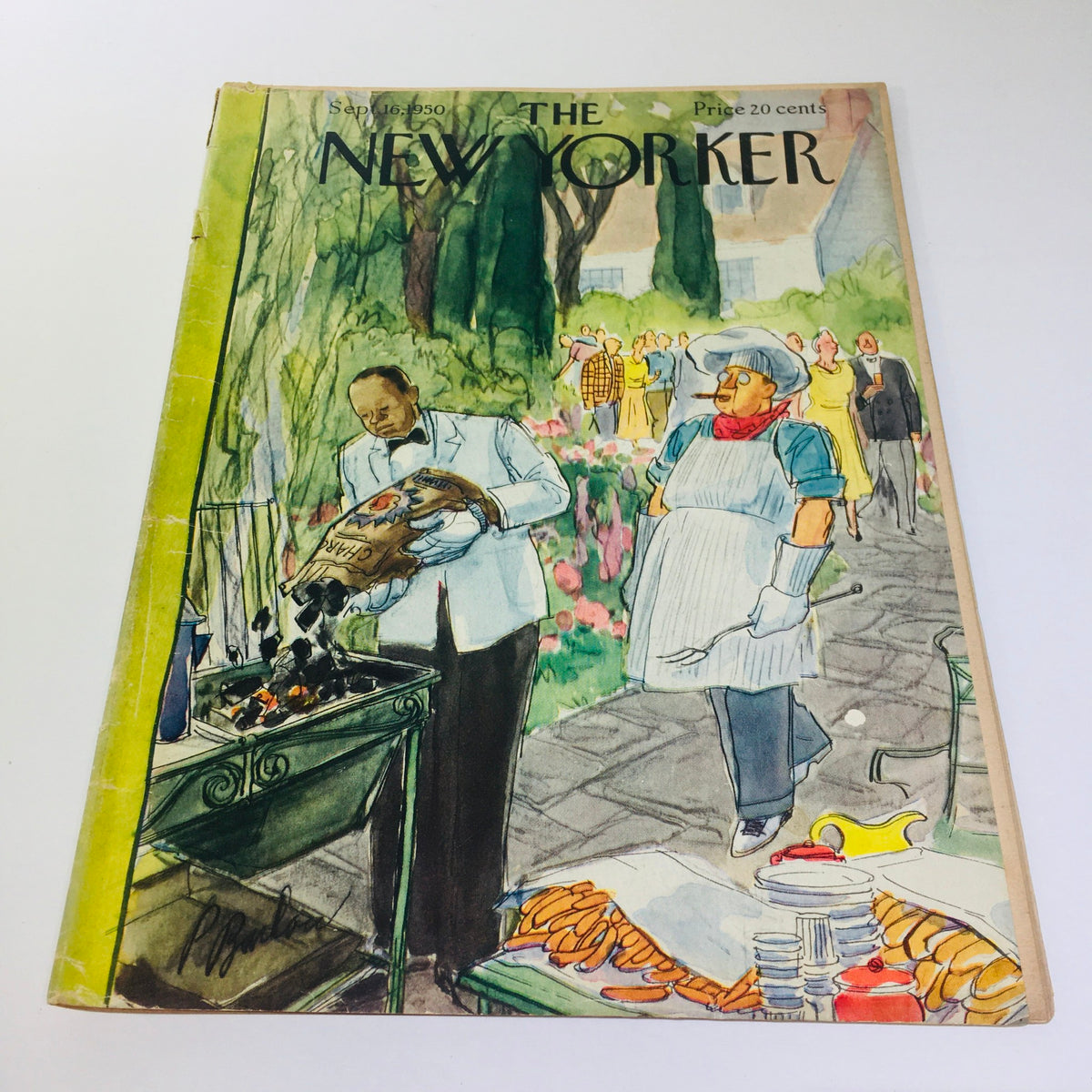
The September 16, 1950 issue of The New Yorker with a theme cover by Perry Barlow is a primary document of one of the magazine's most consistently entertaining and most socially observant mid-century cartoonist-illustrators — and of a specific and historically extraordinary moment in American life that gives any September 1950 New Yorker a documentary significance extending far beyond its cover art. Perry Barlow was among the most recognizable and most warmly regarded contributing cartoonists to The New Yorker from the 1920s through the 1960s, developing a visual specialty in the comedy of marital life, domestic relations, and the specific social rituals of American middle and upper-middle class life that made his work immediately recognizable and consistently beloved within the magazine's readership. His covers, like his interior cartoons, engaged the specific social textures of American domestic and social life with a combination of observational precision and gentle comic warmth that gave them an immediate accessibility and lasting personal memorability. A September 16 cover by Barlow would have engaged the specific seasonal and social territory of early autumn — the return from summer, the resumption of urban social rhythms, the specific quality of September in New York — in the characteristic visual language of social comedy and seasonal observation that defined his most characteristic and most warmly received contributions to the magazine's visual tradition. For collectors building around vintage New Yorker Magazine issues, a Perry Barlow cover from September 1950 represents a specific and personally distinctive strand of the publication's mid-century visual tradition at one of its most historically revealing and most culturally specific expressions.
The September 16, 1950 date places this issue in one of the most historically extraordinary and most dramatically unfolding moments of the entire early Cold War era. The Korean War had begun on June 25, 1950 — just twelve weeks before this issue's publication — and by mid-September 1950 was in its most dramatically changing phase: General Douglas MacArthur's Inchon landing had occurred on September 15, 1950 — one day before this issue's publication date — one of the most audacious and most strategically consequential military operations in the history of American arms, reversing the North Korean advance that had nearly pushed United Nations forces off the Korean peninsula in the war's opening weeks. The Inchon landing would prove to be the turning point of the Korean War's first phase, and the September 16, 1950 New Yorker was published on the day after one of the most consequential and most dramatically successful military operations that American forces had executed since the Second World War. The specific atmosphere of September 1950 in American life — the country eight weeks into an unexpected war in Korea, navigating the specific combination of Cold War anxiety, postwar prosperity, and the dawning realization that the postwar peace was more fragile and more dangerous than the optimism of 1945 had suggested — gives any surviving issue from this week a historical documentary significance that extends well beyond the Barlow cover's social comedy into the full complexity of one of the most extraordinary weeks in postwar American history. For collectors focused on magazines from 1950, a September 16 issue captures that historical moment with maximum specificity.
Harold Ross — the founder and first editor of The New Yorker — died in December 1951, making any 1950 issue a document of the magazine in its final full year under the editor who had created it and defined its character across a quarter century. The specific atmosphere of The New Yorker under Ross in 1950 — his last full year of editorship before his health began to fail — was one of sustained quality and institutional authority that the magazine had built across twenty-five years of publishing. William Shawn, who would succeed Ross in 1952, was already deeply embedded in the magazine's editorial operations as managing editor, and the collaboration between Ross's founding vision and Shawn's developing editorial intelligence was, in September 1950, producing a publication at the peak of its pre-transition institutional maturity. A Perry Barlow cover from this September 1950 moment is therefore a document of the magazine in its most fully realized Ross-era expression — the last year before the succession that would reshape its identity in the decade to come.
About the Publication
The New Yorker was founded by Harold Ross in 1925 and had established itself by 1950 as the most intellectually distinguished and most editorially authoritative general-interest weekly magazine in the United States, widely regarded as the most important venue for American literary fiction, long-form journalism, poetry, criticism, and humor in the country. Under Harold Ross — who would die in December 1951, making 1950 the last full year of his editorship — the magazine was at the culmination of a twenty-five-year project of editorial institution-building that had given it an intellectual authority, a visual identity, and a cultural significance that made it genuinely unlike any other American publication. Its cover tradition — maintained throughout its history through a commitment to original illustration rather than photography — had produced, across twenty-five years, a body of visual art most associated in its daily character with the specific and warmly observational social comedy of contributors like Perry Barlow, whose September 1950 cover represents the full maturity of a visual tradition that Ross had personally built and personally championed throughout his quarter-century editorship.
Key Highlights Inside
- Perry Barlow September theme cover — early autumn social comedy in characteristic Ross-era style: The defining visual artifact of this issue — a Barlow cover engaging with the specific seasonal and social territory of early September in the characteristic visual language of domestic and social comedy that made his contributions some of the most immediately accessible and most warmly remembered in the magazine's mid-century visual archive, produced in the final full year of Harold Ross's editorship at the culmination of the twenty-five-year visual tradition he had personally built.
- Day-after-Inchon Korean War documentation — September 16, 1950: Published one day after General MacArthur's Inchon landing — one of the most audacious and most strategically consequential military operations in the history of American arms, reversing the Korean War's initial phase in a single dramatic stroke — this issue was produced and received in the specific atmosphere of one of the most historically extraordinary single weeks in the entire Korean War, giving any serious journalism in this issue a historically specific and immediately consequential documentary character.
- Final full year of Harold Ross editorship — pre-Shawn transition documentation: September 1950 falls in the final full year of Harold Ross's editorship before his December 1951 death — making any 1950 issue a document of the magazine at the culmination of the founding editor's twenty-five-year project rather than in the transitional period that would follow, and giving surviving issues from this year a specific and recognized position in the magazine's institutional history as documents of the Ross era's most fully realized expression.
- Early Korean War domestic American atmosphere — August-September 1950 anxiety and response: The specific domestic American atmosphere of September 1950 — eight weeks into an unexpected war that had begun with a near-catastrophic reversal before the Inchon turnaround — gave the magazine's journalism, fiction, and cultural commentary a specific Korean War-era character that distinguishes September 1950 issues from both the pre-June 1950 peacetime context and the later phases of a war that would eventually settle into an extended stalemate.
- Note: Specific fiction titles, poetry contributors, journalism subjects, cartoon credits, and individual editorial features for this issue have not been confirmed from available listing details. The above reflects what is verifiable from the cover artist, the publication date, and the well-documented historical context of The New Yorker under Harold Ross in September 1950.
Condition & Rarity
A Good condition rating with no address label, minor edge wear and possible small rips, a loose binding, and no plastic protective covering for a seventy-five-year-old weekly magazine requires careful and honest reading from collectors assessing this issue for their archive. The loose binding is the most significant condition note to assess carefully against the available photographs — binding loosening in a seventy-five-year-old weekly magazine can range from a slightly weakened spine that remains structurally functional to a more advanced separation that compromises page security and increases the risk of individual page loss over time. The specific degree of binding loosening should be assessed before any collector decision, as it affects both the issue's long-term preservation and its suitability for active handling. The absence of a mailing label is a positive attribute, preserving whatever visual integrity the Perry Barlow September cover retains without permanent adhesive damage. Minor edge wear and possible small rips are the honest marks of survival across seventy-five years. The absence of a plastic protective covering means that any surviving copy of this issue in this condition should be prioritized for housing in appropriate archival protection — a polypropylene sleeve would provide necessary protection without risk. Interior page integrity alongside the binding assessment represents the most important condition evaluation for the editorial content that makes a September 1950 Ross-era New Yorker historically significant.
Looking for More Issues Like This?
A September 16, 1950 New Yorker with a Perry Barlow theme cover — published one day after the Inchon landing in the final full year of Harold Ross's editorship, at the most historically extraordinary single week of the Korean War's opening phase, in a no-label edition that preserves the Barlow cover in its original unencumbered form — is a more historically layered and more institutionally significant find than its surface description as a vintage weekly magazine might initially convey to collectors who don't immediately recognize both Barlow's specific place in the magazine's visual tradition and the extraordinary historical weight of the week of September 16, 1950. If this particular issue has already been claimed, the broader New Yorker Magazine collection at OriginalMagazines.com spans the publication's extraordinary publishing history and regularly includes 1950 issues from the final Ross year that document the magazine's literary, journalistic, and visual traditions at the culmination of their founding editorial period. Collectors with a specific focus on the cultural and political atmosphere of 1950 will find the 1950 magazine archive a rich source of primary material from one of the most historically extraordinary years of the entire postwar era.