
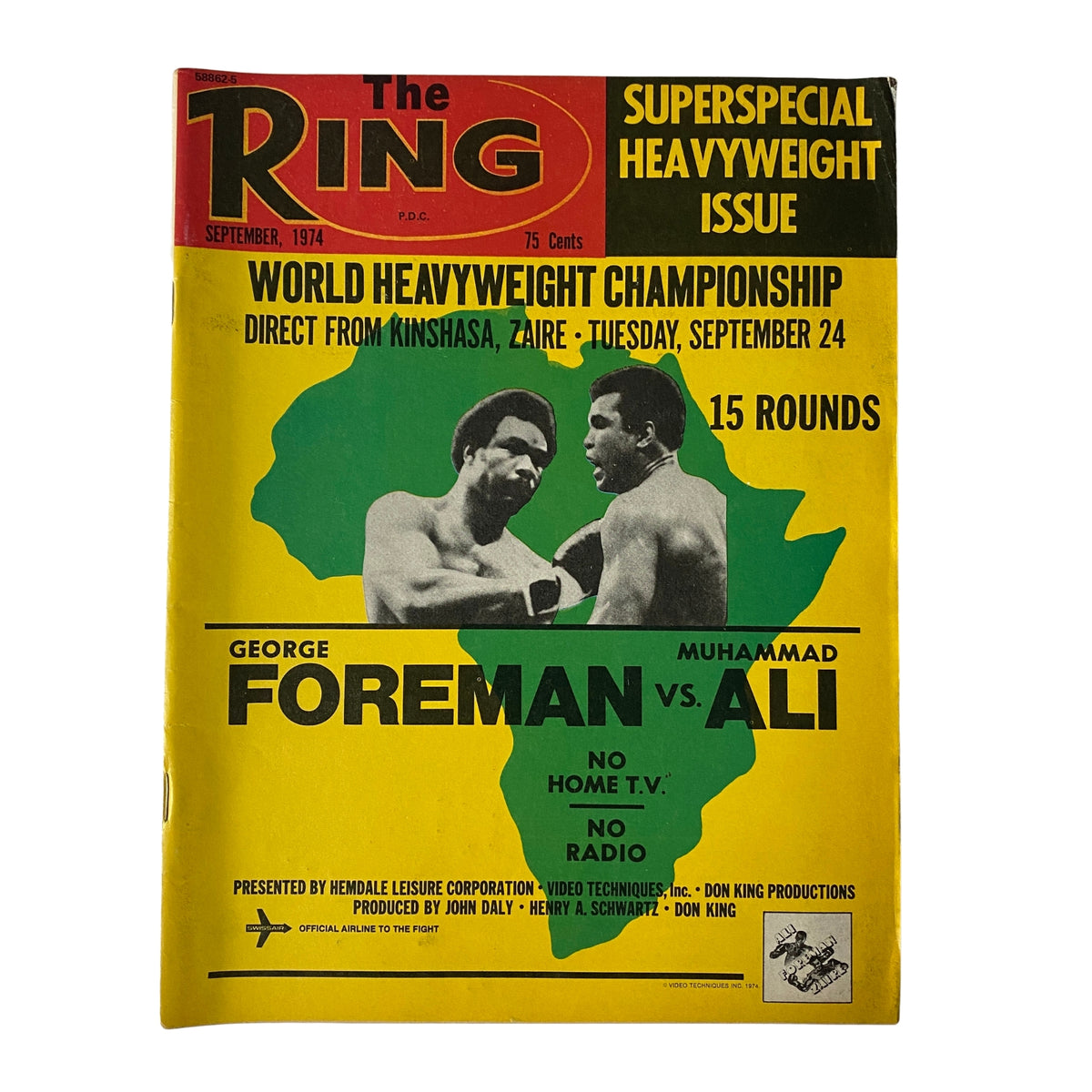


Description
Collector's Note – Why This Issue Matters
September 1974 is one of the most historically significant publication dates in the entire run of The Ring Magazine, and this issue is a primary document of one of the most celebrated sporting events of the twentieth century in its specific pre-fight anticipatory moment. The "Rumble in the Jungle" — George Foreman versus Muhammad Ali in Kinshasa, Zaire — was scheduled for October 30, 1974, making this September Ring a contemporaneous primary source published six weeks before the fight itself, when both fighters were actively training, the promotional machinery was at its most intense, and the specific arguments about each man's chances were being made with the full conviction of pre-outcome certainty. What makes this issue exceptional — and what elevates it well above ordinary fight-anticipation journalism — is the documented presence of first-person commentary by both Foreman and Ali themselves, published under their own names in the pages of the sport's most authoritative publication. "When I Catch Ali, He Will Fall" by George Foreman and "My Speed Will Nullify Foreman's Strength" by Muhammad Ali are primary source documents in the most literal sense: the actual words of the two combatants, staking their specific arguments about the fight's outcome, preserved in the original publication that gave those arguments their contemporary authority. For collectors building an archive of Muhammad Ali magazine covers and features, this September 1974 Ring is among the most specifically significant primary sources in the Ali back-catalog — not a retrospective celebration but a contemporaneous engagement with Ali at the precise moment of his most celebrated comeback challenge.
The historical irony that gives this September 1974 Ring its additional documentary power is the specific confidence of Foreman's pre-fight position. George Foreman was at the time of this magazine's publication the most feared heavyweight champion in recent memory — he had demolished Joe Frazier in two rounds in January 1973 and had destroyed Ken Norton in two rounds in March 1974, two fighters who between them had beaten Ali. The boxing establishment's consensus, reflected in the Ring's own analysis alongside the fighters' direct statements, was overwhelmingly that Foreman would destroy Ali as he had destroyed everyone else. The specific arguments being made in this September Ring — Foreman's power against Ali's speed — constitute a primary document of the conventional wisdom that the Rumble in the Jungle's outcome would completely overturn. Read retrospectively, the Foreman first-person certainty in these pages carries an extraordinary historical weight: a primary source record of a man whose confidence was both entirely justified by every available evidence and entirely wrong. Collectors researching The Ring Magazine issues from the Foreman-Ali era will find this September 1974 edition the single most important issue in the run-up to the most celebrated upset in the history of heavyweight boxing. Collectors researching boxing and sports magazines from 1974 will find this the most historically consequential Ring issue of the year.
The supporting content documented in the table of contents adds further historical dimensions that give this issue a secondary significance beyond the Foreman-Ali primary source material. Joe Frazier's "Fighter of the Month" designation and the Frazier-Quarry fight report constitute primary documents of Frazier's continued boxing activity in the fall of 1974 — a figure who, like Ali, was navigating the specific and complicated position of being a former heavyweight champion in the era of Foreman's dominance. The closed-circuit television promotion article by David Berman documents the specific commercial infrastructure of how the Rumble in the Jungle was being presented to the American public — closed-circuit boxing was one of the defining commercial innovations of the era, and its pre-fight promotional architecture is a primary source of the sports entertainment business history of the period. The "Foreman: A Man Without A Country?" feature by George Girsch engages the specific political and personal dimensions of Foreman's relationship to American identity at a moment when Ali's political history and Foreman's flag-waving 1968 Olympic persona had made both fighters' American identities matters of active public discussion.
About the Publication
The Ring Magazine was founded by Nat Fleischer in 1922 and by September 1974 had sustained fifty-two years as the most authoritative boxing publication in the world, earning and maintaining the designation "The Bible of Boxing" through decades of comprehensive fight coverage, historical record-keeping, and editorial relationships with the sport's most significant figures. Its world ratings, published monthly, were treated as the definitive official rankings of professional boxing, and its coverage of major fight buildups — including the first-person fighter commentary documented in this September 1974 issue — represented the highest level of boxing journalism available to the sport's global audience. The Foreman-Ali issue represents The Ring at its most historically engaged, publishing the actual words of the two fighters at the precise moment of the century's most anticipated heavyweight championship fight.
Key Highlights Inside
- "When I Catch Ali, He Will Fall" by George Foreman and "My Speed Will Nullify Foreman's Strength" by Muhammad Ali — primary source documents in the most literal sense, the actual first-person pre-fight statements of both combatants published six weeks before the Rumble in the Jungle, constituting a uniquely significant historical artifact: the fighters' own words expressing the specific arguments and certainties that the fight's outcome would dramatically resolve.
- "New York Boxing In Jeopardy As Greatest Title Fight In History Is Set" by Dan Daniel — a primary document of the specific regulatory and promotional context within which the Foreman-Ali fight was being organized, engaging the New York boxing establishment's relationship to a fight that was being staged in Zaire and that represented the most significant international boxing promotion in the sport's history.
- "Foreman-Ali Promoters Predict Record Viewing Of Closed Circuit TV" by David Berman — a primary source document of the commercial infrastructure of closed-circuit boxing promotion at its most ambitious moment, providing research material of genuine value for historians studying both the business history of boxing and the broader development of pay-per-view entertainment economics in the 1970s.
- Frazier "Fighter of the Month" by Nat Loubet and Frazier-Quarry fight report — primary documents of Joe Frazier's continued boxing activity in September 1974, constituting a comprehensive survey of the heavyweight division's full competitive landscape in the specific weeks before the Rumble in the Jungle that provides the complete contextual backdrop for understanding what the Foreman-Ali fight meant within the division's contemporary hierarchy.
- "Foreman: A Man Without A Country?" by George Girsch — a primary source engagement with the specific political and personal dimensions of Foreman's American identity in 1974, reflecting the ways in which both Foreman and Ali's public personas were inseparable from questions of American patriotism, Black identity, and the specific cultural politics of early-seventies America that gave the fight its meaning beyond boxing.
- World Ratings, United States Ratings, and Results for the Month — the official Ring Magazine rankings and records documentation for September 1974, representing the sport's most authoritative competitive record for the precise month before one of the most famous heavyweight title fights in history and constituting a primary source of boxing historical data from its most consequential era.
Condition & Rarity
The Ring Magazine issues from September 1974 are approaching their fifty-second year of existence, and the condition landscape for surviving copies of this specific issue reflects both the general attrition of that age and the sustained collector pressure that a pre-fight Foreman-Ali issue generates across multiple overlapping communities — Ali memorabilia collectors, Foreman collectors, boxing history researchers, and Ring Magazine completists all seek this issue with consistent intensity. Very Good condition with only minor edge wear is an honest and strong grade for a fifty-one-year-old monthly boxing magazine, indicating a copy that retains full structural integrity, displays cleanly, and shows no significant cover damage or interior page loss beyond the minimal evidence of its age. The absence of a mailing label is a meaningful condition positive that preserves the full Foreman-Ali cover design without adhesive damage, identifying this as a newsstand copy and distinguishing it from subscriber examples in a publication whose institutional subscriber base was among the most loyal in American sports journalism. The plastic protective sleeve provides ongoing archival protection. Collectors evaluating surviving examples should prioritize cover image integrity and the completeness of the two first-person fighter statements as the primary condition criteria most directly relevant to this issue's extraordinary primary source significance.
Looking for More Issues Like This?
A Very Good newsstand copy of The Ring Magazine from September 1974 with the Foreman-Ali cover, both fighters' first-person pre-fight statements, and the full documented table of contents is one of the most historically significant entries in the publication's entire archive — the combination of Ali and Foreman's own words, six weeks before one of the greatest upsets in boxing history, makes this a primary source document that serious collectors of the Ali legend, the Rumble in the Jungle, and heavyweight boxing history treat as a category of its own. If this issue is no longer available, the Muhammad Ali magazine collection at OriginalMagazines.com is the most focused resource for other significant Ali coverage across publications and years. The full Ring Magazine collection offers surviving issues from across the publication's history for collectors building a broader archive of its seventies heavyweight coverage, and the 1974 magazine collection brings together issues from across that year's major sports and cultural publications for collectors interested in the full athletic and cultural landscape of boxing's most consequential year.