

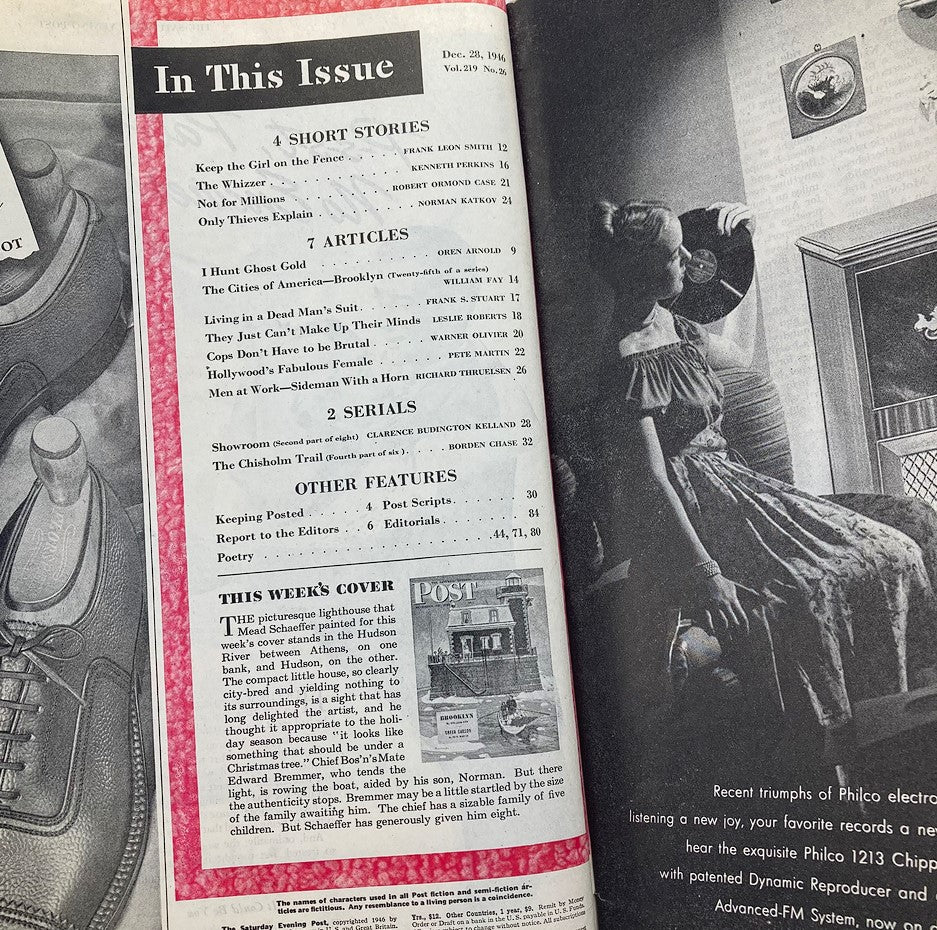


Description
Collector's Note – Why This Issue Matters
The December 28, 1946 issue of The Saturday Evening Post arrives at one of the most psychologically and culturally significant moments in twentieth-century American history — the final days of the first full year of peace after World War II. The war had ended in August 1945, and 1946 had been the year in which America began the enormous and complicated work of reconstitution: veterans returning and reintegrating, war industries converting to consumer production, families reuniting and reforming, and a nation attempting to locate itself in a world fundamentally altered by what had just occurred. The Saturday Evening Post was the primary print vehicle for documenting and reflecting that reconstitution back to its enormous readership, and a December 28 issue — the last full week of the first postwar year — carries the accumulated weight of that transitional moment in concentrated form. William Fay's cover depicting Brooklyn is not simply a piece of urban illustration; it is part of the Post's celebrated "Cities of America" series, a multi-year editorial project that systematically documented American urban life in the immediate postwar period. That Brooklyn appears as the twenty-fifth installment in this series in December 1946 places the cover within a sustained and deliberate journalistic effort to take stock of the American city at the precise moment urban America was being reshaped by the veteran population's return and the beginnings of the suburban migration that would define the postwar decades. Collectors building a serious archive of postwar American cultural history will find the Saturday Evening Post collection an essential resource for the publication's unique role as both mirror and shaper of mid-century American identity.
The "Cities of America" series deserves specific attention as a collector's context for this issue. The Post's decision to commission extended documentary articles on major American cities — each paired with a cover illustration by a commissioned artist — was an editorial project of genuine ambition that produced some of the most substantive contemporaneous journalism about urban American life in the immediate postwar period. William Fay's Brooklyn cover and the accompanying article represent that project's twenty-fifth installment, which means the series had been running for years and had developed a consistent editorial methodology for documenting the particular character, history, and social texture of each city it visited. Brooklyn in December 1946 was a specific and meaningful subject — the most populous of New York's boroughs, home to an enormous veteran population returning from the war, a place of extraordinary ethnic and cultural diversity, and a community navigating the particular tensions of postwar working-class urban life that would define so much of the next decade's American social history. An article devoted to Brooklyn at this precise moment is a primary document of that community before the demographic and physical changes of the late 1940s and 1950s would alter it irreversibly. Collectors focused on Brooklyn history, New York City history, or the urban sociology of postwar America will find this issue particularly rich as a primary source. Those building a broader archive of 1946 across multiple publications will find the 1946 magazine collection a valuable resource for the full range of contemporaneous documentation of this pivotal transitional year.
The editorial content inside this issue extends well beyond the Brooklyn feature and reflects the full scope of The Saturday Evening Post's ambition as America's most widely read general-interest magazine. Four short stories, seven articles, two serial installments, and a full range of regular departments document the magazine operating at its characteristic mid-century peak — fiction from established popular writers alongside journalism covering everything from Hollywood to policing to jazz musicianship to the psychology of indecision. The article "Cops Don't Have to Be Brutal" by Warner Oliver is particularly notable as a document of postwar urban social debate, reflecting the reform-minded civic journalism that the Post pursued alongside its entertainment content. Pete Martin's piece on "Hollywood's Fabulous Female" and the profile of a jazz sideman complete a picture of a publication that covered American popular culture with the same seriousness it brought to politics and social issues. This issue is not simply a Brooklyn artifact — it is a complete and substantial document of American life in the final week of 1946.
About the Publication
The Saturday Evening Post was founded in 1821 and by the mid-twentieth century had become the most widely circulated and culturally influential general-interest magazine in the United States, with a weekly readership measured in the tens of millions and a reach that extended into virtually every demographic and geographic corner of American life. Its editorial format combined short fiction, serialized novels, long-form journalism, political commentary, humor, and the commissioned cover art that had made it one of the most visually recognized publications in America — Norman Rockwell's covers alone had given it an iconic visual identity that defined American popular self-representation for decades. The magazine's audience was the American middle class in the broadest possible definition: farmers and factory workers, housewives and professionals, veterans and their families, all of whom found in the Post's pages a reflection of their own lives alongside aspirational and entertaining content that situated them within a shared national narrative. By 1946, the Post was navigating the same postwar cultural reconstitution it was documenting, adjusting its editorial program to address the concerns and interests of a readership that had been transformed by the war and was now building the America that would define the next quarter century.
Key Highlights Inside
- "The Cities of America — Brooklyn" by William Fay, the twenty-fifth installment of the Post's sustained documentary series on major American cities — a primary source account of Brooklyn in December 1946, documenting one of America's most densely populated and culturally complex urban communities at the precise moment of postwar reconstitution before the demographic and physical transformations of the late 1940s and 1950s.
- "Cops Don't Have to Be Brutal" by Warner Oliver — a piece of postwar civic journalism reflecting the reform debates about urban policing that were active in American cities in 1946, representing the Post's engagement with social issues alongside its entertainment content.
- "Hollywood's Fabulous Female" by Pete Martin and "Men at Work — Sideman With a Horn" by Richard Thruelsen — cultural journalism covering the entertainment industry and jazz musicianship that documents American popular culture in the immediate postwar period from the perspective of the country's most widely read general-interest publication.
- Four short stories by Frank Leon Smith, Kenneth Perkins, Robert Ormond Case, and Norman Katkov — representing the Post's fiction program at its postwar peak, when the magazine was still the most commercially significant venue for popular short fiction in the American publishing landscape.
- Two ongoing serial installments — Clarence Budington Kelland's "Showroom" and Borden Chase's "The Chisholm Trail" — representing the serialized long fiction format that was central to the Post's reader engagement strategy and that gave individual issues their place within longer narrative arcs followed by subscribers week to week.
- December 28, 1946 dating — the last full issue of the first full postwar year, making this a document of the specific cultural and psychological moment when America was taking stock of what it had become after the war and what it intended to become in the years ahead.
Condition & Rarity
Excellent condition with light wear typical for age is a strong and meaningful grade for a Saturday Evening Post issue now nearly eighty years old, and the specific attributes of well-preserved surviving copies of this issue are worth understanding clearly in collector terms. Excellent condition indicates a copy showing only the minimal surface aging consistent with careful long-term storage — very slight toning of the paper edges, perhaps negligible spine stress from decades of shelving — while retaining full structural integrity, clean interior pages, bright cover art, and binding stability that reflects deliberate archival care across a very long period. For a large-format weekly magazine from 1946, excellent condition is a genuinely uncommon outcome that reflects storage history of unusual quality. The absence of a mailing label confirms newsstand origin — a meaningful collector attribute given the Post's enormous subscription base in this period, which means the statistical majority of surviving copies carry labels on their covers. A label-free copy preserves the full visual integrity of William Fay's Brooklyn cover illustration without the adhesive damage or paper residue that subscription labels cause, which is directly relevant to the display value of a cover that is both an artistic commission and a primary historical document. A protective plastic covering applied to a copy in this condition indicates deliberate preservation intent consistent with the excellent overall grade.
Looking for More Issues Like This?
Label-free, excellent-condition copies of the Saturday Evening Post from December 1946 — particularly those featuring the "Cities of America" series with its combination of commissioned cover art and substantive urban documentary journalism — are among the more specifically sought issues for collectors working at the intersection of postwar American history, urban studies, and mid-century magazine art. The broader Saturday Evening Post collection is the most reliable starting point for finding other significant issues from across the publication's long and visually distinguished run, including other installments of the "Cities of America" series and other issues from the immediate postwar years. Collectors building a comprehensive picture of 1946 as a year of American cultural and social reconstitution will find the complete 1946 magazine collection an invaluable resource for locating issues across multiple titles that document this extraordinary transitional year from the multiple perspectives that serious historical research requires.