


Description
Collector's Note – Why This Issue Matters
The November 14, 1936 issue of The Saturday Evening Post is, by any serious literary measure, one of the most substantive single issues the magazine produced in the entire decade of the thirties, and the case for that claim rests primarily on a name that appears in the short fiction section: William Faulkner. "The Unvanquished," listed here without illustration credit, is one of the most significant pieces of fiction the magazine published in that period — a story that Faulkner eventually expanded into the 1938 novel of the same name, set during and after the Civil War and centering on the Sartoris family whose history would recur throughout his Yoknapatawpha cycle. The Post published multiple Faulkner stories across the thirties, and those appearances in a mass-circulation magazine with a readership in the millions represent a fascinating intersection between one of America's greatest literary modernists and the popular fiction market that simultaneously paid his bills and, in many ways, subsidized the more demanding work he was producing simultaneously. A surviving issue with a Faulkner story in original print form is a primary literary artifact regardless of condition, and collectors building serious archives of vintage Saturday Evening Post issues from the literary thirties will recognize this November 1936 edition as among the most significant pieces in that collection on the strength of that single story alone.
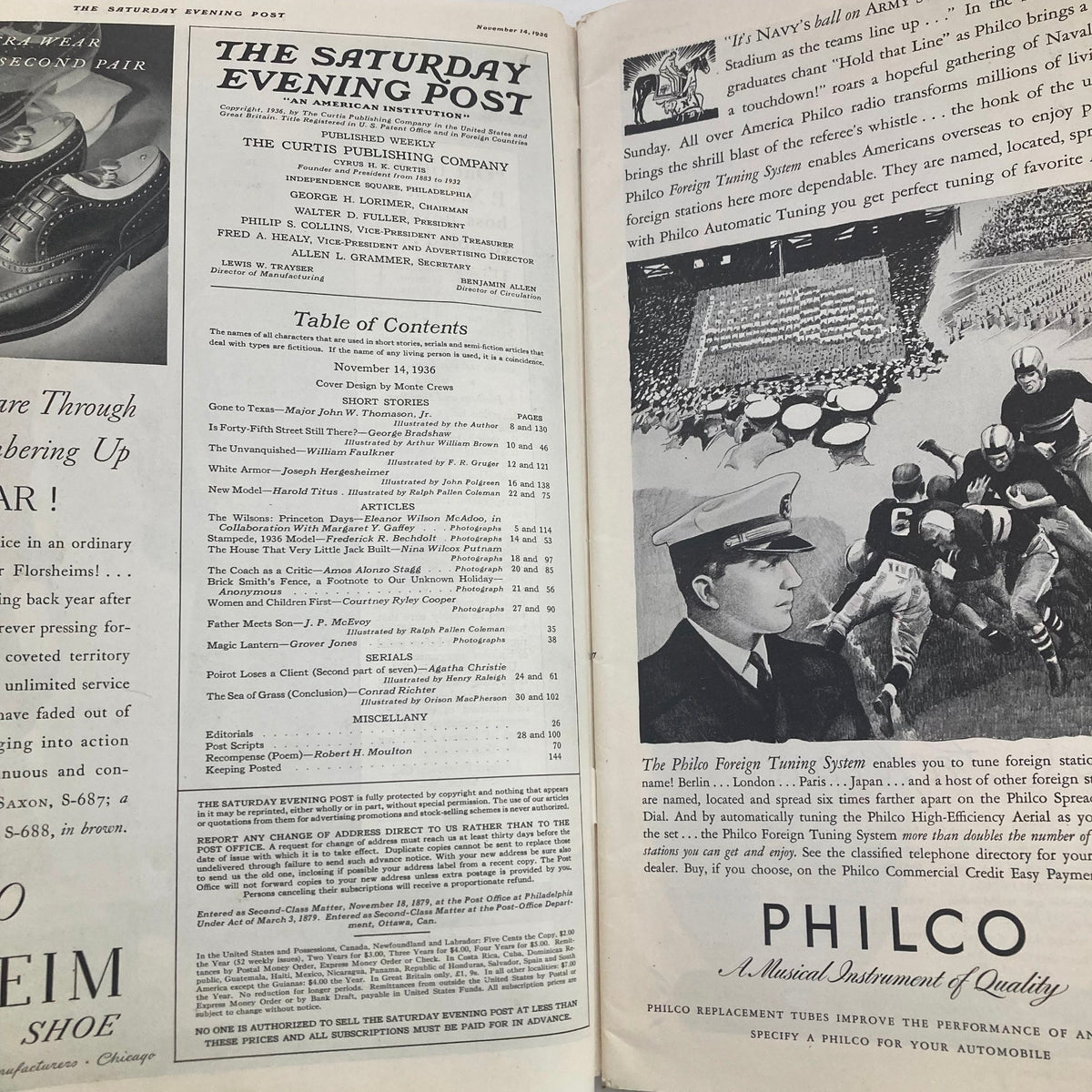
The table of contents documented in this listing is remarkable in its breadth and quality even beyond Faulkner, and reading it carefully reveals a publication operating at the height of its literary ambition and commercial confidence simultaneously. Agatha Christie's serialized "Poirot Loses a Client" — the second of seven installments of the novel later published as Dumb Witness — appears here in its original American magazine form, making this issue a primary document of one of Christie's Poirot novels in the serialized form in which American readers first encountered it. Conrad Richter's "The Sea of Grass" appears in its concluding installment — the novel that would be published in book form in 1937 and eventually adapted into a film starring Spencer Tracy and Katharine Hepburn. Joseph Hergesheimer, a major American literary figure of the twenties and thirties whose reputation has since faded but who was considered a serious novelist during his active years, contributes "White Armor." Amos Alonzo Stagg — one of the most famous and longest-serving football coaches in American history, then in his mid-seventies and still actively coaching — contributes "The Coach as a Critic," a piece that reflects the Post's characteristic ability to attract both literary talent and major cultural figures to its pages in a single issue. The Wilson family article by Eleanor Wilson McAdoo — the daughter of President Woodrow Wilson, writing about her father's Princeton days — adds a political history dimension that connects this issue to one of the more significant American presidencies of the early twentieth century.
The broader context of November 1936 in American life adds further historical depth that makes this issue valuable as a primary document beyond its literary contents. The 1936 presidential election had just taken place on November 3, eleven days before this issue's publication date, producing Franklin Roosevelt's landslide re-election in one of the most decisive victories in American political history. The Great Depression was still ongoing, but the New Deal had transformed the relationship between government and the American economy in ways that were still being debated with great intensity, and the cultural atmosphere of the mid-thirties — its particular combination of hardship, resilience, political passion, and artistic vitality — infuses every dimension of what appears in this issue. Faulkner writing about the Civil War, Richter concluding a story of Western settlement and loss, Christie delivering a murder mystery installment, and the daughter of Woodrow Wilson writing about her father's academic years — the editorial mix is a precise cross-section of what educated American readers were thinking about and being offered in the autumn of 1936. Those assembling a comprehensive archive of 1936 magazines as primary documents of the Depression decade's cultural richness will find this issue one of the most editorially distinguished and historically layered pieces available from that year.
About the Publication
The Saturday Evening Post, founded in its modern form under editor George Horace Lorimer in 1897 and built across the following decades into the most widely circulated and commercially successful general interest magazine in the United States, had by 1936 spent nearly four decades establishing itself as the primary venue for American popular fiction and the central institution of mainstream American magazine culture. At its peak in the twenties and thirties the magazine reached circulation figures that made it genuinely the most widely read publication in the country, and its editorial model — combining short stories, serialized novels, and articles on politics, business, sports, and American life, all illustrated by the finest commercial artists of the era — had defined what an American general interest magazine was and could be for an entire generation of readers and publishers. The Post's fiction program was the most significant in American commercial publishing: it paid the highest rates, attracted the most prominent authors, and reached an audience of tens of millions that no literary quarterly or serious fiction journal could approach. That combination of commercial scale and genuine literary ambition produced issues like the November 14, 1936 edition — a single weekly magazine that contained work by Faulkner, Christie, and Richter alongside major cultural and political figures — that are now recognized as primary documents of American literary and cultural history as well as artifacts of magazine publishing at its mid-century peak.
Key Highlights Inside
- "The Unvanquished" by William Faulkner — one of the stories Faulkner published in the Post during the thirties that he later expanded into his 1938 novel of the same name, set in the Civil War-era South and centered on the Sartoris family that recurs throughout his Yoknapatawpha cycle — appears here in its original American magazine publication form, making this issue a primary literary artifact of one of the greatest American novelists of the twentieth century in the specific form in which millions of American readers first encountered this work.
- "Poirot Loses a Client" by Agatha Christie — the second installment of the seven-part serialization of the novel later published as Dumb Witness — appears in this issue in its original American magazine form, documenting one of Christie's Poirot novels in the serialized publication context that was the primary mode through which American readers first experienced her long-form fiction during this period.
- "The Sea of Grass" by Conrad Richter — the concluding installment of the serialization of the novel that would be published in book form in 1937 and later adapted into a major Hollywood film — appears here at its narrative conclusion, making this issue the primary document of the moment American Post readers first encountered the end of one of the most significant American Western novels of the decade.
- "The Wilsons: Princeton Days" by Eleanor Wilson McAdoo, daughter of President Woodrow Wilson, in collaboration with Margaret Y. Gaffey, provides a firsthand biographical account of Woodrow Wilson's academic career at Princeton — a primary document of presidential history from the most intimate possible perspective, published in a mainstream magazine less than twenty years after Wilson's presidency had ended and while many figures who had known him personally were still alive and engaged with his legacy.
- "The Coach as a Critic" by Amos Alonzo Stagg — then in his mid-seventies and one of the most storied figures in the history of American college football — reflects the Post's characteristic editorial ability to attract major American cultural and sporting figures alongside its literary talent, giving this issue a breadth of notable contributors that distinguishes it from more narrowly literary publications of the same period.
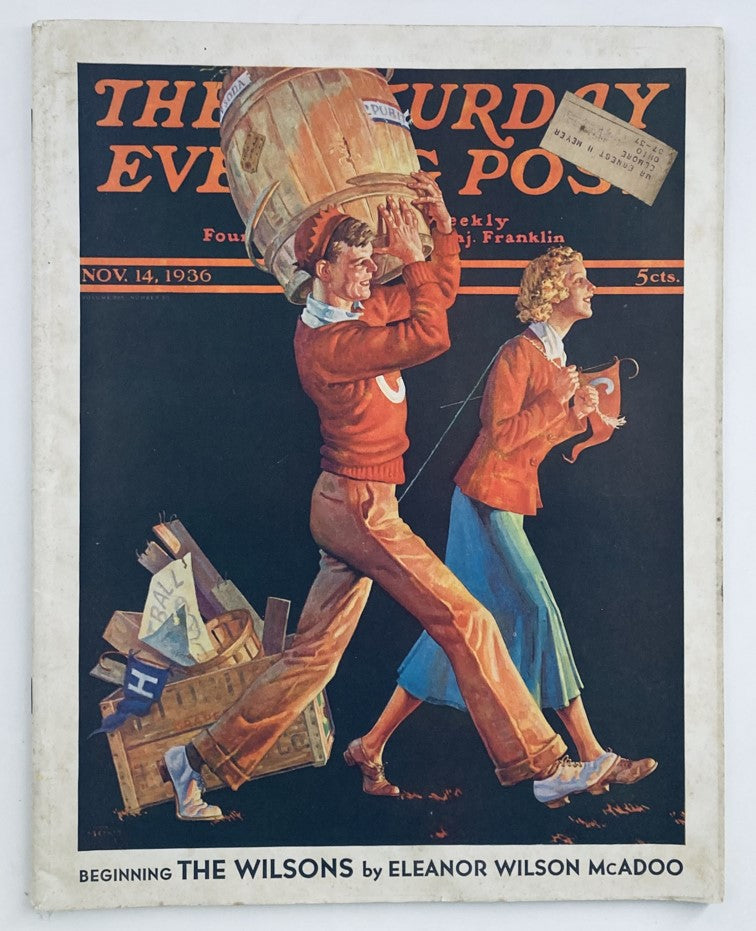
- The cover design by Monte Crews, along with illustrations throughout the issue by noted commercial artists including Henry Raleigh, Ralph Pallen Coleman, and Orson MacPherson, makes this issue a significant document of American commercial illustration at the height of its prestige and influence — a period when Post cover and interior illustration was among the most widely seen and culturally influential visual art being produced in the United States.
Condition & Rarity
Surviving copies of the November 14, 1936 Saturday Evening Post in collectible condition represent a meaningful fraction of a substantial original print run — the Post of this era was the most widely circulated magazine in the country, which means more copies were produced than for most other publications of the period, but ninety years of attrition and the lightweight paper stock on which the magazine was printed have reduced the surviving population of well-preserved examples considerably. The Post of this era was printed primarily on newsprint-adjacent paper for its editorial pages with slightly heavier stock for its illustrated covers, and the characteristic aging patterns of mid-thirties Post issues are well established: significant tanning and possible brittleness to outermost pages, potential foxing on interior spreads, spine softening and possible cracking from decades of storage, and the edge wear and small tears that accumulate over nine decades of handling and varied ownership. The listing directs collectors to the provided photographs for condition assessment rather than specifying detailed verbal grades — an honest approach for a publication of this age whose individual surviving copies each present a specific and individual condition profile best evaluated visually. Collectors assessing any surviving copy of this issue should prioritize page completeness and the legibility of the fiction content — particularly the Faulkner and Christie installments, which are the primary literary assets of this specific issue — alongside the structural assessments of cover attachment and spine integrity that determine a copy's long-term stability as an archival object. Protective plastic sleeve storage is the appropriate preservation standard for newsprint-based periodicals of this type and age.
Looking for More Issues Like This?
The November 14, 1936 Saturday Evening Post is one of the more editorially extraordinary issues the magazine produced in its Depression-era run — a single weekly that brings together Faulkner, Christie, Richter, and the daughter of a United States president in original first publication form, alongside major figures in American sporting and cultural life — and copies that retain complete and legible literary content are consistently pursued by collectors working across multiple areas of American literary and magazine history. The vintage Saturday Evening Post collection at OriginalMagazines.com brings together a carefully assembled range of issues from across the publication's remarkable run, and is the essential starting point for anyone building a serious archive of American fiction in its original popular magazine publication context. For collectors drawn to the full cultural richness of the Depression decade — a period of extraordinary literary and artistic productivity that the Post's pages documented with unique completeness and reach — the 1936 magazine collection offers a varied and historically significant cross-section of the year across multiple titles and editorial perspectives.