




Description
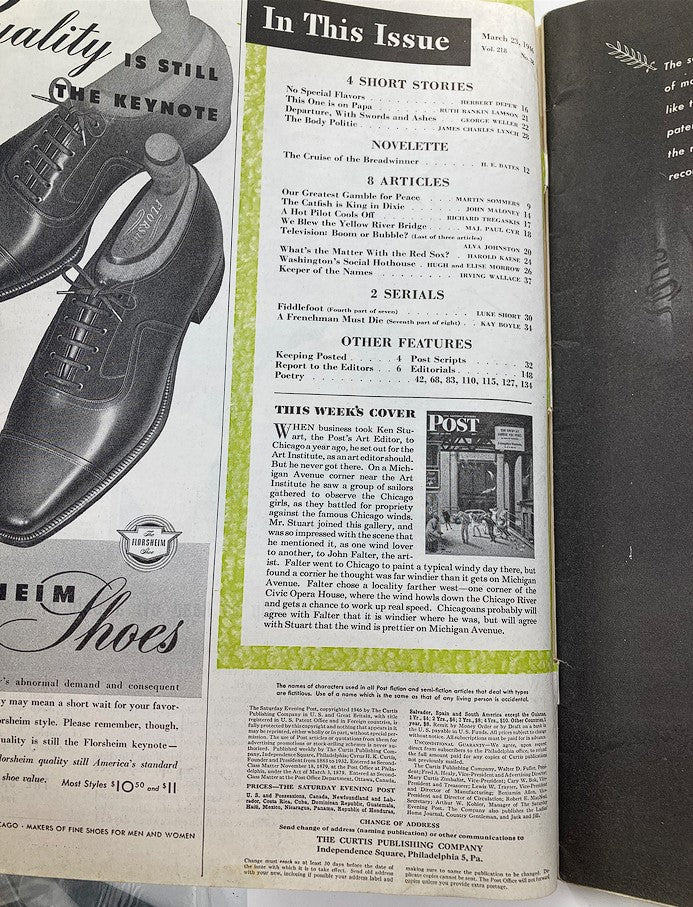
Introducing the timeless piece of history: The Saturday Evening Post dated March 23, 1946. This vintage magazine encapsulates an essential narrative with its compelling cover story, "Our Greatest Gamble For Peace." As the world emerged from the shadows of World War II, this issue reflects the challenges and optimism that defined a nation striving for peace and recovery.
This vintage magazine is not just reading material; it is a collectible treasure that offers insight into a pivotal time in American culture. The Saturday Evening Post, renowned for its rich storytelling and captivating illustrations, serves as a window into the aspirations and anxieties of the American public in the post-war era. Each article and visual serves to engage and enlighten, making it a must-have for collectors and history enthusiasts alike.
The significance of this issue cannot be overstated. It provides a unique glimpse into the thoughts and sentiments prevalent during a crucial juncture in history, making it a valuable addition to any collection of vintage magazines. This particular edition is perfect for display, conversation starters, or simply to enjoy the nostalgia and cultural commentary of the time.
This collectible magazine is in excellent condition, maintaining its charm with slight wear typical for its age, which only adds to its character and historical value. Note that care must be taken to examine the item, as any marks or rips are part of its rich story and tradition.
- Original publication from 1946, providing authentic insight into the post-war era.
- Protective plastic covering included to keep your magazine in pristine condition.
We ensure your purchase is handled with care, offering combined shipping for those interested in multiple items. Each order will be packaged thoughtfully to assure safe delivery to your doorstep.
Don't miss out on this opportunity to own a unique piece of Americana. Whether you are a passionate collector or looking for the perfect gift, this edition of The Saturday Evening Post is certain to enrich your vintage magazine collection.
Embrace the charm of the past and get your hands on this vintage gem today!
Note: The content list below is digitally transcribed for searchability. Please refer to the photos for the exact Table of Contents.
Inside This Issue (Full Table of Contents):-
4 Short Stories
- No Special Flavor — Robert Hardy Andrews
- Dipsone in Our Papa — George Fassett
- The Drive, With Smoke and Ashes — George Lynch
- They Don’t Notice — James Charles Lynch
-
Novelette
- The Cruise of the Breadwinner — H. E. Bates
-
8 Articles
- Our Greatest Gamble for Peace — Martin Sommers
- The Cities of America: Baltimore — John Gunther
- A Hot Pilot Cools Off — Richard Thruelsen
- To Hell with Yellow River Bridge — Maj. Paul F. Davis
- Television Boom or Bubble? — Alvin Moscow
- What’s the Matter with the Red Sox? — Harold Moore
- Washington’s Social Hotchpotch — E. J. Kahn, Jr.
- Keeper of the Name — Irving Wallace
-
2 Serials
- Fiddlefoot (Fourth part of seven) — Luke Short
- A Frenchman Must Die (Seventh part of eight) — Kay Boyle
-
Other Features
- Keeping Posted
- Report to the Editors
- Poetry
- Post Scripts
- Editorials
-
This Week’s Cover
- When business comes to Chicago, the Post’s Art Editor, to study a year ago he sent our artist, John Falter, as an art editorialist. But he never there. On a Michigan Avenue corner near the Art Institute he saw a group of sailors gathered to observe the Chicago girls, as they strolled for propriety against the famous Chicago wind. Mr. Stuart joined this gallery, and was so impressed with the scene that he mentioned it, as one would love to another editor. Falter, the art editor, learned it from Stuart, and he decided to paint a typical windy day there, but found a corner he thought was rather than it gets on Michigan Avenue. Falter chose a location farther west—one corner of the Civic Opera House, where the wind blows down the Chicago River and gets a chance to work up real speed. Chicagoans probably agree with Stuart that the windier where he was, but will agree with Stuart that the wind is windier on Michigan Avenue.