
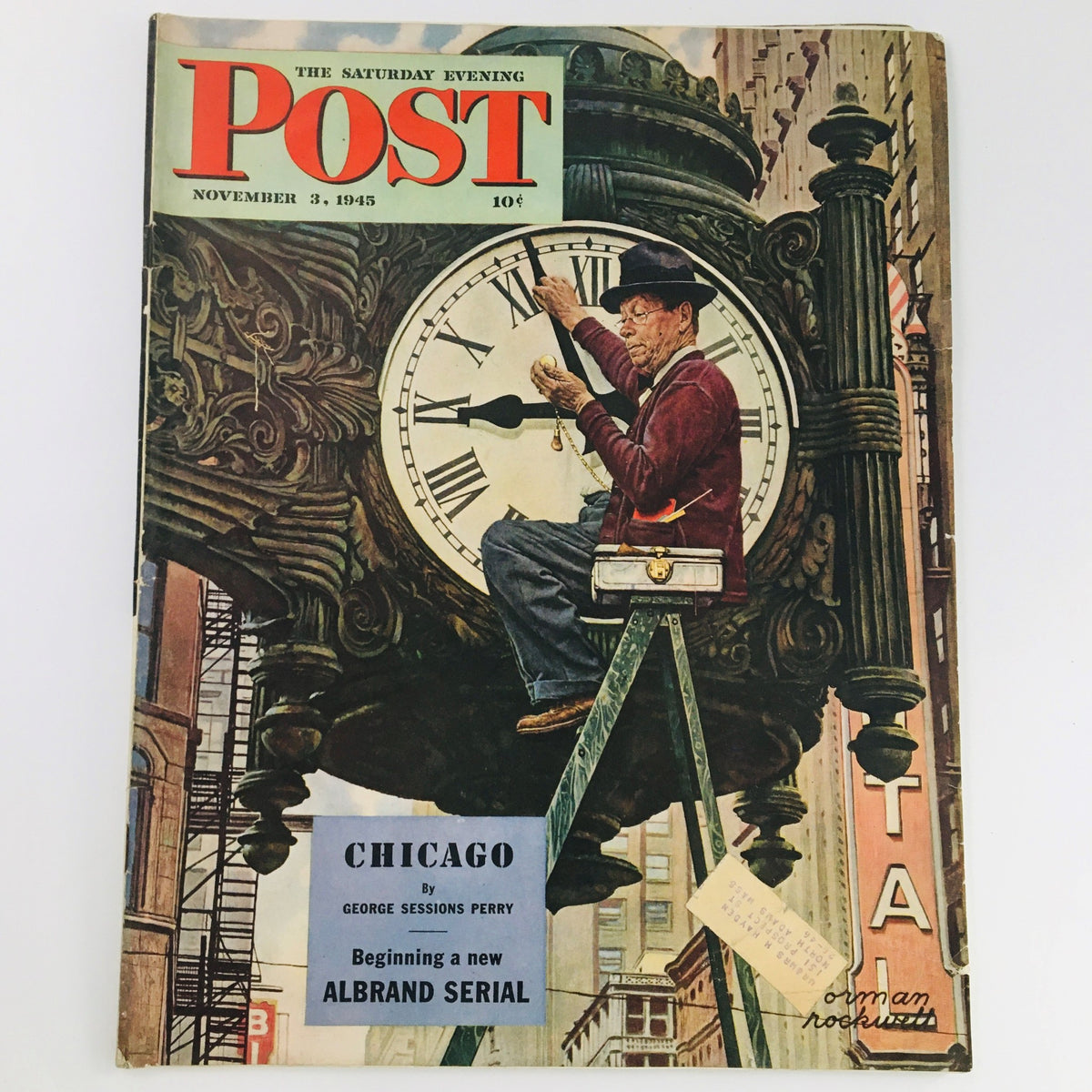

Description
Collector's Note – Why This Issue Matters
November 3, 1945 fell in the extraordinary weeks that followed the formal end of World War II — Japan had surrendered on September 2, and the United States was only two months into the long, complicated process of becoming a peacetime nation again. Millions of servicemen were returning home, families were reuniting, and the country was collectively exhaling after nearly four years of total war. Norman Rockwell understood this moment as well as any artist in America. His covers for The Saturday Evening Post had accompanied the nation through the entire war — from the famous Four Freedoms series of 1943 to countless images of soldiers, home front workers, and anxious families — and his postwar work carried that same emotional intelligence into the new uncertainty of peace. A Rockwell cover from this precise season is not merely decorative. It is a primary record of how mainstream America was being invited to feel about itself at one of the most consequential transitions in the nation's history.
Rockwell's relationship with The Saturday Evening Post spanned 47 years and more than 300 covers, and the issues from 1945 sit at a particularly charged moment in that collaboration. The specific illustration on this November 3 cover would reflect the visual language Rockwell had spent years perfecting — intimate, warmly observed, technically masterful, and rooted in a distinctly American sense of ordinary life rendered extraordinary. For collectors building a serious archive of Saturday Evening Post covers from across its golden era, the 1945 issues occupy a special category: they document the emotional terrain of America at the exact moment the modern world began. Rockwell himself would later describe the postwar years as a period of creative restlessness, sensing that the uncomplicated optimism of his earlier work was being tested by a more complicated reality.
The broader historical context of magazine publishing in 1945 also matters here. Print media was at the absolute apex of its cultural authority. Television was not yet a household presence, and weekly magazines like the Post were the primary way millions of Americans engaged with news, fiction, illustration, and advertising simultaneously. A surviving copy from this year is a remarkably intact time capsule — editorial content, advertisements, fiction, and art all frozen together in a single artifact.
About the Publication
The Saturday Evening Post, founded in 1821 and revitalized under editor George Horace Lorimer in the early twentieth century, was by the 1940s the most widely circulated magazine in the United States, reaching several million households weekly. Its format combined short fiction, serialized novels, political commentary, and journalism with the illustrated covers that became its most enduring cultural legacy. The magazine self-consciously positioned itself as a mirror of mainstream American life — aspirational, optimistic, and rooted in the values of the white middle class — and its covers, particularly those by Rockwell, functioned almost as a weekly national self-portrait. By 1945, the Post was an institution, and its covers were discussed, clipped, and kept in a way that few other periodicals could claim.
Key Highlights Inside
- Cover illustration by Norman Rockwell, one of the most celebrated and collectible artists ever associated with American periodical publishing, from the defining final months of his wartime and immediate postwar period.
- Editorial content consistent with the Post's November 1945 moment: the magazine would have been engaging directly with demobilization, the return of veterans, reconversion of the wartime economy, and the social adjustments of early peacetime America.
- Fiction and serialized content typical of the Post's format, which regularly featured work by major American authors of the era alongside its journalism and illustration.
- Period advertising throughout — itself a significant historical record of American consumer culture in the immediate postwar moment, when manufacturers were transitioning back from wartime production to civilian goods.
- Note: Specific interior article titles, fiction bylines, and features beyond the cover illustration have not been independently confirmed for this issue. The above reflects what is verifiable from the publication's known editorial format and the historical context of the date.
Condition & Rarity
Surviving copies of this issue present the condition profile typical of subscriber copies that passed through regular household use before entering collections. A Good rating with minor wear throughout is an honest and accurate designation for an eighty-year-old weekly magazine: it indicates structural integrity — covers attached, pages present and legible — with the softening and light handling marks that any well-read copy of this age will show. The presence of a subscriber address label on the front cover is characteristic of the vast majority of Post issues that survive from this era, as subscription copies far outnumbered newsstand copies in circulation; collectors generally treat a clean, intact label as evidence of provenance rather than a detraction. A plastic protective sleeve signals that a previous owner recognized the issue's collectibility and took deliberate steps to arrest further deterioration. For Rockwell cover issues specifically, condition of the cover illustration itself — color retention, absence of tears or creasing across the image — is the primary criterion collectors apply when evaluating any surviving copy.
Looking for More Issues Like This?
Norman Rockwell Saturday Evening Post covers from the 1940s are among the most actively sought issues in the entire vintage magazine market, and the 1945 run in particular moves steadily whenever clean copies surface. If this issue has already found a home, the full Saturday Evening Post collection at OriginalMagazines.com is one of the best places to continue the search across the publication's long run. Collectors focused on this specific moment in American history should also explore the complete 1945 magazines collection, which gathers significant issues from across multiple major publications from the final year of World War II and the dawn of the postwar era.