


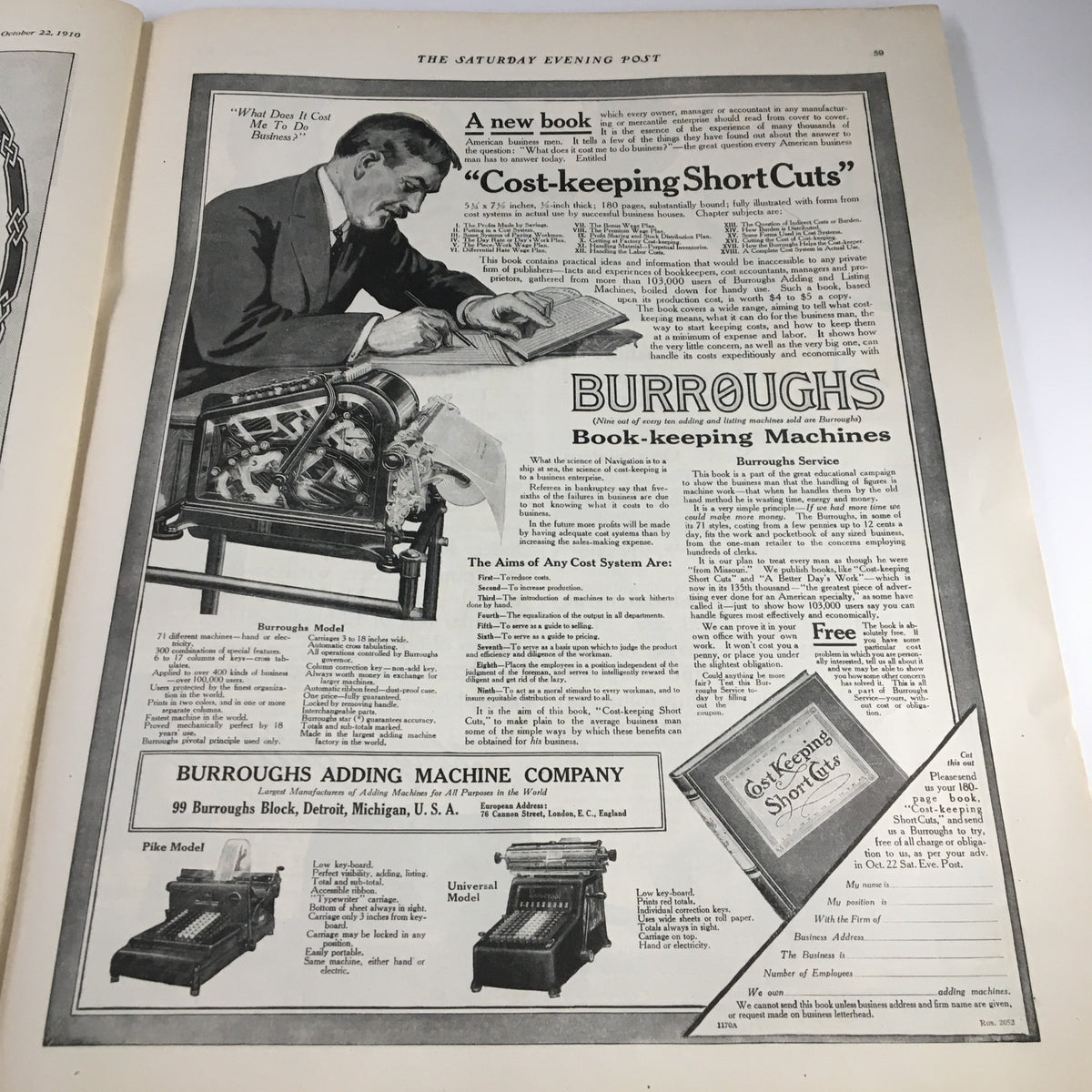


Description
Collector's Note – Why This Issue Matters
The October 22, 1910 issue of The Saturday Evening Post, with its featured piece "In The Old Days of The Old Lyceum," documents the publication at the absolute zenith of its Edwardian-era authority and one of its most remarkable periods of editorial ambition. Under the editorship of George Horace Lorimer, who had taken the helm in 1899 and would lead the magazine until 1936, The Saturday Evening Post had by 1910 become the most widely circulated weekly magazine in the United States — a publication that reached into millions of American households and defined the aspirations, anxieties, and entertainments of the middle-class reading public. A feature titled "In The Old Days of The Old Lyceum" reflects a characteristic strand of the Post's editorial identity in this period: the nostalgic and historically reflective piece that connected its readership to American cultural traditions that were receding within living memory. The Lyceum lecture circuit — the network of public halls, churches, and educational institutions that had brought speakers, performers, and lecturers to communities across America throughout the nineteenth century — was a genuinely significant institution whose decline by 1910 was already being mourned by those who had experienced it. For collectors building an archive of Saturday Evening Post issues from across its long publication history, an October 1910 edition is a document of the publication at the height of its Lorimer-era cultural authority.
The October 22, 1910 date places this issue in a specific and historically charged moment in American life. The Progressive Era was at its most politically active — Theodore Roosevelt had completed his presidency in 1909 and William Howard Taft was in his first year in office, while the reform movements that would produce the constitutional amendments of the following decade were gaining momentum. The Saturday Evening Post under Lorimer was not a political publication in the activist sense, but it was deeply engaged with the texture of American life and the values of the prosperous middle class that formed its readership. A nostalgic piece on the Lyceum era in October 1910 was therefore engaging with a cultural tradition that its readership would have recognized as formative — the public lecture as a form of democratic education and entertainment that had shaped American intellectual life before the age of mass media. Publications from 1910 document American life at a specific Progressive Era hinge point, and The Saturday Evening Post provides its characteristic broad-circulation perspective on that moment.
About the Publication
The Saturday Evening Post, which traced its origins to 1821 and had been revitalized under George Horace Lorimer beginning in 1899, was by October 1910 the most widely circulated weekly magazine in the United States, with a readership of several million and a cultural authority that made it the definitive publication of American middle-class life in the early twentieth century. Its format combined fiction — including work by the most prominent American authors of the era — with essays, political commentary, business journalism, and the nostalgic historical features exemplified by the Lyceum piece. Its covers, illustrated by some of the period's most accomplished commercial artists, were themselves cultural artifacts, and individual issues from the Lorimer era are among the most sought-after in the Post's long publishing history.
Key Highlights Inside
- "In The Old Days of The Old Lyceum" — a nostalgic feature engaging the history and cultural significance of the American Lyceum lecture circuit, a nineteenth-century institution of public education and entertainment whose decline by 1910 made retrospective treatment both timely and resonant for the Post's readership.
- October 22, 1910 publication date — placing this issue in the Progressive Era at the height of the Saturday Evening Post's Lorimer-era cultural dominance, when the publication was reaching its peak circulation and influence as the defining periodical of American middle-class life.
- Subscriber copy with address label — a characteristic attribute of Post issues from this period, when home delivery through subscription was the primary distribution method for the magazine's enormous readership.
- Note: Specific additional fiction, essays, and features beyond the confirmed Lyceum piece are unverified for this issue. The above reflects what is documented and consistent with the Saturday Evening Post's well-established editorial format during this period.
Condition & Rarity
Good condition with minor wear throughout and some marks is an honest and appropriate assessment for a publication now over 115 years old. The presence of a mailing label on the front cover identifies this as a subscriber copy — the standard distribution method for the Post during this period, when its enormous subscription base dwarfed its newsstand sales. Label presence is the norm rather than the exception for surviving copies of 1910-era Post issues, and label-free examples are considerably less common. The plastic protective covering indicates deliberate preservation storage. For a weekly publication of this age printed on the paper stock typical of early-twentieth-century commercial magazines, the primary condition factors to assess in any surviving copy are the degree of toning and brittleness in the paper, cover integrity, and the soundness of the binding, which bears the most structural stress over 115 years of storage.
Looking for More Issues Like This?
A 1910 Saturday Evening Post in good, readable condition is a genuinely meaningful find from one of the most important periods in American magazine publishing history — the Lorimer era at its height, reaching the broadest readership any American weekly had achieved to that point. If this issue has already been claimed, the full archive of Saturday Evening Post issues spans the publication's extraordinary run across multiple decades and is worth exploring for other significant editions. The broader 1910 magazine collection offers additional context for this specific Progressive Era year in American life and publishing history.