



Description
Collector's Note – Why This Issue Matters
The March 1970 issue of The Wrestler featuring Buddy Rogers, Terry Funk, and Bill Watts on its cover brings together three figures who collectively represent the full breadth of professional wrestling's territorial era — and does so at a moment when each was at a distinctly interesting point in his career. Buddy Rogers was by 1970 a figure of genuine wrestling legend, the original "Nature Boy" whose career had spanned nearly three decades and who had been the first man to hold the NWA and WWWF World Heavyweight Championships simultaneously in the early 1960s. His flamboyant persona, his ring psychology, and his influence on the development of the heel character in American professional wrestling had been foundational — Ric Flair, who would inherit the "Nature Boy" name and style in the 1970s, was building his persona directly on Rogers's template. Terry Funk in March 1970 was in the early phase of what would become one of the most remarkable careers in wrestling history — a young Texas brawler still developing the rough-edged, emotionally intense style that would eventually make him one of the most respected and most resilient performers in the sport's history. And Bill Watts was establishing himself as one of the most physically imposing and credible big men in the business, a former Oklahoma football player whose combination of genuine athletic ability and growing ring skills made him a compelling figure in the territories where he worked. For collectors who focus on vintage issues of The Wrestler magazine from the territorial era, a cover combining these three figures from March 1970 is a primary document of professional wrestling at a specific and historically interesting generational moment.
The March 1970 date places this issue at a specific point in the territorial system's history that collectors who specialize in this period will recognize as significant. The NWA was still the dominant organizational framework of American professional wrestling, with regional promoters maintaining their territories through working relationships and the shared use of the NWA championship as a promotional tool. The wrestling landscape of 1970 was genuinely pluralistic in ways that the subsequent national consolidation of the 1980s would permanently alter — different regions had their own stars, their own title lineages, and their own distinctive wrestling cultures, and figures like Rogers, Funk, and Watts moved through this landscape with the specific regional identities and storylines that the territorial system made possible. A Wrestler magazine cover from March 1970 documenting these three figures is therefore not merely a celebrity portrait but a document of how the territorial system understood and presented its own history and its current stars simultaneously — the past (Rogers), the developing present (Funk), and the current main event landscape (Watts) all visible in a single editorial choice. Collectors building archives around the wrestling magazines of 1970 will find this issue a particularly revealing cross-section of the territorial era's generational structure.
The listing notes that this issue does not include its original poster — a detail worth flagging for collectors who approach The Wrestler as a complete physical artifact rather than simply an editorial document. Wrestling magazines of this era regularly included pull-out poster inserts featuring major stars, and these posters are frequently among the most actively collected individual items from this period of wrestling memorabilia. A complete copy of a Wrestler issue from 1970 with its original poster intact commands meaningfully different collector attention than an otherwise identical copy without one, and serious collectors should note this distinction when evaluating the issue's completeness and positioning it within their archives.
About the Publication
The Wrestler was one of the most widely distributed and most avidly read professional wrestling magazines of the territorial era, published by the Stanley Weston Group — the same publishing operation behind Pro Wrestling Illustrated — and aimed at the dedicated American wrestling fan audience that followed the NWA territories and wanted more coverage than regional television programming could provide. Like its stablemates in the Weston Group's sports magazine stable, The Wrestler maintained a careful relationship with kayfabe, presenting wrestling as a legitimate competitive sport while its knowing readership understood the performance dimensions of what they were reading. Its coverage of the full NWA territorial landscape gave it a breadth and a documentary value for the era that regional publications could not match, and its issues from the late 1960s and early 1970s are among the most actively collected primary sources for the territorial system's history.
Key Highlights Inside
- A cover feature connecting three figures who collectively represent the generational span of American professional wrestling in 1970 — Buddy Rogers as the foundational legend whose career and persona had shaped the sport's visual and character language for a generation; Terry Funk as the emerging young talent whose style and intensity would eventually make him one of the most respected performers in the sport's history; and Bill Watts as the credible main event presence whose combination of genuine athleticism and ring skill was making him one of the most compelling figures in the territories where he worked.
- Coverage of the NWA territorial landscape as it existed in early 1970 — a period when the territorial system was operating with its characteristic combination of regional specificity and shared championship infrastructure, producing the kind of varied and locally rooted wrestling culture that the national consolidation of the following decade would permanently alter.
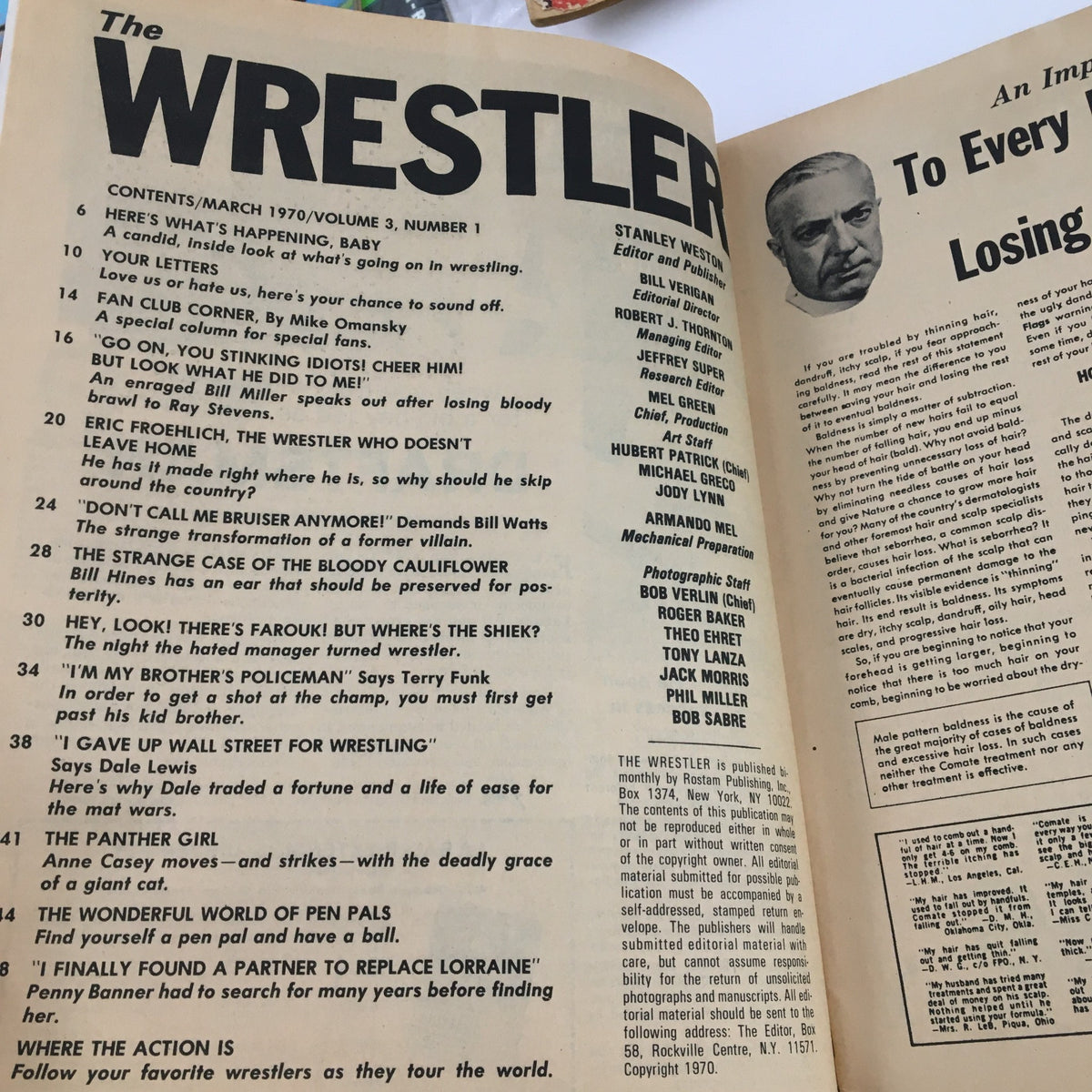
- Articles and interviews consistent with The Wrestler's editorial approach to the sport — coverage that engaged with the narrative and personality dimensions of professional wrestling within the kayfabe framework that defined wrestling journalism of the era, providing the kind of character development and storyline context that television coverage of the period could not consistently supply.
- Note: The original poster insert has been removed from this issue, which collectors should factor into their assessment of the issue's completeness relative to examples that retain their original inserts.
Note: Specific interior article titles, additional featured wrestlers, and further editorial details beyond the cover subjects are unconfirmed for this issue from available sources. The highlights above reflect verifiable historical context drawn from the cover subjects, publication date, and the well-documented editorial character of The Wrestler during this period.
Condition & Rarity
This copy is identified as a no-label newsstand edition in good condition with minor wear consistent with its age — a solid condition profile for a wrestling magazine now more than fifty years old that has been stored rather than actively handled. The newsstand provenance and absence of a mailing label preserve the cover as originally printed, without subscription label adhesive damage. The minor wear falls within the expected range for good condition without compromising the structural integrity or readability of the issue. The plastic protective sleeve provides ongoing conservation value and indicates preservation-conscious storage. The disclosed absence of the original poster insert is a meaningful completeness consideration that collectors should weigh against the issue's otherwise good condition — a copy without its poster represents a different and typically less sought-after form of the issue than a complete example, and this distinction should inform the collector's assessment of how it fits within a serious territorial-era archive. For a March 1970 Wrestler featuring Rogers, Funk, and Watts, a no-label newsstand copy in good condition with readable interior pages represents a legitimate historical acquisition, with the missing poster being the primary completeness caveat for comprehensive collectors.
Looking for More Issues Like This?
A Rogers, Funk, and Watts cover Wrestler from March 1970 is a historically specific and generationally rich find within the territorial-era wrestling magazine collector market, and if this issue has already found a home, the broader vintage Wrestler magazine collection at OriginalMagazines.com is an excellent resource for other significant covers and editorial issues from the publication's remarkable run documenting the NWA territorial system at its most pluralistic and most historically interesting phase. Collectors focused on the wrestlers, territories, and cultural atmosphere of professional wrestling's early-1970s landscape will find it well worth exploring the full 1970 magazine archive, which brings together wrestling and general interest publications from one of the territorial era's most consequential and most actively collected years.