


Description
Collector's Note – Why This Issue Matters
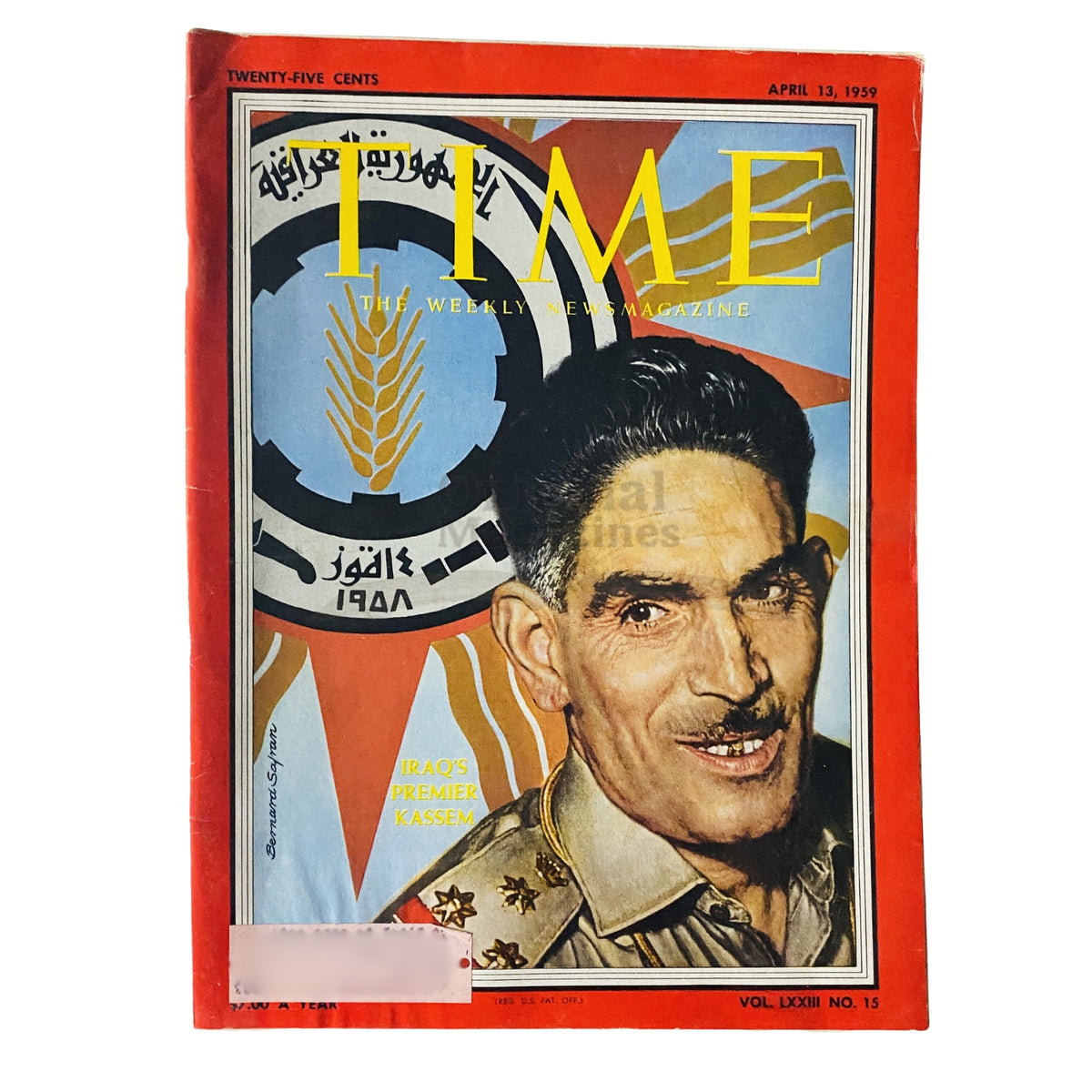
This April 13, 1959 issue of Time Magazine features Iraqi Premier Abdul Karim Kassem on its cover under the title "Iraq's Premier," with cover art by Bernard Safran, arriving nine months after Kassem and a small circle of fellow military conspirators violently overthrew the Iraqi monarchy in the early hours of July 14, 1958. That coup brought a brutal end to the very political order this same magazine had profiled less than two years earlier, in its June 1957 cover feature on longtime Premier Nuri as-Said: King Faisal II was killed as royal forces stormed the palace, and Nuri as-Said himself, having attempted to flee disguised as a woman, was hunted down and killed by the mob the following day, his body dragged through the streets of Baghdad. This issue's cover story, titled "The Dissembler," picks up that story directly, portraying Kassem's Iraq as a nation gripped by ongoing terror, political purges, and an estimated five thousand political prisoners, a stark and violent contrast to the apparent stability Time's own coverage had described in Nuri's Iraq just two years prior. For collectors following the Iraqi monarchy's history through this magazine's own coverage, this issue offers a genuinely direct continuation of that earlier story, documenting the specific and violent aftermath of the political order Time had profiled so differently in 1957.
Time's profile portrayed Kassem as a genuinely complex and contradictory figure: a modest, teetotaling career soldier who had quietly nursed plans for revolution for over two decades while serving as one of the monarchy's most trusted officers, yet who proved strikingly inexperienced in the actual business of governing once he seized power. The piece traced his path from the Royal Military College and distinguished service in the 1948 Palestine war through a British officers' training course in Devizes, England, where classmates reportedly nicknamed him "the snake charmer" for his ability to argue colleagues into improbable courses of action during field exercises. Central to the article's narrative was Kassem's fraught relationship with his former revolutionary partner, Colonel Abdul Salam Aref, who had once proclaimed himself "Kassem's son" but was ultimately exiled, arrested, and sentenced to death by a Communist-dominated revolutionary court after the two men split over Aref's enthusiasm for closer ties with Egyptian President Nasser's United Arab Republic. That personal and political rupture, according to Time's account, opened the door for the Iraqi Communist Party to expand its influence dramatically throughout Kassem's first nine months in power.
The issue's broader analysis situated Kassem's Iraq within the most anxious currents of Cold War strategic thinking, describing a nation that had already withdrawn from the Western-aligned Baghdad Pact and expelled British air forces from their base near Baghdad, seemingly drifting toward becoming a Soviet client state at a moment when the Eisenhower administration was closely watching Middle Eastern alignments. The article detailed a recently signed economic assistance agreement between Iraq and Moscow worth over one hundred million dollars, alongside the arrival of Soviet technicians to help build new Iraqi factories, framing these developments as major and unwelcome advances for Soviet influence at the strategic heart of the Middle East. Time's coverage also documented, in considerable detail, the Mosul revolt of March 1959, a Nasserist-backed uprising against Kassem that had been crushed just weeks before this issue's publication with the help of Communist militia and Kurdish tribal fighters, alongside the televised revolutionary tribunals through which Kassem's Communist allies were consolidating power by publicly trying and executing his political opponents.
Taken together with the earlier June 1957 Time cover on Nuri as-Said, this issue offers collectors a genuinely rare, two-part documentary arc capturing the complete rise and fall of one Iraqi political order and the violent birth of its immediate successor, told through the same magazine's own contemporaneous reporting. For collectors specifically building a collection around 20th-century Iraqi and Middle Eastern political history, pairing this issue with its 1957 predecessor offers an unusually direct before-and-after narrative rarely available within a single publication's own back catalog. This issue stands as a substantive primary source for understanding how the American press processed one of the Cold War's most consequential Middle Eastern power shifts as it was actively unfolding.
About the Publication
Time Magazine was founded in 1923 by Henry Luce and Briton Hadden and grew into one of the most influential news and current affairs publications in American history, known for its weekly coverage of politics, business, culture, and international affairs. The magazine's cover feature became one of its most recognizable editorial conventions, regularly spotlighting major international figures during moments of significant political upheaval, often accompanied by extensively reported features examining both personal biography and broader strategic stakes. Time's Middle Eastern coverage throughout the 1950s reflected the region's growing centrality to American Cold War strategy, particularly as oil wealth, Arab nationalism, and competing superpower influence reshaped the political landscape of countries like Iraq in rapid succession. The magazine maintained correspondents in the region capable of witnessing and reporting on events like Iraq's revolutionary tribunals firsthand, giving its coverage of this period a genuinely documented, on-the-ground quality beyond secondhand analysis. Time's audience was broad and national, reaching a readership across the country interested in comprehensive, digestible coverage of international developments and the leaders shaping American foreign policy concerns abroad. Advertising within the magazine during this period reflected products aimed at a broad, educated, and professionally engaged national readership. Time's willingness to track a single volatile national situation across multiple cover stories, as its coverage of both Nuri as-Said in 1957 and Kassem in 1959 demonstrates, reflected the magazine's broad editorial ambition to document significant international power shifts across their full unfolding arc. This issue exemplifies that longitudinal editorial approach clearly.
Key Highlights Inside
- A cover feature titled "The Dissembler," profiling Iraqi Premier Abdul Karim Kassem nine months after his July 1958 coup. The piece traces his biography from the Royal Military College through his quiet, decades-long planning of revolution. It portrays Kassem as a genuinely contradictory figure, modest in manner but increasingly dependent on Communist political support.
- Detailed coverage of the July 1958 coup itself, including the deaths of King Faisal II and former Premier Nuri as-Said. This issue offers a direct continuation of the story covered in Time's own June 1957 cover feature on Nuri as-Said. It documents the violent conclusion of the political order profiled in that earlier issue.
- Coverage of Kassem's fractured relationship with former revolutionary partner Colonel Abdul Salam Aref, who was exiled, arrested, and sentenced to death after favoring closer ties with Nasser's United Arab Republic. This rupture opened space for growing Iraqi Communist Party influence. It represents a central turning point in the article's broader narrative.
- Analysis of Iraq's withdrawal from the Baghdad Pact and expulsion of British air forces, alongside a substantial new economic agreement with the Soviet Union. This content situates Iraq within the broader anxious currents of Cold War strategic competition in the Middle East. It reflects Western diplomatic concern over Iraq's apparent drift toward Soviet alignment.
- Firsthand documentation of Iraq's revolutionary "People's Court" and its televised political tribunals, witnessed directly by a Time correspondent. These tribunals reflected the Iraqi Communist Party's growing practical control over the machinery of government. This coverage offers a genuinely detailed, on-the-ground account of Kassem-era Iraq's internal political theater.
Condition & Rarity
This issue is described as being in excellent condition, showcasing light wear typical for its age while maintaining its overall integrity. At this grade, collectors can generally expect strong cover presentation, minimal handling marks, and good overall structural preservation, an outcome that is notably less common among widely circulated 1950s newsweeklies than among more specialized or limited-run publications. Time Magazine issues from this period were produced in large volumes and read broadly across the country, meaning surviving copies in excellent condition represent a smaller proportion of original print runs than the sheer circulation numbers might suggest. Cover feature issues connected to significant and dramatic Middle Eastern political developments, particularly one offering such a direct narrative continuation of an earlier documented cover story, often draw additional collector interest beyond the magazine's general publishing history. A plastic protective covering, when present, functions as a stabilizing measure intended to preserve a copy's current condition rather than a factor that changes its underlying grade. Collectors evaluating any surviving copy of this issue should examine the spine and cover gloss closely, since these are the attributes most likely to distinguish a genuinely excellent-grade copy from one merely described as such. Given this issue's substantive connection to one of the Cold War's more dramatic and violent Middle Eastern power transitions, an excellent-grade surviving copy represents a particularly desirable find for collectors of Cold War and Middle Eastern history.
Looking for More Issues Like This?
Well-preserved issues of Time Magazine documenting dramatic Middle Eastern political transitions, particularly one offering such a direct narrative continuation of an earlier cover story on the same country's political history, are a genuinely appealing category for collectors of Cold War and Middle Eastern history specifically. For those drawn to this particular issue, our Time Magazine collection is an excellent place to continue browsing, since it gathers other surviving issues from across the publication's long history of political and international cover journalism, including further coverage of Iraq's turbulent late-1950s political transitions. That collection offers a broader look at how Time's cover choices documented the shifting concerns and key figures of the Cold War across different years and regions. Collectors interested in the wider context of 1959, including the Iraqi revolution's Cold War implications and the broader rupture between Kassem and Nasser, may also want to explore our 1959 magazines collection, which spans titles well beyond news journalism alone. Browsing across both collections can be especially valuable for collectors interested in Middle Eastern political history or the broader publishing landscape of this specific year. Given how significant issues connected to dramatic historical turning points like this one tend to be among collectors once discovered, we'd encourage anyone interested in this period to browse these collections at their own pace. There is always more of this history available than a single issue can represent on its own. We hope these collections help round out whatever corner of Cold War and mid-century Middle Eastern history you're most drawn to.