
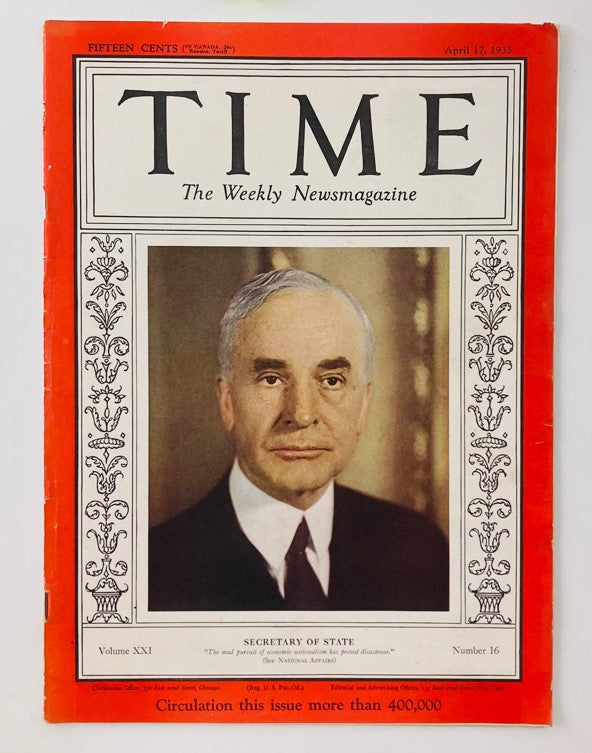


Description
Collector's Note – Why This Issue Matters
The April 17, 1933 issue of Time magazine — Volume 21, Number 16 — featuring Secretary of State Cordell Hull on the cover and reporting on Hitler's raids on Jewish communities is one of the most historically significant issues in the publication's entire pre-war run, a primary document of the moment when the Nazi persecution of Germany's Jewish population first entered American mainstream media consciousness as a major news story. The April 1933 date is precise and important: Adolf Hitler had been appointed Chancellor of Germany on January 30, 1933, and the antisemitic program of the new regime had moved with extraordinary speed in the weeks that followed. A nationwide boycott of Jewish businesses had been organized and carried out on April 1, 1933 — just two weeks before this issue appeared — and the dismissal of Jewish civil servants, the expulsion of Jewish students from universities, and the systematic removal of Jews from professional and public life were accelerating daily. American Jewish organizations were calling for boycotts of German goods, diplomatic pressure was being demanded by members of Congress, and the Roosevelt administration — which had taken office on March 4, 1933, just ten weeks before this issue — was navigating the extraordinarily difficult question of how aggressively to respond to reports of persecution in a country with which it maintained diplomatic relations. Secretary of State Cordell Hull was at the center of that navigation, which is precisely why he appears on the cover of this April 17 issue: his handling of the Jewish persecution question was one of the most pressing and most watched diplomatic challenges of the new administration's opening weeks. Collectors building a serious archive of early Nazi-era American press documentation will find the Time magazine collection at OriginalMagazines.com the most comprehensive resource for issues from this critical period.
The specific pairing of Cordell Hull's cover with the "Hitler Raids Jews" reporting gives this issue a documentary significance that extends well beyond its status as a news magazine from a consequential week. Hull would serve as Secretary of State from 1933 to 1944 — longer than any other person in the role — and would be awarded the Nobel Peace Prize in 1945 for his role in establishing the United Nations. But his record on the Jewish refugee crisis of the 1930s and 1940s remains among the most contested aspects of his legacy: the State Department under his leadership was responsible for restrictive visa policies that prevented large numbers of Jewish refugees from reaching the United States, and the April 1933 issue of Time documents him at the very beginning of his engagement with the persecution that would, over the following decade, produce the Holocaust. For researchers studying the American government's response to Nazi antisemitism in its earliest phase — when intervention was still theoretically possible and when the full trajectory of what was beginning was not yet understood — this cover and its accompanying coverage is a primary source of the first order. The 1933 magazines collection at OriginalMagazines.com gathers publications from one of the most consequential years of the entire twentieth century, when two of the decade's defining catastrophes — the Great Depression and the rise of Nazi Germany — were simultaneously at their most formative phases.
The April 17, 1933 issue also occupies a specific and important position in the longer history of American media's engagement with the Nazi persecution of Jews. The coverage this issue provided was among the earliest sustained American mainstream reporting on the antisemitic program of the new German government, appearing just eleven weeks after Hitler's appointment as Chancellor and just two weeks after the April 1 boycott. How the American press covered — or failed to cover, or minimized, or contextualized — the Nazi persecution of German Jews in these early months is a subject of ongoing historical debate, and individual issues from this period are primary sources for that debate. That Time used the framing "Hitler Raids Jews" — language that conveys deliberate, organized violence rather than civil disorder — in April 1933 is itself a historically significant editorial decision, and the issue that contains it is an irreplaceable document of how the most widely read American newsweekly was understanding and characterizing events in Germany at the critical moment of their beginning.
About the Publication
Time was founded in 1923 by Henry Luce and Briton Hadden as the first American weekly news magazine, built on the premise that educated readers needed a single authoritative source synthesizing the week's events across politics, business, science, culture, and international affairs into a coherent, opinionated, and readable package. By April 1933, the magazine had been operating for ten years and had established itself as the most influential newsweekly in the United States, with a readership that spanned the educated professional class and an editorial voice that was confidently opinionated in ways that the daily press rarely allowed itself to be. Its international coverage — and particularly its European coverage in the 1930s — was among its most important contributions, providing American readers with sustained analytical engagement with developments in Europe that the daily press covered episodically and that the magazine's format allowed it to track systematically across weeks and months.
Key Highlights Inside
- Cover story on Secretary of State Cordell Hull — Jewish persecution response — coverage of the Roosevelt administration's most senior diplomatic official at the precise moment of his first engagement with the antisemitic program of the new Nazi government, documenting the beginning of a diplomatic response that would be studied and debated for decades as the question of what the United States knew, when it knew it, and what it chose to do about it became central to the historical reckoning with American policy toward Nazi Germany.
- "Hitler Raids Jews" — April 1933 persecution coverage — among the earliest sustained mainstream American newsweekly reporting on the systematic antisemitic violence and legal persecution of Germany's Jewish population, appearing two weeks after the April 1 national boycott of Jewish businesses and documenting the new regime's program in its first weeks of active implementation.
- Published eleven weeks after Hitler's appointment as Chancellor — this issue appears at the earliest stage of the Nazi regime's antisemitic program, before the full trajectory of what was beginning could be understood by contemporary observers, making it a primary document of the specific moment when the persecution was first entering sustained American journalistic consciousness as a major international news story.
- Roosevelt administration's opening weeks — foreign policy formation — published in the tenth week of the Roosevelt presidency, when the administration's approach to the Nazi persecution of Jews was still being formed and when the diplomatic questions Hull was navigating were among the most consequential early foreign policy decisions of the New Deal era.
- Volume 21, Number 16 — tenth year of publication — this issue belongs to the mature phase of a publication that had been operating for ten years and had fully established the editorial voice and analytical format that made its early Nazi-era coverage among the most authoritative and most consequential in American journalism.
- Note on additional interior content: Specific additional features, columns, and department coverage beyond the Hull cover story and Jewish persecution reporting are unconfirmed from available sourcing for this individual issue. The highlights above reflect what is verifiable from the cover subject, the reported content, the volume and issue number, and Time's well-documented editorial format and international coverage priorities for the period.
Condition & Rarity
Surviving copies of this issue must be assessed with full appreciation of what over ninety years of existence means for a weekly newsweekly printed on the paper stock typical of early 1930s American periodical publishing. Paper from this era has been accumulating the effects of age, humidity, and handling for nearly a century, producing the yellowing, brittleness, and edge fragility that are the standard condition characteristics of Depression-era magazines that have been in private storage rather than archival conditions. The listing confirms a plastic protective covering, indicating deliberate preservation effort and more careful recent storage than an unprotected copy would have received. The most consequential condition factors for display and collector purposes are the integrity of the cover portrait of Hull — specifically whether the image retains visual coherence and legibility despite any toning or surface damage — and the completeness and readability of the reporting on the Jewish persecution, which constitutes the primary historical documentary value of the issue. For a cover and content combination of this specific historical significance — Cordell Hull and Hitler's treatment of Jews in the same April 1933 issue, documenting the beginning of a persecution whose full consequences were still unknown — collector and historical relevance extends across a wide condition range.
Looking for More Issues Like This?
Early 1930s Time covers documenting the first months of both the Roosevelt administration and the Nazi regime — and the April 17, 1933 Hull cover with its "Hitler Raids Jews" reporting occupies one of the most historically weighted positions in that entire early-decade series — are among the most significant numbers for collectors of Depression-era American political journalism and for researchers of the American press's early response to Nazi persecution. If you're building a collection of Time's most historically consequential pre-war international coverage, the Time magazine collection at OriginalMagazines.com is the most comprehensive place to browse what's currently available. For collectors drawn to the full historical weight of 1933 — the New Deal's opening weeks, the rise of Hitler, and the simultaneous transformation of American domestic and international life — the 1933 magazines collection offers a wide range of titles from one of the most consequential years of the entire twentieth century.