


Description
Collector's Note – Why This Issue Matters
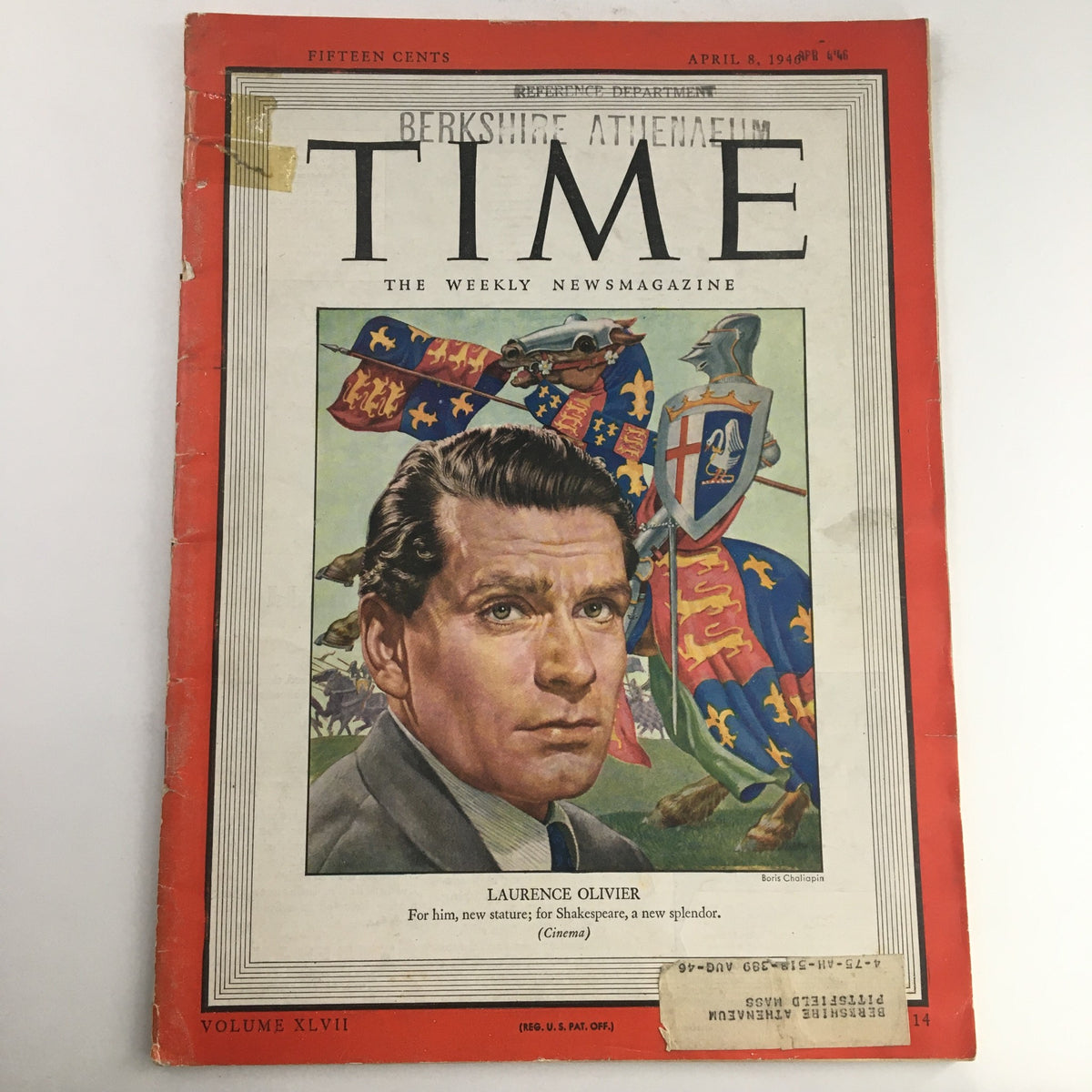
April 8, 1946 places this Time Magazine cover story on Laurence Olivier at one of the most historically significant moments in the history of Shakespeare on film. Olivier's Henry V had been released in the United States in April 1946 — the cover line "For him, new stature; for Shakespeare, a new splendor" is a direct reference to the film's American premiere — and the cover was timed to coincide with its arrival before the American audience that Time's editors judged most likely to be moved by it. Henry V had been produced during the war in Britain under extraordinary circumstances: funded partly by the British Ministry of Information as a morale-building project, filmed while the Blitz was still a living memory, and released in Britain in 1944 to enormous critical and popular response. The film's American arrival in 1946 brought it to an audience that had just emerged from the same war that had shaped its production, and the specific combination of Shakespeare's celebration of English military valor and Olivier's extraordinary performance — which he directed himself, at the age of thirty-seven — gave the work a resonance in 1946 that it could not have had in any other year. For collectors building an archive of Time Magazine covers from the immediate postwar period, this April 1946 edition is a primary document of one of the most consequential film events of the decade, captured at the precise moment of its American cultural impact.
The cover portrait, painted by Boris Chaliapin — the Russian-American artist who produced some of the most significant Time cover paintings of the mid-century period — is itself a primary document of a specific artistic tradition that Time maintained throughout its peak decades. Chaliapin's painted Time covers, produced from detailed photographic references, were among the most technically accomplished commercial portraiture of the era, and his rendering of Olivier — against a background of medieval heraldic imagery consistent with the Henry V production design — represents the full resources of that tradition applied to one of its most cinematically appropriate subjects. The cover image is therefore simultaneously a portrait of Olivier the actor and a visual argument about the relationship between his face and the Shakespearean world his film had brought to life. The specific caption — "Cinema" in parentheses — reflects Time's departmental framing and places this cover explicitly within the magazine's understanding of film as a cultural force worthy of its most prominent weekly real estate. Collectors researching American cultural magazines from 1946 will find this issue a precisely dated primary artifact of the postwar cinema's most celebrated artistic achievement of the year.
The provenance of this specific copy adds a historical dimension that the cover alone cannot provide. The Berkshire Athenaeum stamps and library label visible on the cover identify this as a copy that circulated through the Reference Department of the Pittsfield, Massachusetts public library — one of the oldest and most distinguished public libraries in New England, founded in 1871. A Time Magazine from the Reference Department of a public library in 1946 is a document of the specific way in which America's most widely read newsweekly was made accessible to communities beyond its subscriber base, and the physical evidence of that institutional circulation — the stamps, the binding tape, the call number — is part of the authentic provenance history of this copy rather than a detraction from it. Libraries in 1946 treated their Time subscriptions as reference resources, and the specific wear patterns associated with institutional use tell a different and historically interesting story than the more common subscriber copy wear.
About the Publication
Time Magazine was founded in 1923 by Henry Luce and Briton Hadden as the first weekly news magazine in the United States, and by April 1946 had sustained twenty-three years as one of the most widely read and institutionally authoritative publications in American journalism. Its cover portrait tradition, executed primarily by a small group of accomplished commercial painters including Boris Chaliapin, gave Time's covers a visual character unlike any other major publication of the era — the painted portrait rather than the photograph conveying a deliberate sense of historical weight and artistic seriousness that reinforced the magazine's institutional claim to identify each week's most significant figure with genuine editorial authority. The Cinema department, under whose rubric the Olivier cover appeared, had by 1946 become one of the more culturally serious film criticism venues in the American press, and its treatment of Henry V reflected the magazine's consistent willingness to engage significant film as a legitimate art form worthy of its full critical resources.
Key Highlights Inside
- Laurence Olivier cover portrait by Boris Chaliapin — a primary document of one of the twentieth century's most significant actor-directors at the moment of Henry V's American release, painted by the Russian-American artist whose Time cover work constitutes one of the most significant bodies of mid-century American commercial portraiture, with the medieval heraldic imagery of the background connecting the cover composition directly to the film's visual world.
- Cinema cover story on Henry V — Time's feature engagement with Olivier's Shakespeare adaptation at the moment of its American premiere in April 1946, representing the magazine's full editorial response to one of the most critically significant film events of the immediate postwar period, produced under the specific emotional and cultural conditions of an audience that had just emerged from the war the film had been made to address.
- National and world affairs coverage consistent with Time's April 1946 editorial scope — the immediate postwar world of early 1946, including the nascent United Nations, the beginning of the Cold War's formation, the Nuremberg trials in progress, and the full range of American domestic reconversion from wartime to peacetime, collectively providing the historical context within which the Olivier cinema cover story had its full cultural meaning.
- Period advertising reflecting the commercial culture of Time's readership in April 1946 — the advertising pages of an immediate postwar Time document the specific way in which American industry and consumer brands were addressing the return to peacetime prosperity, providing primary research material for historians of mid-century American commercial culture at its most transitional moment.
- Note: Specific secondary article titles, confirmed departmental content details, and individual bylines beyond the cover story have not been individually verified for this issue. The highlights above reflect Time's well-documented editorial format, the verified cover subject, artist, and caption, and the historical context of April 8, 1946.
Condition & Rarity
This is a library copy from the Berkshire Athenaeum in Pittsfield, Massachusetts — the institution's Reference Department stamps and call number label are visible on the cover, and the binding has been reinforced with tape consistent with library conservation practice of the period. These attributes define the specific provenance profile of this copy: good condition overall with the honest evidence of institutional circulation use, including the stamps, label, and binding repair that are characteristic of library copies from this era. The address label visible on the cover is the Athenaeum's library label rather than a subscriber mailing label, which means the cover design is otherwise intact though the institutional markings are visible. For researchers and collectors whose primary interest is the Boris Chaliapin cover portrait, the Cinema feature content, and the historical documentation of Henry V's American premiere, the condition described is entirely consistent with a readable and complete primary source. Collectors prioritizing display condition over research utility should seek label-free civilian copies when they surface; collectors focused on the documentary content and institutional provenance history will find the library copy's specific markings an authentic and historically interesting record of how this issue circulated in postwar New England. The plastic protective sleeve provides ongoing archival protection. Cover legibility, binding integrity, and interior page completeness are the primary condition criteria for evaluating surviving examples of this issue.
Looking for More Issues Like This?
A copy of the April 8, 1946 Time Magazine with the Boris Chaliapin portrait of Laurence Olivier — timed to Henry V's American premiere — is a historically specific postwar cinema and portraiture find that surfaces infrequently in any condition, and the institutional provenance of a library copy adds a dimension of authenticity and historical interest that purely commercial copies rarely carry. If this issue is no longer available, the full Time Magazine collection at OriginalMagazines.com is the most comprehensive place to browse surviving issues from across the publication's history and locate other significant cinema covers, postwar cultural profiles, or Chaliapin portrait issues from the magazine's peak portrait era. The 1946 magazine collection brings together surviving issues from across that year's major publications for collectors working to document the full breadth of American print culture during the first full year of postwar life.