


Description
Collector's Note – Why This Issue Matters
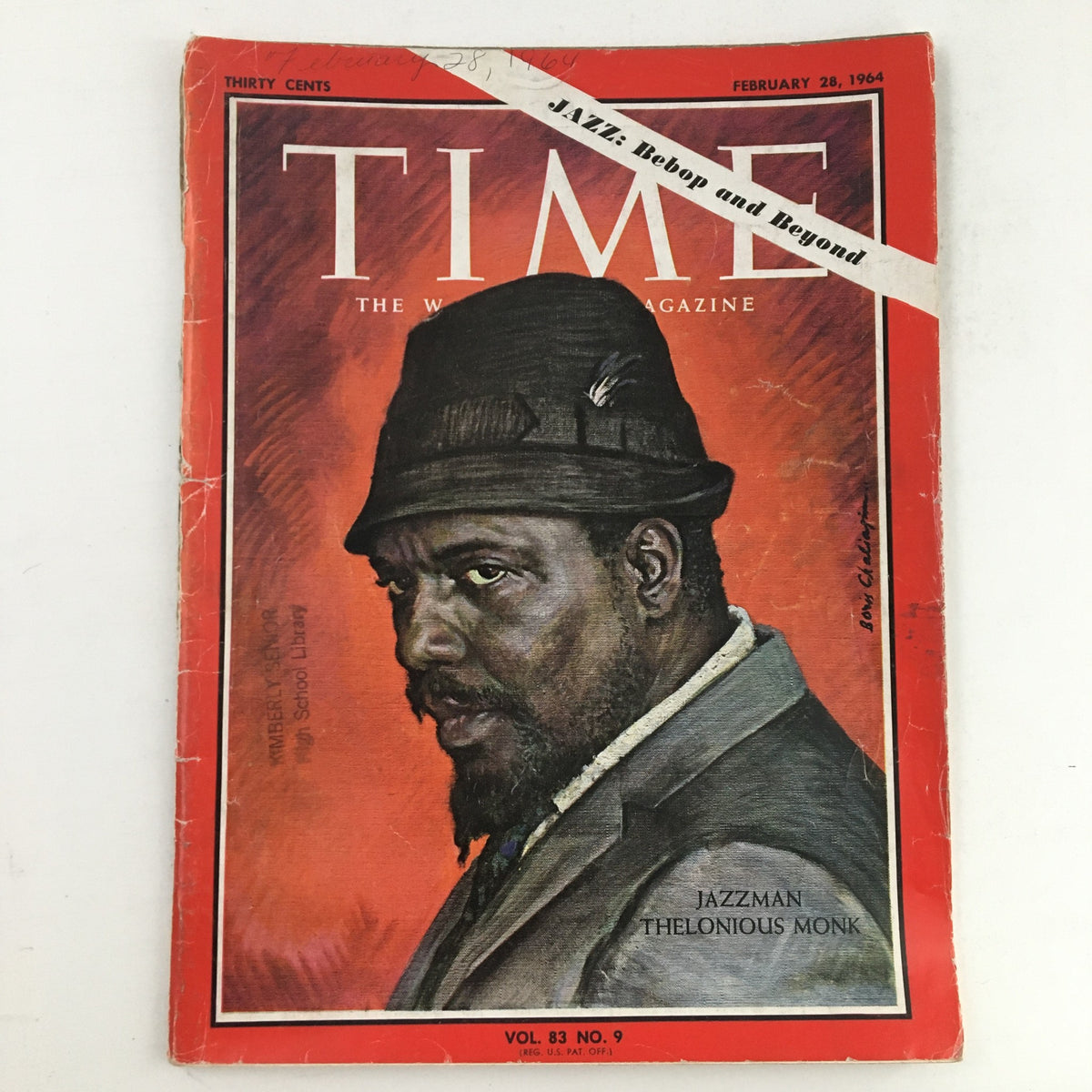
The February 28, 1964 issue of Time magazine — Volume 83, Number 9 — places Thelonious Monk on its cover at one of the most historically loaded moments in both jazz history and American popular culture. By February 1964, Monk had completed one of the most remarkable rehabilitations in the history of American music. The New York City Police Department's revocation of his cabaret card in 1951 — triggered by a confrontation with the authorities that was not his fault — had prevented him from performing in the city's clubs for six years at the peak of his creative powers, forcing him into a kind of enforced obscurity while musicians who had learned from him gained the recognition that should have been his. His return to full visibility in the late 1950s and early 1960s, anchored by his celebrated quartet with Charlie Rouse, had produced some of the most consistently fine work of his career and finally earned him the mainstream critical recognition that his foundational role in bebop had always deserved. A Time cover in February 1964 was the capstone of that recognition — the mainstream American media's definitive acknowledgment that one of the most genuinely original musical minds of the century had arrived at the cultural standing his work commanded. For collectors researching vintage Time magazine issues that document jazz's place in mid-century American cultural life, this February 1964 cover is one of the most significant the publication produced on the subject.
The timing within February 1964 gives this issue an additional and remarkable layer of cultural context. The Beatles had landed in New York on February 7, 1964 — just three weeks before this issue's cover date — and their appearance on The Ed Sullivan Show on February 9 had generated a cultural earthquake whose reverberations were still being felt when this issue went to press. Time's choice to put Thelonious Monk on its cover at the precise moment Beatlemania was dominating every other media conversation was a deliberate editorial counterstatement — an insistence that American music's most sophisticated and enduring achievement deserved the same national platform as its most commercially explosive new phenomenon. Monk's music and the Beatles' music inhabited almost entirely separate aesthetic universes in February 1964, but their simultaneous presence in the American cultural landscape that month makes this issue a uniquely layered document of a single extraordinary week in American music history. Anyone building a collection around magazines from 1964 as documents of that extraordinary year's cultural breadth will find this issue one of the most specifically resonant objects the year produced.
About the Publication
Time: The Weekly News-Magazine, founded by Henry Luce and Briton Hadden in 1923, was by 1964 still one of the most widely read and editorially influential weekly publications in the United States, combining national and international news, science, business, arts, and cultural analysis within a format that positioned its covers as authoritative weekly declarations about who and what mattered in American life. Its coverage of jazz and classical music in the early 1960s reflected a serious editorial engagement with American musical culture, and a jazz musician on the cover of Time in this era carried genuine cultural weight as a statement about the art form's place in the national conversation — particularly one whose recognition had been delayed as long and as unjustly as Monk's.
Key Highlights Inside
- Cover feature on Thelonious Monk — one of the founding architects of bebop and among the most harmonically and rhythmically original composers in jazz history, receiving his Time cover at the culmination of a recognition arc that had been delayed by six years of enforced absence from New York's clubs due to the cabaret card restrictions of the 1950s.
- Issue dated February 28, 1964 — published three weeks after the Beatles' arrival in America and their historic Ed Sullivan Show appearance, placing this jazz-focused cover within one of the most culturally turbulent and historically specific months in the history of American popular music.
- Label-free newsstand copy — the preferred provenance for display-focused collectors of this issue, with the Monk cover portrait unobscured by subscriber address markings, allowing the cover art to be appreciated in its intended form.
- Important condition note: A library stamp is present on the front of this issue, as documented in the listing. This is a meaningful provenance attribute that collectors should evaluate against the accompanying photographs — library stamps are typically applied to the cover or interior pages and can affect both the visual presentation and the collectible grade of an issue, though they also serve as a documented chain of custody through institutional ownership.
- Note: Specific interior article titles and additional features beyond the cover story are unconfirmed for this issue. The above reflects what is verifiable from the cover subject, volume and issue number, date, and the publication's documented editorial format for this period.
Condition & Rarity
This issue presents a condition profile that requires careful evaluation by collectors. The label-free status is the most positive provenance attribute — newsstand origin without a subscriber address label leaves the Monk cover portrait fully visible, which is the primary display criterion for a cover of this visual and historical significance. The library stamp on the front is the most significant condition factor: library stamps were applied by institutional owners as ownership markers and typically appear as ink impressions directly on the cover or early pages. Depending on their size, placement, and ink saturation, stamps can range from minor cosmetic details to prominent visual intrusions on the cover's photographic integrity, and the accompanying photographs are the authoritative reference for assessing their specific impact on this issue. Minor wear and marks consistent with age are standard attributes for a sixty-year-old weekly publication. The plastic protective covering provides current preservation stability. For collectors whose primary interest is the historical and musical documentation value of this specific cover — Monk, February 1964, three weeks after the Beatles — a library-stamped newsstand copy in good condition remains a historically meaningful acquisition, with the stamp acknowledged as a condition factor rather than a disqualifying one.
Looking for More Issues Like This?
Thelonious Monk's February 1964 Time cover is one of the most recognized jazz-related covers in vintage newsweekly collecting, and the historical density of its specific publication date — simultaneous with the Beatles' American arrival — gives it a documentary significance that makes it consistently sought by collectors of jazz history and 1960s American cultural history alike. If this issue is no longer available, the broader vintage Time magazine archive at OriginalMagazines.com spans the full 1960s run and is the most reliable place to continue searching for culturally significant covers from this decade. The complete 1964 magazine collection is also worth exploring for collectors documenting the full cultural and political landscape of that extraordinary year.