
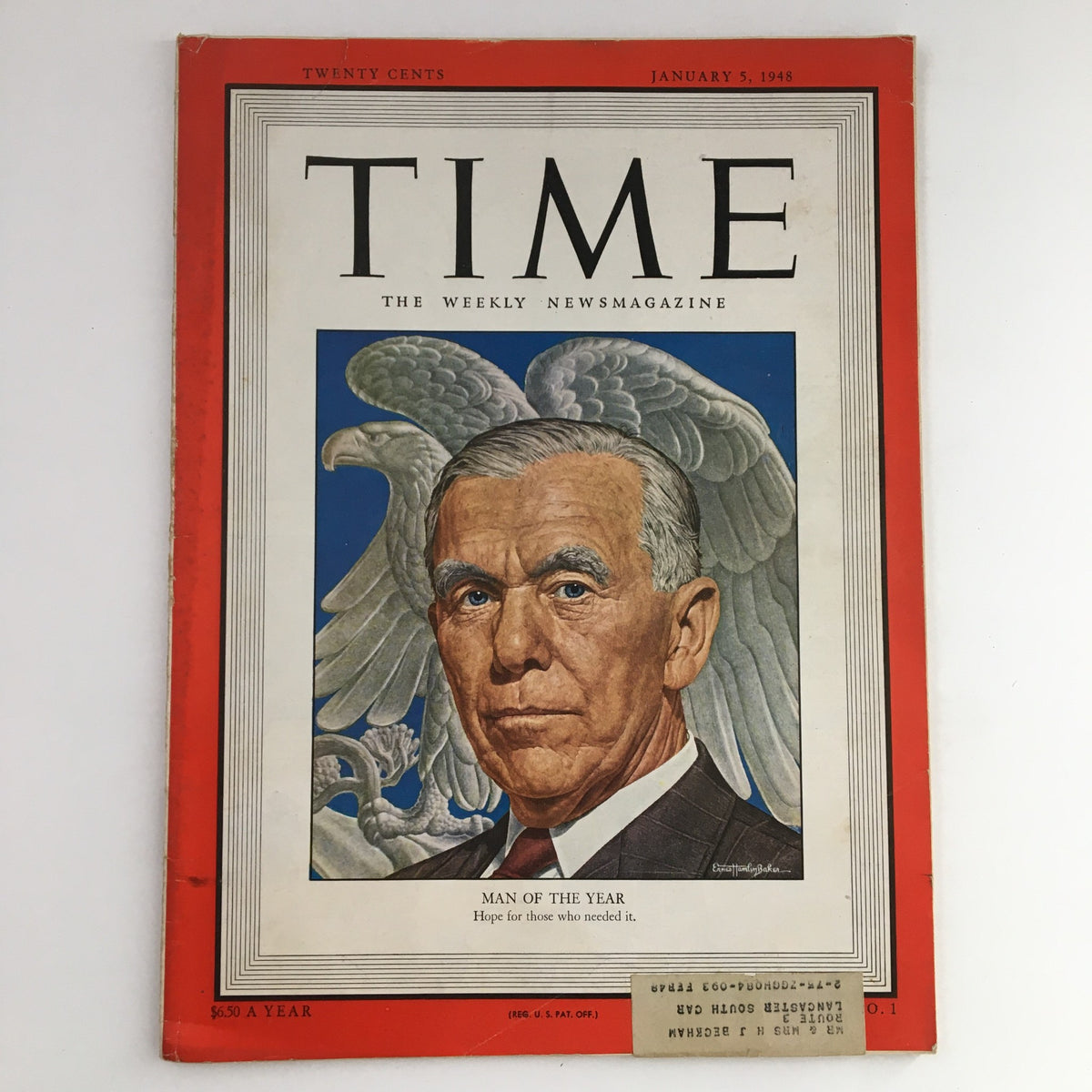


Description
Collector's Note – Why This Issue Matters
The January 5, 1948 issue of Time magazine is one of the most historically significant newsweeklies ever published — not simply because of who appears on the cover, but because of what that choice represented at one of the most consequential turning points in modern history. George C. Marshall, named Time's Man of the Year for 1947, was at that precise moment the architect of what would become the most ambitious foreign policy initiative in American history. The European Recovery Program — universally known as the Marshall Plan, a name that attached itself to the initiative almost immediately and has never let go — had been formally proposed in Marshall's landmark commencement address at Harvard University in June 1947. By the time this issue reached newsstands in early January 1948, the U.S. Congress was in the process of debating its authorization, and the fate of postwar Europe hung in a very real sense on the outcome of that debate. To hold this issue is to hold a document produced at the precise hinge moment between the devastation of World War II and the architecture of the postwar Western world. Collectors with a serious interest in mid-century American political history will find the full range of 1948 magazines at OriginalMagazines.com an essential resource for understanding the breadth of that pivotal year in print.
George Catlett Marshall's selection as Man of the Year was not a gesture toward celebrity or popular appeal — it was a recognition of strategic and moral consequence on a scale that few individuals in any era have achieved. Marshall had served as Army Chief of Staff throughout World War II, coordinating the largest military mobilization in American history and earning the deep respect of both Franklin Roosevelt and Winston Churchill. President Truman appointed him Secretary of State in January 1947, and within months Marshall had diagnosed the core problem confronting American foreign policy with a clarity that his predecessors had not managed: that the economic devastation of Europe represented not merely a humanitarian catastrophe but a direct strategic threat, one that the Soviet Union was positioned to exploit if the United States failed to act. The plan that bore his name would ultimately channel the equivalent of well over one hundred billion dollars in today's terms into the reconstruction of Western Europe, and it is widely credited with stabilizing democratic governance across the continent at a moment when communist parties were making significant electoral inroads in France, Italy, and elsewhere. Marshall would go on to receive the Nobel Peace Prize in 1953, the only career military officer ever to do so. For collectors assembling a focused archive of Time's Man of the Year issues — one of the most coherent and historically rewarding collecting categories in American newsweekly history — the Time magazine collection at OriginalMagazines.com is the natural starting point.
It is worth appreciating the specific timing of this issue within the broader arc of the early Cold War. January 1948 was a month of acute international tension. The Iron Curtain had descended across Eastern Europe, the Soviet Union had consolidated its control over Poland, Romania, Bulgaria, and Hungary, and Czechoslovakia — still nominally democratic — was two months away from the communist coup of February 1948 that would shock Western governments and galvanize congressional support for the Marshall Plan's passage. The Berlin Blockade, another defining crisis of the early Cold War, was still six months away. This issue of Time was published, in other words, at the precise moment when the ideological and geopolitical shape of the second half of the twentieth century was being determined, and when Marshall himself was at the center of the American response. Very few individual magazine issues from any era can claim to document a moment of such concentrated historical consequence, which is why this particular volume and number occupies a distinct place not just in Time collecting but in the broader field of twentieth-century ephemera.
About the Publication
Time was founded in 1923 by Henry Luce and Briton Hadden as the first weekly news magazine published in the United States, built on the premise that busy, educated readers needed a single authoritative source that synthesized the week's events across politics, business, science, culture, and international affairs into a coherent, readable package. By 1948 it had become the most widely read newsweekly in the world, with a readership that spanned every level of American professional and civic life and an international edition that extended its reach across Europe, Latin America, and Asia. The magazine's editorial voice was distinctive — opinionated, confident, sometimes polemical, and unapologetically committed to the idea that journalism should interpret events rather than merely report them. Its format during this era followed a consistent structure: a cover portrait or thematic image, followed by departments covering national affairs, foreign news, business, science, medicine, education, religion, the arts, and sport, with the cover story typically running at substantial length and drawing on Time's global network of correspondents. The Man of the Year franchise, inaugurated in 1927 with Charles Lindbergh, had by 1948 become one of the most anticipated editorial announcements in American journalism, and the January issue in which it appeared was reliably among the highest-circulation issues of any given year.
Key Highlights Inside
- Man of the Year: George C. Marshall — the cover story recognizing Marshall's selection as Time's Man of the Year for 1947, documenting his role in conceiving and advancing the European Recovery Program and situating his achievement within the broader context of American postwar foreign policy.
- The Marshall Plan in real time — published while the plan's congressional authorization was still being debated, this issue captures the initiative at the precise moment of its political uncertainty, before its passage and ultimate success had transformed it into the celebrated historical landmark it is now recognized as.
- Volume 51, Number 1 — as the first issue of a new volume year, this issue carries additional bibliographic significance for institutional and archival collectors who organize their holdings by volume and number.
- Postwar world coverage — issues of Time from early 1948 addressed the full sweep of an extraordinarily volatile international moment: the consolidation of Soviet influence in Eastern Europe, the ongoing reconstruction of Western Europe, the independence of India still less than six months old, and the approaching end of the British Mandate in Palestine.
- Domestic affairs and American political landscape — 1948 was a presidential election year in the United States, with Harry Truman facing a deeply uncertain path to reelection. Early January issues from this year captured the opening of what would become one of the most dramatic electoral years in American political history.
- Note on interior specifics: Precise article titles, page-level content, and specific features beyond the Man of the Year designation are unconfirmed from available sourcing for this individual issue. The highlights above reflect what is verifiable from the cover subject, volume and issue number, publication date, and Time's well-documented editorial priorities and format for the period.
Condition & Rarity
Surviving copies of this issue should be evaluated with a clear-eyed understanding of what seventy-five-plus years of existence means for a weekly newsweekly printed on the relatively modest paper stock typical of the late 1940s. Minor wear throughout — light toning, gentle softening of the cover stock, small stress marks along the spine — is entirely consistent with a magazine of this age and does not in itself diminish historical or collector value. More specific condition attributes require careful attention. The presence of an address label on the front cover is a meaningful factor: subscriber copies of Time were mailed with labels adhered directly to the cover, and clean removal without residue, staining, or paper lifting is rarely achievable, meaning labeled copies occupy a lower tier in collector grading than their unlabeled newsstand counterparts. Small rips, where present, should be assessed for location — a tear at the margin of the cover is considerably less damaging to display value than one that intersects the cover portrait or title treatment. Page completeness is the foundational criterion for any issue of this significance; a Man of the Year issue missing its cover story pages loses the core of its historical value regardless of exterior condition. The presence of a plastic protective covering indicates prior collector awareness and suggests more conscientious storage than a loose, unprotected copy would typically have received. For a Man of the Year issue of this particular historical weight, even a good-condition copy with a label and minor wear represents a genuinely substantive piece of twentieth-century documentary history.
Looking for More Issues Like This?
Time Man of the Year issues are among the most consistently sought-after newsweeklies in the vintage magazine market, and the January 1948 Marshall issue in particular — anchored to one of the defining foreign policy achievements of the twentieth century — is one that serious collectors of the series prioritize. If you're building out a run of Man of the Year issues or simply want to explore Time's coverage across its most historically eventful decades, the Time magazine collection at OriginalMagazines.com is the most comprehensive place to browse what's currently available. For collectors drawn to the broader sweep of postwar American history in print, the 1948 magazines collection spans a remarkable range of titles from one of the most consequential years of the entire twentieth century — a year that repays close attention from as many angles as possible.