

Description
Collector's Note – Why This Issue Matters
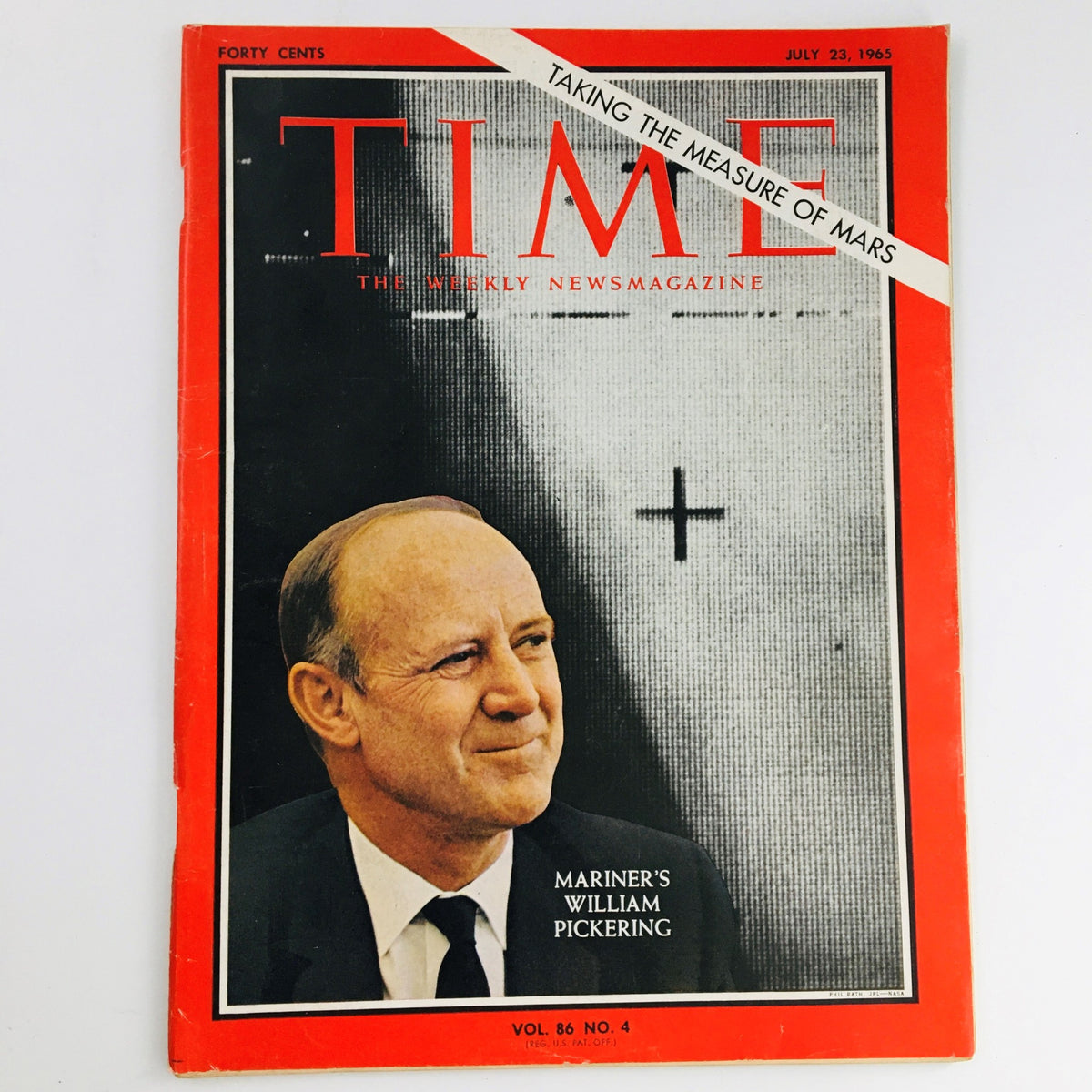
The July 23, 1965 issue of Time — Volume 86, Number 4 — hits newsstands in the immediate wake of one of the most consequential moments in the history of space exploration. On July 14–15, 1965, NASA's Mariner 4 spacecraft completed the first successful flyby of Mars, transmitting 22 close-up photographs of the Martian surface back to Earth. They were the first detailed images ever taken of another planet from close range, and they fundamentally altered scientific understanding of Mars — revealing a cratered, apparently lifeless landscape rather than the canal-laced world that had fired imaginations for nearly a century. Time placing William H. Pickering on its cover the following week was a precise acknowledgment of what had just happened: a genuine turning point in human knowledge, accomplished within days of publication.
William H. Pickering had served as director of NASA's Jet Propulsion Laboratory in Pasadena since 1954, overseeing the development of the Explorer 1 satellite — America's first successful orbital mission — and guiding JPL through its central role in the unmanned space program throughout the late 1950s and 1960s. The Mariner program was among his defining achievements. A New Zealand-born physicist who had come to Caltech in the 1930s, Pickering represented a particular kind of mid-century American scientific figure — methodical, institutionally embedded, less publicly celebrated than the astronauts but arguably more architecturally important to what the space program actually accomplished. For collectors building around vintage Time magazine issues that document the Space Age at its most electric, this cover belongs in the same conversation as the Apollo-era issues that tend to attract more attention.
The summer of 1965 was an extraordinary moment in the space race more broadly. Gemini missions were flying with increasing frequency and ambition, the Apollo program was accelerating toward its lunar goal, and unmanned probes were beginning to return data that made the solar system feel newly real and immediate. Mariner 4's Mars photographs were front-page news around the world for days. Among surviving magazines from 1965, issues that document the space program's unmanned exploratory achievements are consistently undervalued relative to their historical significance — the Mariner 4 moment in particular has grown more important as Mars exploration has expanded into a defining scientific and cultural project of the twenty-first century.
About the Publication
Time, founded in 1923 by Henry Luce and Briton Hadden, was by the mid-1960s the dominant American newsweekly, with a circulation of several million and an editorial mandate to interpret as well as report the week's most significant events. Its cover selections were deliberate and closely watched — to appear on the cover of Time in 1965 was to be identified as the person or subject most central to the national and global conversation that week. The magazine's science and technology coverage during the Space Age was among its strongest editorial work, tracking the NASA program with a seriousness and depth that reflected how completely the space race had captured American public attention and institutional ambition.
Key Highlights Inside
- Cover feature on William H. Pickering, director of NASA's Jet Propulsion Laboratory, timed to the Mariner 4 spacecraft's historic first flyby of Mars on July 14–15, 1965.
- Documentation of the Mariner 4 mission's transmission of the first close-up photographs of another planet — 22 images that permanently revised scientific understanding of Mars and the broader question of planetary habitability.
- Coverage situated within the broader context of the mid-1960s Space Age, with Gemini missions underway and the Apollo lunar program building toward its goal.
- Note: Specific additional interior articles, departments, and features beyond the Pickering cover story are unconfirmed for this issue. The Mariner 4 and JPL coverage is the documented editorial centerpiece.
Condition & Rarity
Newsstand origin with no address label is the preferred configuration for collectible Time issues from this era, and it is the less common one — the magazine's subscription circulation significantly outnumbered newsstand sales in 1965, making labeled copies the dominant survivors in the market. Good condition with minor wear, including small rips, edge wear, and creases, is an honest grade for a sixty-year-old staple-bound newsweekly; the coated stock Time used in the mid-1960s ages reasonably well but is susceptible to tanning, edge brittleness, and spine stress with decades of handling. A plastic protective sleeve indicates deliberate preservation at some point in the issue's history, which limits further surface deterioration. When evaluating any surviving copy of this issue, the priority attributes are the clarity and color integrity of the Pickering cover portrait, the security of the spine staples, and the absence of significant moisture damage or brittleness in the interior pages.
Looking for More Issues Like This?
Space Age Time covers tied to specific mission milestones are among the most historically durable finds in the magazine's archive, and the Mariner 4 moment — the first photographs of Mars — is one that serious collectors of NASA-era material return to consistently. If this issue has already moved on, the Time magazine collection at OriginalMagazines.com spans the full run of the Space Age and regularly surfaces covers from the Gemini and Apollo years. For collectors following the thread of mid-1960s American science and culture more broadly, the 1965 magazine collection is a rewarding place to keep looking — it was an exceptionally eventful year, and the coverage across multiple titles reflects that.