


Description
Collector’s Note – Why This Issue Matters
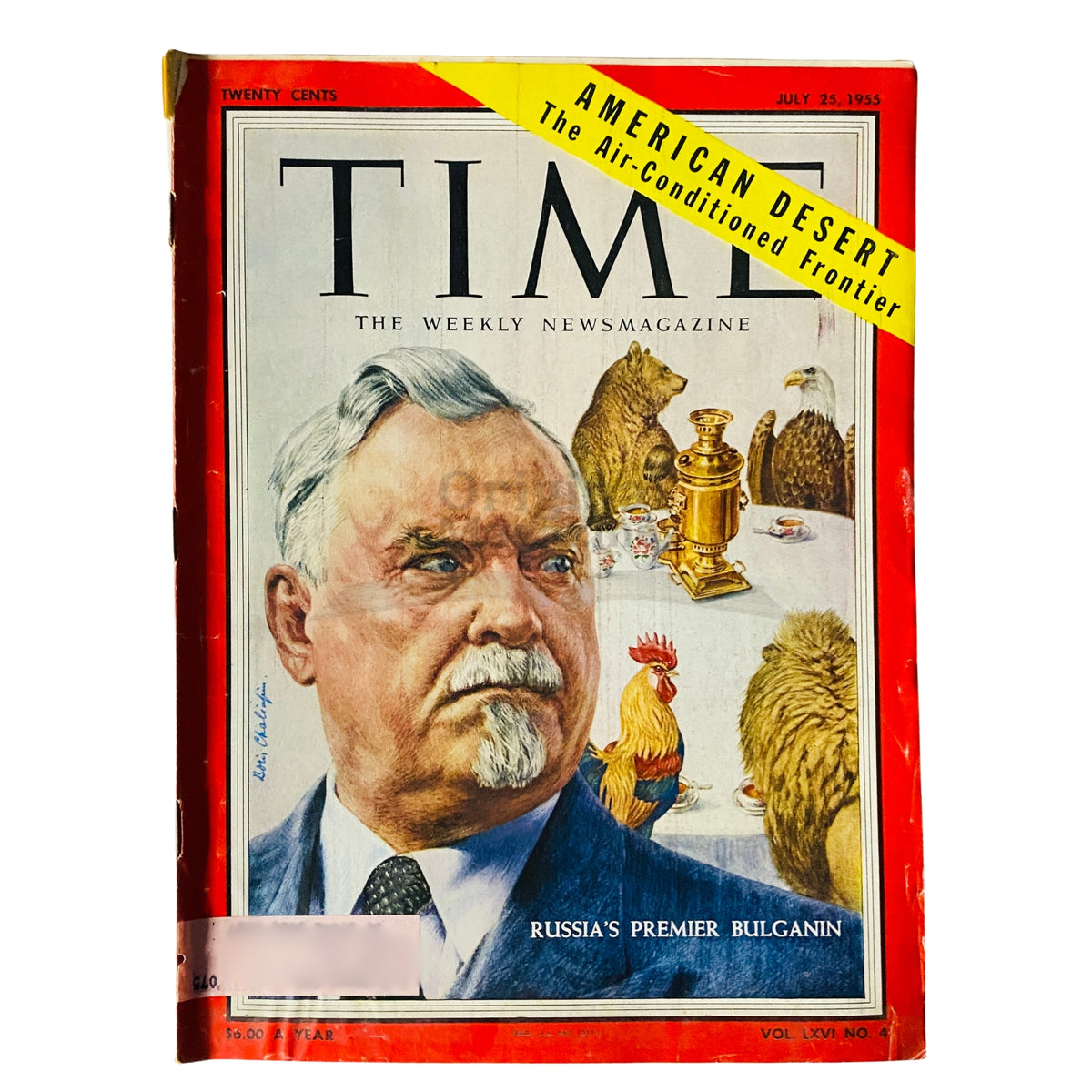
TIME Magazine’s July 25, 1955 issue, Volume LXVI, Number 4, features Soviet Premier Nikolai Bulganin in a painted cover portrait by Boris Chaliapin. The cover identifies him as “Russia’s Premier Bulganin,” placing one of the Soviet Union’s most visible government officials before an American mass readership at a critical point in Cold War diplomacy. Bulganin had become chairman of the Soviet Council of Ministers, commonly described in the West as premier, earlier in 1955 and remained in that office until 1958. The issue appeared while the heads of government of the United States, Great Britain, France, and the Soviet Union were meeting at Geneva from July 18 through July 23. President Dwight D. Eisenhower, Prime Minister Anthony Eden, Premier Edgar Faure, and Bulganin discussed disarmament, the future of Germany, European security, and possibilities for wider contact between East and West. Their meeting did not end the Cold War or settle its central disputes, but it contributed to the temporary easing of tension remembered as the “Spirit of Geneva.” The timing makes this cover an unusually direct visual document of a Soviet leader presented to American readers during an active international summit.
The principal profile, “The Chummy Commissar,” examined Bulganin’s personality, political career, administrative experience, and position within the collective Soviet leadership that followed Joseph Stalin’s death. TIME introduced the feature through Bulganin’s pre-summit appearance before reporters in Moscow, which the magazine described as the first press conference conducted by a Soviet premier. Questions were not permitted, yet the carefully arranged event allowed Bulganin to present the Soviet delegation’s stated interest in reducing international tension while affirming the strength of the country’s armed forces. Nikita Khrushchev, Vyacheslav Molotov, Georgy Zhukov, and Andrei Gromyko appeared with him, emphasizing that Soviet policy was being represented through a group of senior officials rather than through Bulganin alone. The article considered Bulganin’s earlier work in municipal government, banking, industrial administration, wartime organization, defense affairs, and Communist Party politics. It also reflected the uncertainty among Western observers about the relative authority of Bulganin and Khrushchev during a period when the internal balance of Kremlin power was still developing. Its language and judgments should be read as products of American Cold War journalism, making the feature valuable both as biography and as evidence of how the Soviet leadership was interpreted in 1955.
The edition contains considerably more than its Bulganin cover story, preserving a broad weekly record of political, scientific, commercial, cultural, and social concerns. Its foreign reporting follows the Geneva negotiations while examining developments in India, Great Britain, West Germany, Morocco, Italy, Laos, Argentina, Brazil, Canada, and the international oil trade. National coverage addresses the Eisenhower presidency, Congress, the armed forces, federal administration, immigration, political strategy, investigations, and American territories. Science and medicine articles consider balloon-launched rockets, controlled fusion, vaccine disagreement, psychology in the workplace, and expectations for future medical progress. The business department asks whether inflation was approaching and reports on management, railroads, automobile safety restraints, agriculture, real estate, foreign trade, and overseas development. Cultural sections cover the Newport Jazz Festival, dance at Jacob’s Pillow, mambo, radio, television, art authentication, cinema, and contemporary books. A special feature titled “The American Desert, 1955: A New Way of Life in the U.S.” expands the issue into a study of growth and adaptation in the American Southwest. Together, these materials place the Bulganin issue within both the archive of historical TIME Magazine editions and the wider documentary record of magazines published in 1955.
About the Publication
TIME was founded by Henry R. Luce and Briton Hadden, and its first issue was published in 1923. It was conceived as a compact weekly summary that organized major events for readers who wanted an efficient overview of national and international news. The magazine developed recurring departments devoted to politics, foreign affairs, business, science, medicine, religion, education, sports, books, theater, cinema, radio, television, and the arts. Its editorial writing became known for compressed narratives, vivid characterization, wordplay, and a strongly interpretive voice. By the 1950s, TIME had become one of the most influential American news magazines and an important source through which readers encountered world leaders. Cover selection was a central part of its identity because each featured personality was presented as a symbol of a larger event, institution, conflict, or historical trend. The red border became one of the publication’s most recognizable design elements. Painted portraits remained common during the mid-century period, giving artists room to combine physical likeness with background symbols connected to the subject’s public role. Boris Chaliapin produced numerous TIME covers and became closely associated with the magazine’s tradition of symbolic portraiture. Political figures from both sides of the Cold War appeared on its covers, allowing the publication to introduce foreign leaders while interpreting their influence for an American audience. The July 25, 1955 issue demonstrates this editorial method by placing Bulganin’s portrait beside reporting on the Geneva Summit and the broader structure of Soviet power. Surviving TIME issues now serve as dated primary sources for examining journalism, international perceptions, illustration, advertising, and the changing public presentation of twentieth-century leaders.
Key Highlights Inside
- The principal cover feature, “The Chummy Commissar,” profiles Nikolai Bulganin shortly after he became premier of the Soviet Union. It examines his administrative career, public manner, political adaptability, and place within the collective leadership that emerged after Stalin. The article also reveals how American journalists attempted to evaluate Soviet personalities whose exact authority was difficult to determine from outside the Kremlin.
- The “Big Four” report, “Around the Hollow Square,” covers the Geneva meeting of Eisenhower, Eden, Faure, and Bulganin. The conference addressed disarmament, Germany, European security, and possibilities for improved East–West relations. Its inclusion connects the cover directly with one of the most closely watched diplomatic gatherings of 1955.
- The foreign-news section includes “Two Plans for Europe” and reports on India, Great Britain, West Germany, Morocco, Italy, and Laos. Additional coverage examines political and economic events in Argentina, Brazil, Canada, and other parts of the Western Hemisphere. This geographic range preserves a broad view of international affairs during a period shaped by Cold War rivalry, decolonization, and regional instability.
- National-affairs reporting addresses the Eisenhower presidency, Congress, the armed forces, investigations, immigration, administrative appointments, and political maneuvering. These reports show how TIME framed domestic government while international leaders were meeting at Geneva. They also provide context for the political institutions and policy debates occupying American attention during the summer of 1955.
- The science department includes “Rockets from Balloons” and “Controlled Fusion.” These reports reflect contemporary interest in advanced propulsion, high-altitude experimentation, atomic research, and technologies that could affect both peaceful development and military competition. Their appearance demonstrates how closely scientific progress and Cold War strategy were linked in mid-century news coverage.
- Medical articles include “Vaccine Dissent,” “Psychology at Work,” “A Look Ahead,” and a collection of shorter health developments. The subjects preserve contemporary debates over preventive medicine, professional practice, workplace behavior, and anticipated advances in treatment. They also show how TIME translated specialized medical discussions into reports intended for a general readership.
- The business department asks “Is Inflation Coming?” and examines management, railroads, automobile safety, housing, agriculture, foreign trade, and economic development abroad. The automobile article concerning safety straps is especially representative of the growing public discussion surrounding passenger protection in the 1950s. Together, these reports document the opportunities and anxieties accompanying postwar American expansion.
- Arts and entertainment coverage includes the Newport jazz scene, dance at Jacob’s Pillow, mambo, radio, television, visual art, cinema, and recently published books. Articles concerning questionable artwork and modern “Spatiodynamisme” demonstrate the magazine’s interest in both authenticity and experimentation. These departments offer a cultural counterpoint to the issue’s concentration on international diplomacy and Soviet politics.
- The special section “The American Desert, 1955: A New Way of Life in the U.S.” examines social and economic development in the desert regions of the United States. Its promotion also appears across the upper corner of the Bulganin cover, making it an important part of the issue’s visual identity. The feature places a domestic story of settlement, infrastructure, climate control, and regional transformation beside the week’s international political reporting.
Condition & Rarity
The supplied description characterizes this July 25, 1955 issue as being in excellent condition with light wear appropriate to its age. “Excellent” should be understood as the descriptive assessment provided with the magazine rather than as a standardized numerical grade. The exact locations and extent of the reported wear are not identified in the written notes. The accompanying photographs should therefore be used to evaluate the cover surface, corners, page edges, spine, and general physical presentation. The pictured magazine is described as the same example represented by the listing rather than a generic photograph of the issue. A plastic protective covering is also reported to accompany it. That covering is a later preservation accessory intended to limit dust and unnecessary handling, not an original component of the 1955 publication. No definite information has been supplied concerning an address label, mailing marks, writing, clipping, staining, tears, detached pages, tape, or restoration. Those characteristics should remain unconfirmed unless they can be established through the photographs or direct physical examination. Preservation of the Boris Chaliapin cover is particularly important because the Bulganin portrait, symbolic background, and American Desert banner collectively establish the issue’s identity. Completeness of the interior also matters because the magazine contains the Bulganin profile, Geneva coverage, the American Desert special section, and an extensive range of weekly departments. TIME was widely circulated during the 1950s, so historical and collector interest in this date is best connected to its cover subject, summit timing, artwork, documented contents, and physical condition rather than to an unsupported claim of exceptional rarity.
Looking for More Issues Like This?
Additional political portraits and weekly historical records can be explored through the TIME Magazine collection. Nearby editions help place Bulganin’s appearance within TIME’s continuing coverage of the Soviet Union, the Eisenhower administration, European recovery, nuclear strategy, and international diplomacy. They also allow comparison between Boris Chaliapin’s portrait and covers created by other leading illustrators and photographers. Examining consecutive issues can show how the Geneva Summit developed from anticipation and negotiation into analysis of its results. It can also clarify how TIME distinguished the formal role of Bulganin from the growing political influence of Nikita Khrushchev. Readers interested in the larger historical setting can consult the 1955 magazine archive. Publications from that year document Cold War competition, civil-rights developments, postwar prosperity, scientific ambition, expanding television culture, and changing patterns of consumption. Comparing news magazines with general-interest, business, entertainment, and household publications reveals how the same period was interpreted for different readerships. The July 25 TIME issue is especially useful because its international cover story appears alongside a major feature on the changing American desert. That combination brings Soviet leadership, summit diplomacy, regional development, science, business, and popular culture together within one dated publication. The issue therefore contributes to a fuller understanding of both the global anxieties and domestic confidence that characterized American media in the middle of the 1950s.