
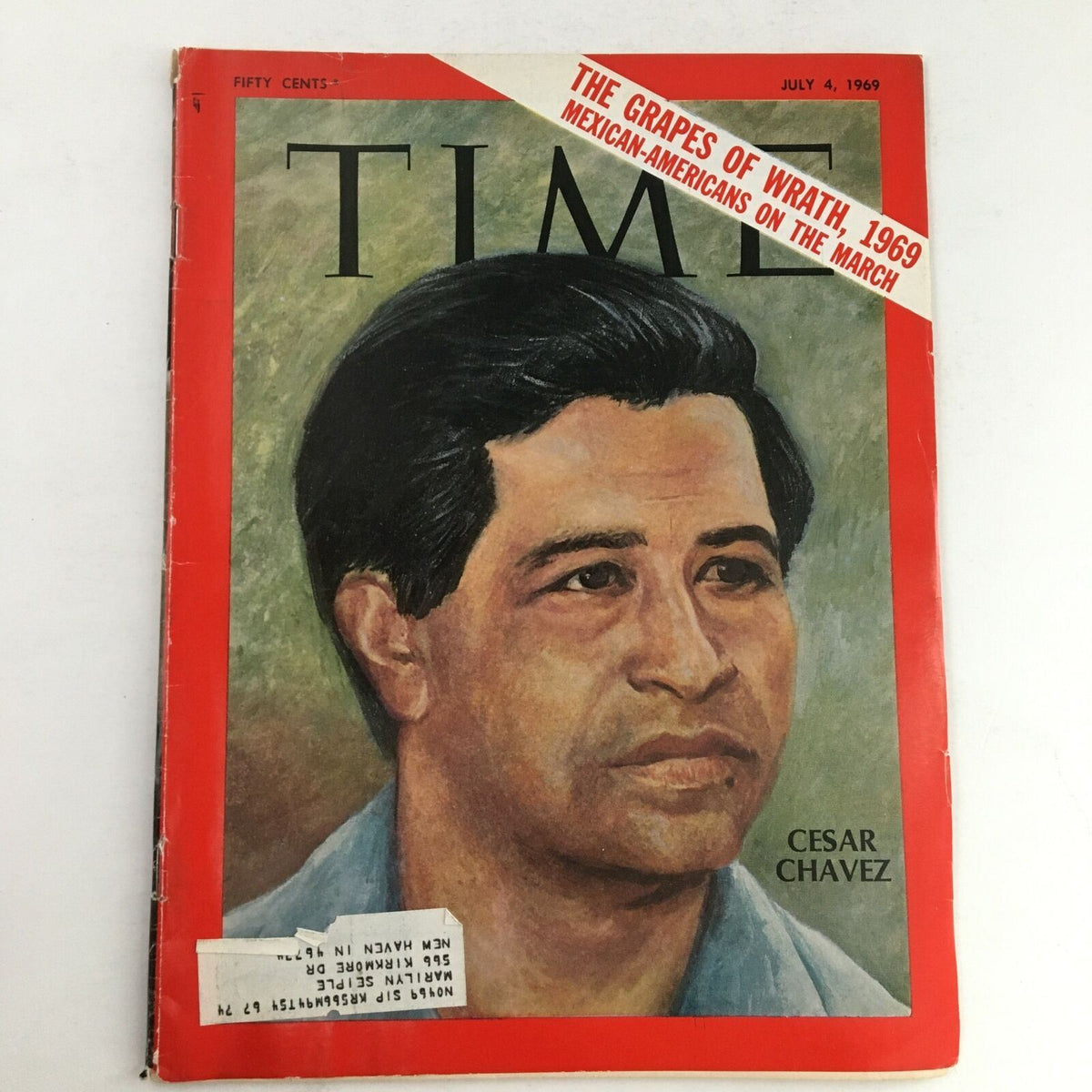

Description
Collector's Note – Why This Issue Matters
July 4, 1969 is one of the most historically resonant publication dates in Time Magazine's archive on American labor and civil rights, and the Cesar Chavez cover story is now recognized as a landmark primary document of the Chicano movement at its most publicly visible and politically consequential moment. The framing — "Cesar Chavez & The Grapes of Wrath: Mexican-Americans" — connects the specific labor organizing struggle of the United Farm Workers directly to John Steinbeck's Depression-era mythology of migrant agricultural workers, an editorial linkage that was simultaneously historically accurate and culturally electrifying for a readership that understood both references. The Delano Grape Strike had begun in September 1965 and by July 1969 had entered its fourth year, with the national consumer boycott of California table grapes generating the kind of mainstream public engagement that made a Time cover treatment both appropriate and historically momentous. The specific July 4 publication date gives this issue an additional layer of editorial intelligence — the independence Day framing of a cover story about the fight for American labor rights and Mexican-American dignity was a deliberate and precisely calibrated editorial statement about what American freedom meant and who was still fighting for it in the summer of 1969. For collectors building an archive of Cesar Chavez magazine covers and features, this July 4, 1969 Time is the foundational primary document of his mainstream American press recognition — the most authoritative weekly newsmagazine's formal designation of him as one of the week's most historically significant figures at the peak of his movement's national influence.
The historical significance of July 1969 for the United Farm Workers and the broader Chicano civil rights movement deserves careful attention as context for this cover's specific importance. By the summer of 1969, the grape boycott had achieved a level of mainstream American consumer support that was genuinely threatening the California grape industry's commercial viability — supermarkets across the country were under pressure to pull California grapes, and the UFW's tactical innovation of the consumer boycott as a labor organizing tool was being studied by organizers across multiple industries and movements. Chavez's specific combination of Gandhian nonviolent discipline, Catholic faith, and Mexican-American cultural identity gave the movement a character that was both politically radical in its economic demands and culturally accessible to a mainstream American audience that might otherwise have dismissed it. The "Grapes of Wrath" framing in the cover designation placed Chavez's struggle within the longest American tradition of agricultural worker organizing and within the specific literary mythology that Steinbeck had created thirty years earlier — a framing that gave mainstream American readers a familiar narrative context for understanding a movement whose specific cultural and ethnic dimensions were less familiar. The cover appeared in the same summer as Woodstock, the moon landing, and the Stonewall uprising — a summer of historical density that gives every major publication from this period a specific documentary significance. Collectors researching Time Magazine's civil rights and labor coverage will find this July 4, 1969 edition among the most historically consequential entries in the publication's late-sixties social justice archive. Collectors researching American magazines from 1969 will find this cover one of the year's most specifically important primary documents.
Cesar Chavez's subsequent historical reputation — his recognition as one of the most significant labor organizers and civil rights leaders in American history, the federal holiday designation in his name in several states, and his enduring importance to the Chicano rights movement — gives this July 4, 1969 Time cover a retrospective significance that deepens considerably with the passage of time. At the moment of the cover's publication, Chavez was a figure of significant but still contested public importance; five decades later, he is recognized as a foundational figure in American labor and civil rights history, and the Time cover that marked his national press breakthrough is a primary document of that recognition at its inaugural moment. The address label on the front identifies this as a subscriber copy that circulated in its original year of publication, carrying the authentic physical evidence of its original use and making it a genuine artifact of the specific historical moment it documents rather than a preserved but unread collector's item.
About the Publication
Time Magazine was founded in 1923 by Henry Luce and Briton Hadden as the first weekly news magazine in the United States, and by July 1969 had sustained forty-six years as one of the most widely read and institutionally authoritative publications in American journalism. Its cover system — designating a single figure or development as the week's most historically significant — carried particular cultural weight in the late sixties, when the rapid succession of major social movements, political assassinations, and cultural upheavals was generating the kind of weekly historical intensity that made Time's cover choices consequential editorial and cultural statements. The July 4, 1969 Chavez cover represents Time's editorial intelligence at its most historically self-aware, using the Independence Day publication date to frame a labor rights story as an American founding principles story in ways that gave the cover's impact a resonance that a different week's publication could not have achieved.
Key Highlights Inside
- Cesar Chavez and the United Farm Workers cover story — a primary document of the most authoritative American weekly newsmagazine's formal recognition of Chavez and the Chicano labor rights movement at the peak of the grape boycott's national influence, published on July 4, 1969 with an editorial framing that connected the agricultural workers' struggle to both the Steinbeck literary tradition and the founding American principles of liberty and dignity that the Independence Day publication date invoked.
- "The Grapes of Wrath: Mexican-Americans" thematic framing — a documented editorial linkage between Chavez's contemporary organizing struggle and both Steinbeck's Depression-era literary mythology and the broader Mexican-American civil rights movement, constituting a primary source record of how Time was contextualizing Chicano activism for its mainstream American readership in the summer of 1969.
- Late-sixties national and world affairs coverage consistent with Time's July 4, 1969 editorial scope — the moon landing was still two weeks away, Woodstock was six weeks in the future, and the full range of American and international developments of early July 1969 would have provided the historical context within which the Chavez cover story had its full political and cultural meaning.
- Period advertising reflecting the commercial culture of Time's late-sixties readership — the advertising environment of a July 4, 1969 Time documents the brands and products most actively associating themselves with the most culturally engaged American demographic at a specific moment of social and political transformation, providing primary research material of considerable value for historians of late-sixties American commercial and consumer culture.
- Note: Specific secondary article titles, confirmed departmental content details, and individual bylines beyond the cover story framing have not been individually verified for this issue. The highlights above reflect Time's well-documented editorial format, the verified cover subject and publication date, and the thoroughly documented historical context of July 4, 1969.
Condition & Rarity
Time Magazine issues from July 1969 are approaching their fifty-seventh year of existence, and the condition landscape for surviving copies of this specific issue reflects both the general attrition of that age and the specific collecting pressure that the Chavez cover generates across multiple overlapping communities — labor history collectors, Chicano civil rights history researchers, and Time Magazine completists all seek this issue with sustained interest. Good condition with minor wear throughout and an address label on the front is an honest and transparent assessment for a fifty-six-year-old weekly newsmagazine — it describes a copy that retains structural integrity and readable content while carrying the authentic physical evidence of its age and original circulation history. The address label on the front identifies this as a subscriber copy, which was the most common distribution method for Time in this period; its presence partially obscures the Chavez cover image and is the primary condition distinction between this copy and the preferred label-free newsstand examples. For collectors whose primary interest is the documentary content of the Chavez cover story and its late-sixties civil rights and labor history context, the condition described represents a complete and readable primary source of major historical significance. The plastic protective sleeve provides ongoing archival protection. Collectors evaluating surviving examples should prioritize cover image legibility, the completeness of the Chavez feature, and overall structural soundness as primary condition criteria.
Looking for More Issues Like This?
A Good-condition copy of the July 4, 1969 Time Magazine with the Cesar Chavez cover is a primary document of American labor and civil rights history at one of its most consequential single-week junctures — issues with this specific cover and publication date attract sustained collector interest from labor historians, Chicano movement researchers, and Time completists, and label-free newsstand examples in particular are the preferred find for the most condition-conscious collectors. If this issue is no longer available or if you are seeking a label-free example, the Cesar Chavez magazine collection at OriginalMagazines.com is the most focused resource for other significant Chavez covers and features across publications and years. The full Time Magazine collection offers surviving issues from across the publication's history for collectors building a broader archive of its civil rights and labor movement coverage, and the 1969 magazine collection brings together issues from across that year's major publications for collectors working to document the full breadth of American print culture during the most historically dense year of the decade.