

Description
Collector's Note – Why This Issue Matters
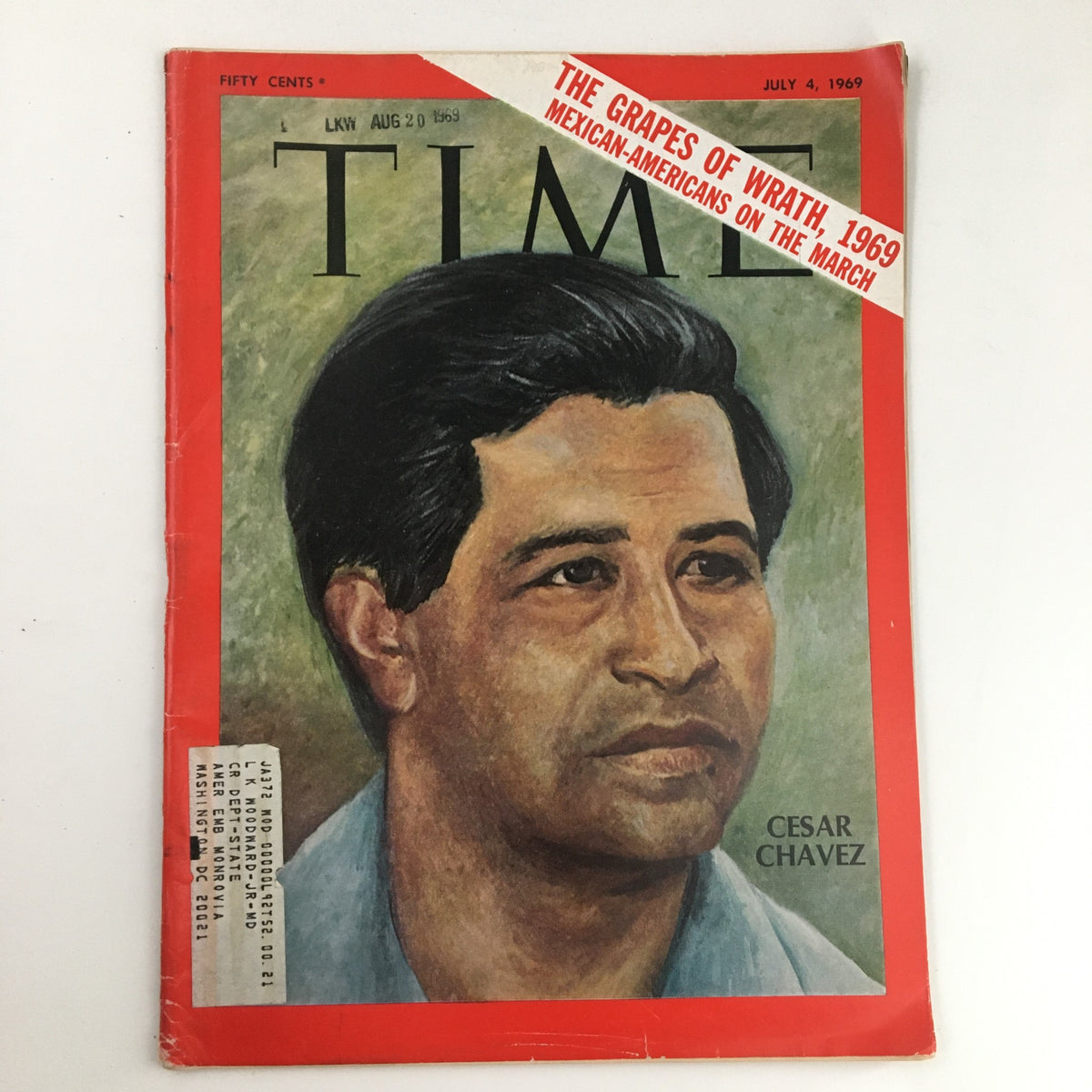
The July 4, 1969 issue of Time Magazine — Volume 94, Number 1 — is among the most historically significant covers the publication produced during the entire decade of the 1960s, and the editorial judgment it represents has only grown more resonant with the passage of time. Placing Cesar Chavez on the cover of Time on Independence Day 1969 was a deliberate and carefully considered act of American journalism at its most politically engaged. Chavez was not a senator, a general, a president, or a corporate titan — the usual subjects of Time cover recognition. He was the son of migrant farmworkers, a labor organizer who had spent the better part of a decade living and working alongside the people he was fighting for, and the leader of a movement that had chosen the most economically vulnerable workers in America — undocumented and domestic migrants laboring in the agricultural fields of California — as the ground on which it would make its stand for human dignity. Placing him on Time's cover on the Fourth of July was the magazine making an unmistakable argument: that Chavez and the farm workers' movement embodied a version of American values — the promise of equal dignity, the right to organize, the possibility of justice for the most marginalized — that was as central to the meaning of Independence Day as any of the country's more celebrated traditions. For collectors focused on the documented history of American labor and civil rights movements, the Cesar Chavez magazine collection at OriginalMagazines.com provides the most focused archive of his press coverage, and this Time cover sits at its most historically significant tier.
By July 1969, the United Farm Workers — the union Chavez had co-founded with Dolores Huerta in 1962 — was in the midst of one of the most important and creative campaigns in American labor history. The Delano grape strike, begun in 1965, had evolved into a national grape boycott that was reshaping how Americans thought about the connection between their consumer choices and the conditions of the workers who produced their food. The boycott was, by 1969, genuinely effective: table grape sales had dropped significantly, major supermarket chains were under pressure from consumers and activist groups, and the political visibility of the farm workers' cause had reached a level that forced serious engagement from politicians and major institutions that had previously ignored agricultural labor entirely. Chavez had conducted a twenty-five-day fast in 1968 — his first major public fast — that had drawn Robert F. Kennedy to his bedside in Delano in one of the most photographed moments of that extraordinary year, and his willingness to use his own body as an instrument of moral witness had given the movement a spiritual dimension that distinguished it from conventional labor organizing. A Time cover in July 1969 captured him at the movement's point of maximum national visibility and moral authority, before the harder years of internal conflict and diminishing returns that the 1970s would bring. The full range of 1969 magazines from this year documents one of the most turbulent and consequential twelve months in American history — the moon landing, Woodstock, the continuation of the Vietnam War, the ongoing civil rights struggle — and the Chavez Time cover stands as one of its most enduring editorial images.
The Independence Day publication date is not incidental and should not be treated as one. Time's editors were making a conscious choice to open their ninety-fourth volume with a cover that placed the farm workers' movement within the framework of American democratic ideals on the country's most symbolic national holiday. The implicit argument — that the promise of American independence remained unfulfilled for millions of the country's workers and that Chavez was among the most important people alive in the effort to redeem that promise — was a political statement of unusual boldness for a mainstream American newsmagazine. The 1960s had been a decade in which Time's relationship with the civil rights movement had evolved considerably, and by 1969 the magazine was capable of making editorial choices that would have been unthinkable a decade earlier. This cover is evidence of that evolution at its most direct and most historically significant, and it rewards examination not just as a document of Chavez's career but as a document of American mainstream journalism coming to terms with the full complexity of the country's democratic commitments. The Time Magazine archive provides the essential context for understanding this issue's place within the publication's long history of consequential cover selections, spanning nearly a century of editorial engagement with American and world affairs.
About the Publication
Time Magazine was founded in 1923 by Henry Luce and Briton Hadden as the first weekly news magazine in the United States, and by the late 1960s it had spent four decades as the most widely read and most culturally authoritative general news publication in the country, its weekly rhythm providing a consistent analytical framework for millions of educated American readers navigating one of the most turbulent periods in the nation's modern history. Its editorial format combined political and foreign affairs coverage with cultural reporting, business news, science, and the arts, delivered through a confident editorial voice that was willing to make judgments, assign significance, and tell its readership what the week's events meant. The cover selection process carried genuine cultural weight: appearing on the cover of Time in this era was broadly understood as one of the most significant forms of mainstream American recognition available to a public figure, and the magazine exercised that power with deliberateness. By Volume 94 in 1969, the magazine was operating under maximum editorial pressure from a society in upheaval — the civil rights movement, the antiwar movement, urban unrest, and the cultural revolutions of the decade all demanding serious engagement from a publication whose readership included the full spectrum of American educated opinion. The Chavez cover represents Time at its most historically consequential, making an editorial argument about American values and democratic ideals that the passage of fifty-plus years has thoroughly validated.
Key Highlights Inside
- Cesar Chavez cover feature and United Farm Workers coverage — The central editorial content of this issue engages with Chavez's leadership of the farm workers' movement and the national grape boycott at the moment of its maximum effectiveness and moral authority. A Time cover story on Chavez in July 1969 would have provided the magazine's mass readership with the most comprehensive portrait of the man and his movement that mainstream American journalism had yet produced, explaining the history of the Delano strike, the mechanics and effectiveness of the boycott, and the broader significance of the farm workers' cause for American labor and civil rights history.
- The grape boycott's national impact documented in real time — By mid-1969, the United Farm Workers' boycott of California table grapes was one of the most effective consumer activism campaigns in American history, with measurable effects on grape sales and supermarket purchasing policies across the country. Coverage from this precise moment captures the boycott at its operational peak, before its ultimate resolution in 1970 — a contemporaneous account of a labor strategy that had no real precedent and that was being watched by organizers, politicians, and corporations with equal intensity.
- Independence Day editorial framing of American democratic values — The deliberate publication of a Chavez cover on July 4, 1969 created an editorial statement about the meaning of American independence and democratic ideals that was as direct and as significant as any the magazine had made during the decade. The framing of the farm workers' struggle within the context of the country's foundational commitments gives this issue a symbolic and rhetorical dimension that is inseparable from its historical content and that elevates it above straightforward labor movement coverage into something closer to a statement of national conscience.
- Civil rights movement at its late-1960s complexity — By July 1969, the civil rights movement had moved well beyond the legislative victories of the mid-1960s into a more complex and contested phase, with the Poor People's Campaign, the continuing Vietnam War's disproportionate impact on minority communities, and the emergence of more militant political formations all reshaping the landscape of American activism. Chavez's movement occupied a distinct position within that landscape — explicitly nonviolent, spiritually grounded, and focused on economic justice through labor organizing — and Time's coverage would have engaged with those distinctions and their significance for the broader movement.
- Late 1960s American political and social context — A Time issue from July 4, 1969 would have contained the full range of the magazine's weekly coverage alongside the Chavez feature — Vietnam War reporting, domestic political news from the Nixon administration's first months in office, and the cultural commentary that Time consistently wove through its news coverage. The surrounding content in any issue from this period of American history is itself a primary document of the country at a moment of extraordinary political and social stress.
- Note: Specific additional article titles, bylines, and the complete table of contents beyond the confirmed cover subject and the farm workers' coverage have not been independently verified for this issue. The highlights above reflect what is documentable from the listing description, the well-established history of the United Farm Workers' movement in 1969, and Time's confirmed editorial practices and cover selections during this period.
Condition & Rarity
This issue is described as being in good condition with minor wear consistent with over fifty years of existence, carrying an address label on the front cover and protected by a plastic covering. The front-cover address label is the primary condition consideration for any collector evaluating a surviving copy of this issue, and its presence is entirely typical for Time from this era — the magazine was primarily a subscription publication throughout the late 1960s, and the vast majority of surviving copies carry labels that have bonded permanently to the cover surface after five decades, making clean removal without damage to the underlying print essentially impossible. Collectors should approach the label question with the baseline expectation that labeled copies are the norm among survivors of this issue and that the label's placement relative to the Chavez portrait — whether it falls in the margin area or over the central image — is the relevant variable for grading the visual impact. The minor wear noted throughout is honest and expected for a publication of this vintage: Time's coated cover stock from this period holds up reasonably well compared to lighter newsprint contemporaries, but five decades of storage inevitably produce some degree of corner blunting, cover scuffing, and page toning regardless of storage quality. The plastic protective covering indicates intentional preservation care at some point in the object's history, which correlates with better overall physical stability and reduced environmental damage compared to unprotected copies stored under similar conditions. Collectors evaluating surviving copies should examine the spine at both staple points for rust spotting and page separation at the gutter — the most consistent structural failure point in Time's saddle-stitched format from this era — and the interior page margins for the toning and brittleness that the paper stock of late 1960s Time issues is susceptible to after extended storage in variable conditions.
Looking for More Issues Like This?
The July 4, 1969 Time Cesar Chavez cover is one of the most historically significant and most actively sought issues in the magazine's entire run among collectors working at the intersection of American labor history, civil rights documentation, and Time archive collecting — three communities that pursue this specific issue with considerable seriousness and that collectively ensure strong copies move quickly when they surface. If this issue is no longer available, the Cesar Chavez magazine collection at OriginalMagazines.com is the essential starting point for finding other significant coverage of his life and legacy across the publications that documented the farm workers' movement across its full arc. The Time Magazine archive provides substantial depth for collectors building around the publication itself, spanning its full history of consequential cover selections and historically significant reporting. And for anyone building a documentary record of 1969 specifically — one of the most historically dense years in twentieth-century American life — the 1969 magazines collection brings together a wide range of titles from that extraordinary year, collectively mapping the full sweep of American culture, politics, and social transformation at one of its most consequential moments.