

Description
Collector's Note – Why This Issue Matters
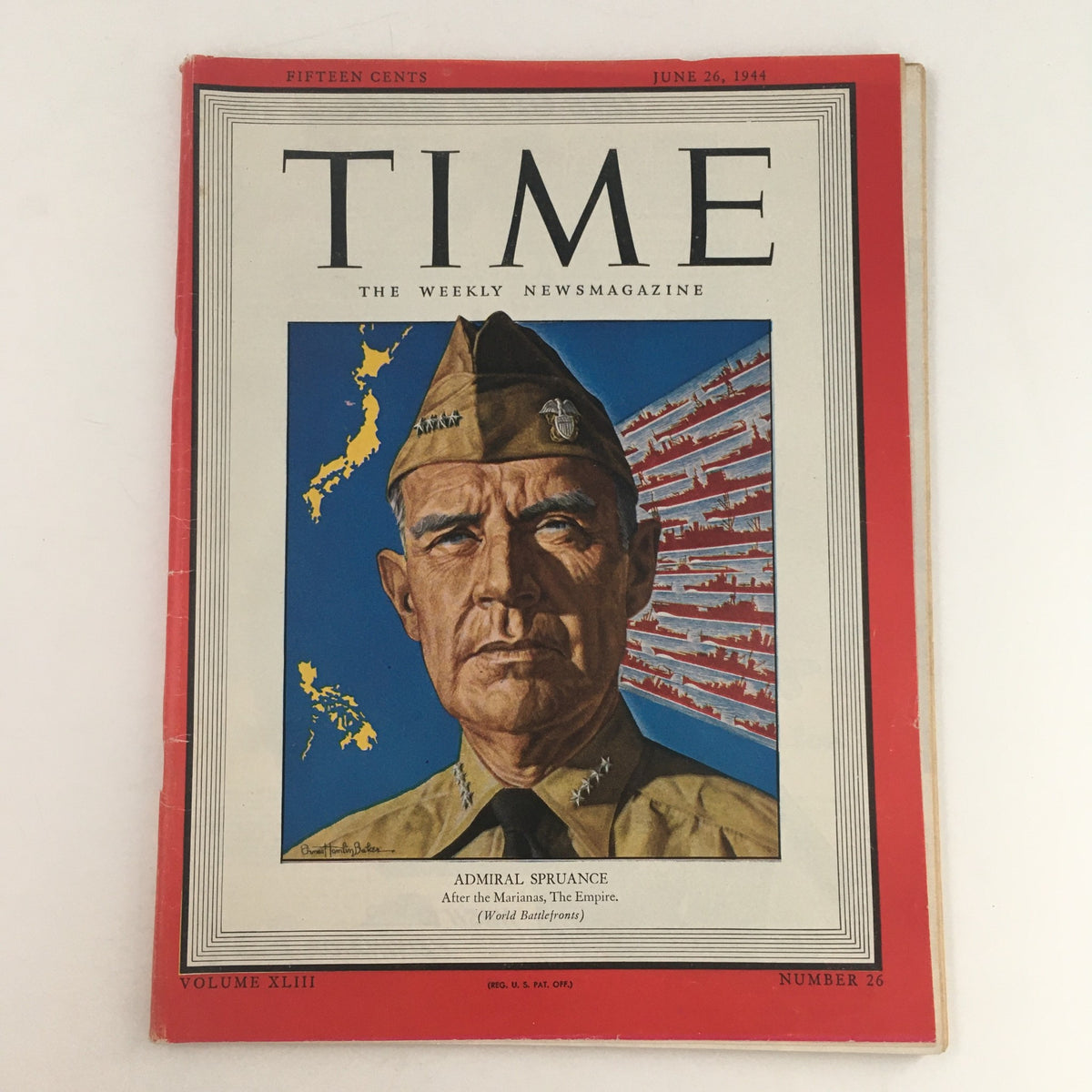
June 26, 1944 is one of the most consequential publication dates in Time Magazine's wartime archive. Admiral Raymond A. Spruance on the cover of this specific issue was not merely a recognition of a significant military commander — it was a direct and precisely timed editorial response to one of the most decisive naval engagements of the entire Pacific War. The Battle of the Philippine Sea had been fought June 19 and 20, 1944, just six days before this issue's publication date. In that battle, Spruance commanded the Fifth Fleet and oversaw the destruction of Japanese carrier aviation in what became known as the "Great Marianas Turkey Shoot" — an engagement that effectively eliminated Japan's ability to conduct offensive carrier operations for the remainder of the war. The timing of this Time cover is therefore not merely a general wartime profile but a direct journalistic response to a specific and decisive military event, produced within days of its occurrence for a readership that was still receiving the first reports of what had happened and what it meant. For collectors building an archive of Time Magazine covers from the Second World War Pacific Theater, this June 26, 1944 edition is among the most historically specific and precisely dated entries in the magazine's wartime run — a cover story produced at the exact moment of one of the war's most consequential turning points.
Raymond Spruance himself was one of the more remarkable and least publicly known senior commanders of the Second World War, and his appearance on the Time cover reflects the magazine's consistent ability to identify the figures whose work was most directly shaping the war's outcome even when those figures operated largely outside the public's awareness. Spruance had commanded the American carrier force at the Battle of Midway in June 1942 — the turning point of the Pacific War — stepping in for the ailing Admiral William Halsey just before the engagement and making the crucial tactical decisions that resulted in the destruction of four Japanese fleet carriers. His subsequent command of the Fifth Fleet had overseen the Central Pacific campaign that was systematically dismantling Japan's island defenses, and the Philippine Sea victory in June 1944 represented the culmination of that campaign's strategic logic. A Time cover in June 1944 was therefore not a belated recognition of a figure who had recently become significant but a timely documentation of a commander at the precise moment of his most operationally decisive achievement. The absence of a newsstand label preserves the cover portrait — almost certainly a Boris Chaliapin painting, consistent with Time's wartime cover practice — in its full, unobstructed form, which for a cover produced in direct response to one of the war's most significant naval engagements has particular documentary value. Collectors researching American magazines from 1944 will find this issue a primary document of the Pacific War at its most operationally decisive June moment.
The broader context of June 26, 1944 in the overall war gives this issue an extraordinary density of historical significance. The D-Day landings in Normandy had occurred on June 6, 1944 — twenty days before this issue's publication — and the Allied breakout from the Normandy beachhead was just beginning. The war in Europe and the war in the Pacific were simultaneously at their most critical phases: in the same week that American forces were consolidating the Normandy beachhead, American naval aviation was destroying Japanese carrier power in the Philippine Sea. A Time Magazine cover story on Spruance, published in this specific week of June 1944, exists in the middle of the most consequential fortnight of the entire war — D-Day already behind, the Philippine Sea battle just concluded, and the ultimate Allied victory beginning to look, for the first time, genuinely inevitable. The weekly news, foreign affairs, Army and Navy, and battlefront coverage that surrounded the Spruance cover story would have engaged all of these simultaneous developments, making this issue a comprehensive primary source document of the war at its most historically charged single week.
About the Publication
Time Magazine was founded in 1923 by Henry Luce and Briton Hadden as the first weekly news magazine in the United States, and by June 1944 had sustained twenty-one years as one of the most widely read and institutionally authoritative publications in American journalism. Its wartime editorial approach committed the full resources of its reporting and its cover portrait tradition — executed primarily by Boris Chaliapin and a small group of accomplished commercial painters — to documenting the global conflict's most consequential figures and events with the weekly urgency and analytical depth that made it the primary framework through which millions of Americans understood the war. The cover system's designation of a single figure as the week's most historically significant person carried particular weight during wartime, and the choice of Spruance for the June 26, 1944 cover — in the immediate aftermath of the Philippine Sea — reflects the editorial intelligence that consistently distinguished Time's war coverage from less analytically rigorous contemporaries.
Key Highlights Inside
- Admiral Raymond A. Spruance cover story — a primary document of Time's direct editorial response to the Battle of the Philippine Sea, fought June 19 and 20, 1944, published six days after the engagement and constituting one of the most precisely timed cover stories in the magazine's wartime run — a contemporaneous journalistic assessment of a commander at the exact moment of his most operationally decisive achievement in the Pacific War.
- Pacific Theater battle coverage — editorial content engaging the Battle of the Philippine Sea's destruction of Japanese carrier aviation, the "Great Marianas Turkey Shoot" that eliminated Japan's ability to conduct offensive carrier operations for the remainder of the war, documented for a readership still receiving the first accounts of what had occurred and what its strategic implications were.
- European Theater coverage — content produced in the third week after D-Day, as the Allied breakout from the Normandy beachhead was beginning and the overall shape of the European campaign was becoming clearer, providing the Atlantic war context within which the Pacific victory at Philippine Sea had its full strategic meaning for readers attempting to assess the overall trajectory of the war.
- Army and Navy, Battlefronts, and Foreign News departmental coverage consistent with Time's June 1944 editorial scope — the full weekly cross-section of wartime military and diplomatic developments across all theaters simultaneously, collectively constituting a comprehensive primary source document of the war at the most historically charged week of its entire duration.
- Note: Specific secondary article titles, confirmed departmental content details, and individual bylines beyond the cover story have not been individually verified for this issue. The highlights above reflect Time's well-documented wartime editorial format, the verified cover subject and volume/issue number, and the thoroughly documented historical context of June 26, 1944.
Condition & Rarity
Time Magazine issues from June 1944 are approaching their eighty-second year of existence, and the condition landscape for surviving copies from this wartime period reflects the full weight of that age alongside the specific paper quality constraints of wartime American production. Good condition with minor wear and no newsstand label is an honest and meaningful assessment for an eighty-one-year-old weekly wartime newsmagazine — it describes a copy that retains structural integrity and readable content while carrying the authentic physical evidence of more than eight decades of existence. The absence of a newsstand label is the most significant condition positive, preserving the Spruance cover portrait in its full, unobstructed form and distinguishing this from the more commonly encountered subscriber copies of the period whose front labels partially covered the cover image. Wartime paper quality considerations are relevant: Time issues from 1944 were produced on paper stock subject to wartime materials restrictions, which accelerates the natural aging of periodicals from this period relative to prewar and postwar examples of comparable age. The plastic protective sleeve provides ongoing archival protection. Collectors evaluating surviving examples of this issue should prioritize cover legibility and the Spruance portrait integrity, the completeness of all interior pages including the Pacific battle coverage, and overall structural soundness as primary condition criteria.
Looking for More Issues Like This?
A Good-condition, label-free copy of the June 26, 1944 Time Magazine with the Raymond Spruance cover — published six days after the Battle of the Philippine Sea in the same week as the post-D-Day Normandy consolidation — is one of the most historically specific and consequential entries in the magazine's wartime Pacific Theater archive, and surviving copies from this extraordinary week in the war's history surface infrequently in any condition. If this issue is no longer available, the full Time Magazine collection at OriginalMagazines.com is the most comprehensive place to browse surviving issues from across the publication's history and locate other Pacific War covers, wartime military profiles, or specific issues from Time's most historically charged wartime year. The 1944 magazine collection brings together surviving issues from across that year's major publications for collectors working to document the full breadth of American print journalism during the decisive final year of the Second World War.