
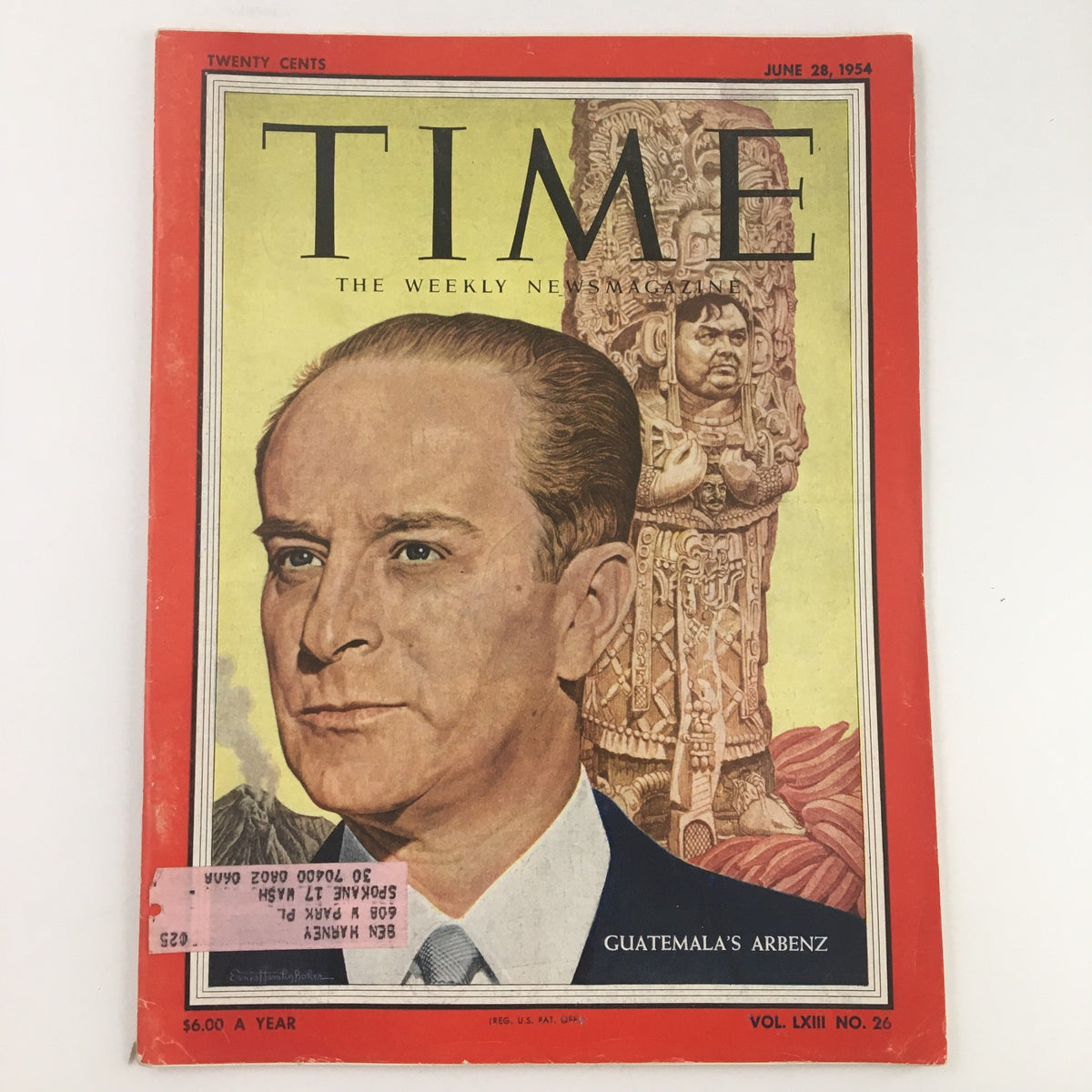

Description
Collector's Note – Why This Issue Matters
This June 28, 1954 issue of Time arrived at the absolute climax of one of the most consequential covert operations of the early Cold War, landing in print during the very days that Guatemalan President Jacobo Árbenz's government was collapsing under a U.S.-orchestrated campaign that would not be publicly acknowledged as a CIA operation for decades. A small invasion force backed by the CIA had crossed into Guatemala from neighboring countries on June 17 and 18, just days before this issue's cover date, and Árbenz would resign from office on June 27, one day before this issue's official publication date. This means the magazine went to press at the exact moment the crisis was reaching its breaking point, capturing American press coverage of events as they were publicly understood at the time, framed through the lens of Cold War anti-communism rather than the covert CIA planning that would only become known through declassified documents released decades later. Time's coverage in this period reflected the prevailing American narrative that Árbenz's land reform government posed a communist threat in "America's backyard," a framing actively shaped by U.S. government statements and the broader anti-communist political climate of the early 1950s. Readers in 1954 would have had no public knowledge of the CIA's Operation PBSUCCESS, the code name for the actual covert campaign behind Árbenz's removal, since that operation remained classified until historical research and declassified records gradually revealed its full scope beginning decades later.
The broader context behind this crisis involved Árbenz's land reform program, Decree 900, which had moved to redistribute large uncultivated landholdings to landless peasants and had directly affected the extensive holdings of the United Fruit Company, an American corporation with deep ties to U.S. political figures, including Secretary of State John Foster Dulles and CIA Director Allen Dulles, both former partners at United Fruit's primary Washington law firm. This entanglement between corporate interest and government policy would only become fully apparent in later historical accounts, but it represents an essential undercurrent to the crisis Time was covering in this issue, even if the magazine's contemporary reporting reflected the official anti-communist justification rather than this underlying commercial dimension. Árbenz's resignation, which followed mounting military pressure and psychological warfare operations designed to convince Guatemalans that an overwhelming invasion was underway despite the comparatively modest size of the actual invading force, marked the definitive end of the broader Guatemalan Revolution that had begun a decade earlier in 1944. For collectors today, this issue offers a genuinely rare opportunity to examine how a major American news publication covered a pivotal Cold War event in real time, before the historical record was substantially revised by later disclosures about the CIA's actual role.
This issue's value to collectors and researchers lies precisely in that gap between contemporary 1954 reporting and the fuller historical understanding that emerged decades later, making it a genuinely useful primary source for studying how American media covered covert Cold War interventions before such operations were publicly acknowledged. That combination of precise historical timing and the documented disparity between contemporary coverage and later historical revelation gives this issue substantial value within the broader landscape of Time magazine collecting, where issues capturing pivotal, since-reexamined Cold War events remain a consistently significant area of interest for historians and serious collectors alike.
About the Publication
Time, founded in 1923 by Henry Luce and Briton Hadden, established itself as one of the most influential American newsmagazines of the twentieth century, known for its condensed, narrative-driven approach to covering national and international current events on a weekly basis. By the 1950s, Time had become a dominant force in shaping how millions of American readers understood unfolding world events, including the rapidly escalating tensions of the Cold War, which the magazine covered extensively through the lens of American anti-communist policy and concern. The magazine's format combined authoritative-sounding reporting with a distinctive, often opinionated narrative voice, a style that distinguished Time from more strictly neutral wire-service reporting and gave its coverage of events like the Guatemalan crisis a particular interpretive framing consistent with the dominant Cold War political climate of the period. Time's reporting during this era reflected the information available to American journalists at the time, which in the case of covert CIA operations like the one in Guatemala did not include the classified details that would only emerge through later historical research and government declassification. This combination of broad influence and necessarily incomplete contemporary knowledge makes Time's 1950s coverage of Cold War events a valuable primary source for understanding the public narrative surrounding interventions whose full covert dimensions were not revealed until much later.
Key Highlights Inside
- Cover story on Guatemalan President Jacobo Árbenz, published during the exact week his government was collapsing under a U.S.-backed military and psychological campaign. The invasion force had crossed into Guatemala on June 17 and 18, just days before this issue's cover date. Árbenz would resign from office on June 27, one day before this issue's official publication date.
- Coverage reflecting the prevailing 1954 American narrative of Árbenz's government as a communist threat in Central America. This framing was shaped significantly by U.S. government statements and the broader anti-communist political climate of the early Cold War. The covert CIA operation behind the crisis, later known as Operation PBSUCCESS, remained classified and was not publicly known at the time of this issue's publication.
- Context related to Árbenz's land reform program, Decree 900, which had redistributed large uncultivated landholdings and affected the extensive Guatemalan holdings of the American-owned United Fruit Company. This land reform initiative was directly connected to the broader crisis covered in this issue. The full extent of United Fruit's political connections to the U.S. government's response would not become widely understood until later historical accounts.
- Broader Cold War-era news coverage characteristic of Time's editorial approach during this period. The magazine's narrative-driven reporting style gave its coverage of unfolding international crises a distinctive interpretive voice. This approach reflected Time's broader influence in shaping American public understanding of Cold War events during the 1950s.
Condition & Rarity
Surviving copies of this issue are generally evaluated using the same standards collectors apply across vintage newsmagazines: cover and spine integrity, completeness of interior pages, and overall condition free of significant brittleness, foxing, or moisture damage given the issue's considerable age. A copy described as being in good condition, with minor wear typical of its age, would be considered a reasonable survivor for a magazine now more than seventy years old. The presence of an address label on the cover is a common characteristic of subscription copies from this era and is generally treated by collectors as a normal feature of surviving mid-century issues rather than a significant flaw, though unlabeled newsstand copies are often considered more visually desirable when available. A plastic protective sleeve is a standard and effective safeguard for an issue of this age, helping prevent further handling wear and environmental damage, though it has no bearing on the underlying grade of the magazine itself. Given this issue's precise and well-documented connection to a pivotal moment in Cold War history, collectors focused on Latin American political history or the broader history of CIA covert operations may weigh the issue's content and exact timing particularly heavily relative to minor cosmetic considerations like the address label. Pages free of brittleness, significant yellowing, or prior tape repairs remain the broader benchmark for a well-preserved copy of any magazine from this era.
Looking for More Issues Like This?
A Time issue capturing the collapse of Jacobo Árbenz's government during the exact week of his resignation offers genuine historical substance for collectors and researchers studying Cold War-era covert intervention and Latin American political history. If this particular issue isn't available, it's worth browsing the broader Time magazine collection for other issues spanning this title's long and historically significant run. Collectors focused on the era itself may also want to look through the full range of 1954 magazines for other issues from that pivotal Cold War year. Each of these collections offers a different way into the period, whether the interest lies in this specific title's editorial history or the broader political snapshot of a single consequential year. A single year's worth of magazines often tells a fuller story than any one issue alone, particularly for a year shaped so heavily by Cold War interventions across multiple regions. Browsing by publication can also help collectors trace how Time's coverage of Guatemala and broader Latin American politics evolved in the years following this pivotal crisis. Whichever angle appeals most, these collections are a useful starting point for going deeper into this consequential period of Cold War and world history.