


Description
Collector's Note – Why This Issue Matters
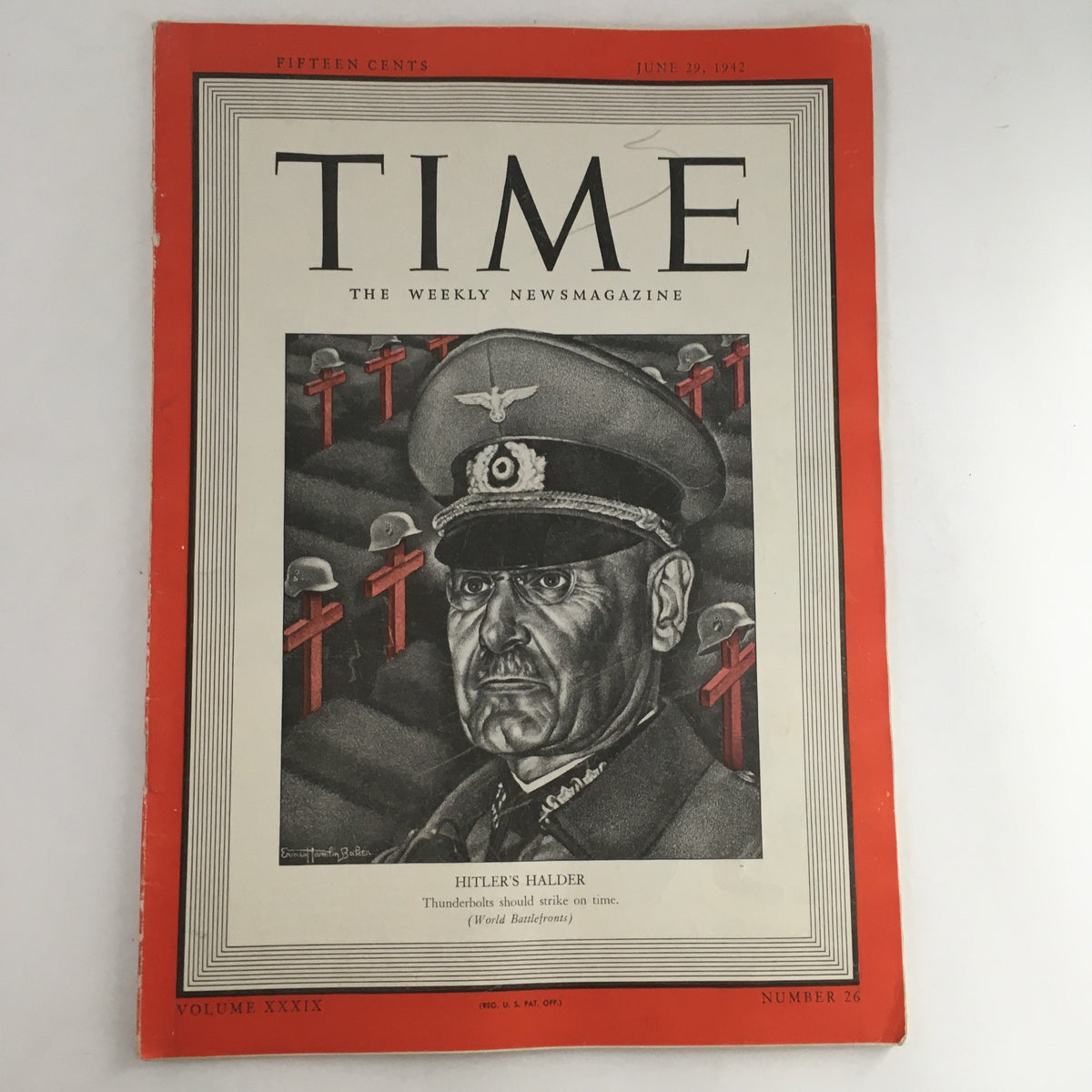
The June 29, 1942 issue of Time Magazine — Volume 39, Number 26 — places General Franz Halder on its cover at one of the most consequential and strategically treacherous moments of the entire Second World War. By late June 1942, the German war in the Soviet Union had entered its second summer, and the Wehrmacht was in the opening phases of Case Blue — the massive southern offensive that would ultimately drive toward Stalingrad and the Caucasus oil fields, the campaign that would end in the catastrophic German defeat of early 1943 and mark the definitive turning point of the war on the Eastern Front. Halder, as Chief of the German Army General Staff since 1938, was the senior professional military mind directing that offensive at the operational level, working under Hitler's increasingly erratic and interventionist strategic direction in a command relationship that was already deeply dysfunctional and would become intolerable within weeks. The fact that Time placed Halder on its cover in June 1942 reflects the American press's effort to explain to its readership who was actually running the German military machine — to identify the professional soldier behind the headlines, the man whose operational planning was translating Hitler's ambitions into the movements of armies across a front of staggering scale. For collectors focused on the documentary history of the Second World War's Eastern Front and the personalities who shaped it, the Time Magazine archive at OriginalMagazines.com provides one of the most consistent and historically significant records of how the American press tracked and interpreted German military leadership throughout the conflict.
Franz Halder's position in the history of the Second World War is genuinely complex, and that complexity gives a Time cover featuring him a layer of historical interest that a simpler subject would not provide. He was, by any measure, one of the most capable professional soldiers of his generation — a Bavarian staff officer of the old school whose meticulous planning had been central to the success of the Fall of France in 1940 and the early phases of Barbarossa in 1941. He had also, in the late 1930s, been involved in at least preliminary discussions among German officers about the possibility of removing Hitler before the war began — not out of moral opposition to Nazism in any developed sense, but out of professional military judgment that Hitler's strategic ambitions would lead Germany to catastrophe. That resistance, such as it was, had come to nothing, and by 1942 Halder was executing Hitler's orders on the Eastern Front while maintaining a private diary that would become one of the most important primary sources for understanding German military decision-making during the war. His dismissal by Hitler in September 1942 — just months after this issue appeared — came as a direct consequence of his professional resistance to Hitler's increasingly unrealistic operational demands during the Stalingrad campaign. A Time cover from June 1942, before that dismissal, captures Halder at the peak of his wartime authority and on the threshold of the strategic disaster that would effectively end his military career. The full range of 1942 magazines from this year documents the arc of that story from the American perspective, spanning the months from the Axis's maximum territorial expansion through the first signs of the strategic reversal that would ultimately doom Germany's war.
June 1942 was a month of genuine strategic uncertainty for the Allied cause, and American readers encountering this issue would have done so in an atmosphere of considerable anxiety about the war's outcome. The fall of Tobruk to Rommel's forces occurred on June 21, 1942 — just eight days before this issue's publication date — representing one of the most significant British military disasters of the entire war and sending shockwaves through the Allied high command. On the Eastern Front, the German summer offensive was just beginning, with its ultimate objectives not yet clear to Allied intelligence. The Pacific war was in its own state of flux, with the Battle of Midway having occurred earlier in June but its full strategic significance not yet absorbed. For American readers in late June 1942, the war's outcome was genuinely uncertain in ways that retrospective history tends to obscure, and a Time cover profile of the general directing Germany's ground forces in the Soviet Union would have been read in that atmosphere of real concern rather than confident hindsight. That contemporaneous quality — the uncertainty, the anxiety, the attempt to understand an enemy whose operational methods were still being deciphered — is precisely what gives primary sources from this period their irreplaceable documentary value for serious collectors and historians.
About the Publication
Time Magazine was founded in 1923 by Henry Luce and Briton Hadden as the first weekly news magazine in the United States, and by the early 1940s it had established itself as the most influential and widely read general news publication in the country, its weekly rhythm providing a consistent analytical and narrative framework for millions of educated American readers navigating the most consequential series of events in their lifetimes. Its editorial format combined political and foreign affairs coverage with reporting on business, culture, science, and the arts, delivered through a confident and distinctive voice that was unabashedly willing to make judgments, assign significance, and tell its readers what the week's events meant rather than simply cataloguing them. The wartime issues of Time represent the publication operating under maximum editorial pressure and with maximum cultural authority simultaneously — a weekly publication trying to make sense of a global conflict whose scale and complexity taxed even the most sophisticated analytical frameworks available. The cover selection process in this period was itself a form of editorial argument: placing a German general on the cover of an American magazine in June 1942 was not a neutral act but a deliberate statement that understanding the enemy's leadership was essential to understanding the war. Issues from this period of the magazine's history are now recognized by collectors and military historians alike as some of the most significant primary documents in its entire publishing run.
Key Highlights Inside
- Franz Halder cover portrait and feature — A Time cover profile of Halder in June 1942 would have provided American readers with a detailed examination of the man directing German ground operations on the Eastern Front at the opening of Case Blue, explaining his professional background, his role in the Wehrmacht's command structure, and the strategic context of the offensive he was overseeing. As a primary document of how American military journalism understood German leadership at this precise moment in the war, the feature carries research value that extends well beyond the fan or collector context into serious military historical scholarship.
- Case Blue and the Eastern Front at a strategic hinge point — The German summer offensive of 1942 was, in retrospect, the last major strategic initiative the Wehrmacht would launch from a position of genuine strength on the Eastern Front. Coverage from June 1942 captures the opening of that offensive before its outcome — catastrophe at Stalingrad — was known, preserving the contemporaneous uncertainty and the American press's attempt to interpret events whose significance would only become fully clear in the months and years that followed.
- The fall of Tobruk and North African campaign context — With Tobruk having fallen to Rommel's forces just eight days before this issue's publication, any Time issue from late June 1942 would have been produced in the immediate aftermath of one of the most shocking Allied military defeats of the war. The North African situation and its implications for the broader Allied strategy in the Mediterranean theater would almost certainly have been prominent in the surrounding coverage, providing a multi-front picture of the war at one of its most anxious moments for Allied planners and observers.
- American wartime journalism at maximum intensity — Time in mid-1942 was producing some of the most consequential journalism in its history, with a reporting and editorial staff operating under the understanding that their publication was one of the primary lenses through which American decision-makers and the educated public were processing a war that touched virtually every American family. The quality of analysis and the depth of reporting in issues from this period reflect that institutional seriousness at full operational intensity.
- Period wartime advertising as historical document — Time issues from mid-1942 contain advertising that is itself a vivid document of the American home front economy in full wartime mobilization — manufacturers pivoting their consumer messaging to war production pride, war bond appeals, and the visual language of American commercial culture operating under total war conditions in ways that illuminate the domestic experience of the conflict from an angle that editorial content alone cannot capture.
- Note: Specific article titles, additional reported features, and the complete table of contents beyond the confirmed cover subject have not been independently verified for this issue. The highlights above reflect what is documentable from the listing description, the well-established historical context of June 1942, and Time's confirmed editorial practices during the wartime period.
Condition & Rarity
This issue is described as being in good condition with minor wear including small rips, edge wear, creases, and marks consistent with over eighty years of existence, presented as a newsstand copy without a mailing label and protected by a plastic covering. The newsstand origin and label-free cover are among the most significant positive condition attributes for a publication of this vintage. Time in 1942 was overwhelmingly a subscription publication, and the vast majority of surviving copies from this period carry address labels applied directly to the front cover — labels that after eight decades have bonded permanently to the cover surface in ways that make clean removal without damage essentially impossible. A newsstand copy with a clean, label-free cover is therefore meaningfully rarer than the subscription majority, preserving the full visual integrity of the Halder cover portrait without the label disruption that characterizes most surviving examples. The minor wear described — small rips, edge wear, creases, and marks — is honest and expected for a publication that is now more than eighty years old and was printed on paper stock that was already subject to wartime conservation measures reducing quality from prewar standards. Small rips along edges and corner creases are the most common wear patterns in surviving copies of wartime Time issues and are generally assessed by collectors as acceptable minor handling evidence at this age rather than significant condition defects. The plastic protective covering indicates intentional preservation care at some point in the object's history, which correlates with better overall stability than unprotected copies stored under comparable conditions. Collectors evaluating surviving copies of this issue should examine the staple points carefully for rust spotting and page separation at the gutter — the most common structural failure point in Time's saddle-stitched format from this era — and the outer margins of interior pages for the toning and brittleness that wartime-era paper stock is particularly susceptible to after extended storage in variable conditions. A newsstand copy presenting at good grade overall with a clean cover, despite the honest wear noted, represents a genuinely strong surviving example of a wartime issue that was never produced with archival longevity in mind.
Looking for More Issues Like This?
Time Magazine covers featuring German military leadership from the active wartime period are among the most historically charged items in American magazine collecting, pursued by Second World War historians, Eastern Front specialists, and Time archive collectors who recognize these issues as primary documents of how American journalism understood and explained the enemy at the height of the conflict. If this June 1942 issue is no longer available, the Time Magazine archive at OriginalMagazines.com is the most comprehensive resource for exploring what else has surfaced from the publication's extraordinary wartime run, spanning its full coverage of the conflict from Pearl Harbor through V-J Day and beyond. For collectors building a documentary record of 1942 specifically — the year of maximum Axis territorial expansion, Midway, Stalingrad's opening, and the Allied strategic turning point — the 1942 magazines collection brings together a wide range of titles from that pivotal year, each offering its own contemporaneous perspective on events whose outcome remained genuinely uncertain to the people living through them.