

Description
Collector's Note – Why This Issue Matters
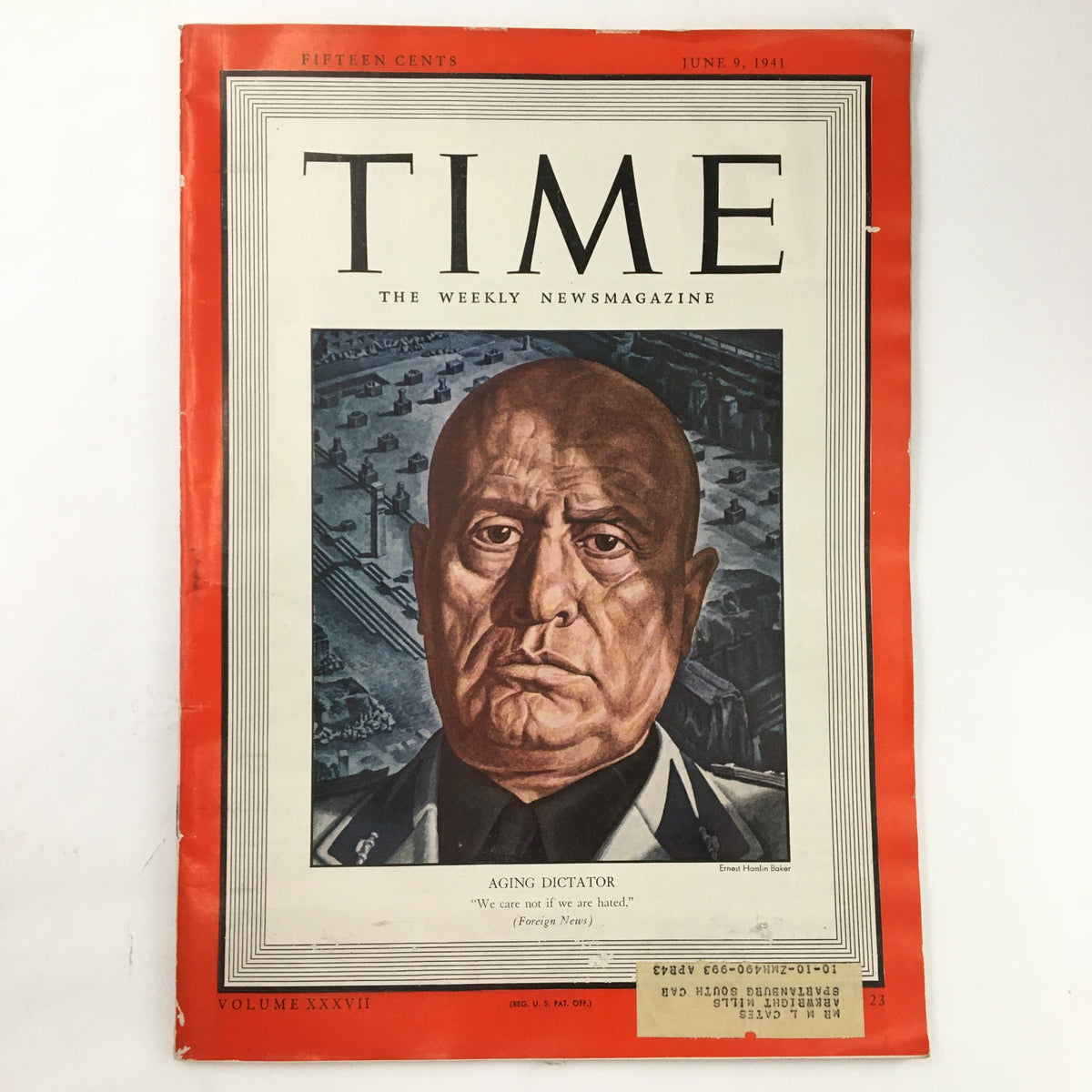
The June 9, 1941 issue of Time Magazine — Volume 37, Number 23 — featuring Benito Mussolini on its cover is one of the most historically charged single issues the publication produced during the entire Second World War, and the timing of its appearance gives it a documentary significance that collectors of wartime American journalism will immediately recognize. By June 1941, Mussolini had been at war for exactly one year — Italy had entered the conflict on June 10, 1940, in the confident expectation of sharing in Germany's rapidly accumulating victories — and the results had been catastrophic. The Italian military campaigns in Greece, North Africa, and East Africa had all gone disastrously wrong, requiring German intervention to prevent outright collapse and demonstrating to the world that Mussolini's imperial ambitions far exceeded his military capabilities. The Time cover's framing of Mussolini as an "aging dictator" in June 1941 is itself an editorial judgment of extraordinary significance: it captures the precise moment when the Fascist leader's aura of invincibility had definitively cracked, when the bombastic confidence that had defined his public persona for two decades was giving way to the visible strain of a war that was already consuming his regime's pretensions. For collectors building a serious archive of Second World War American journalism, the Time Magazine vintage collection is the most comprehensive resource for tracing how the most widely read American newsweekly covered the war's major personalities and turning points across its full duration.
Mussolini's historical position in June 1941 — and what it meant for American readers encountering this cover on their newsstands — is worth tracing with some care, because the American political context gives this issue a specific resonance that goes beyond the Italian military situation. The United States was still six months from Pearl Harbor when this issue appeared, formally neutral but increasingly engaged in supporting Britain through Lend-Lease and increasingly hostile to the Axis powers in ways that stopped just short of active belligerency. American public opinion was deeply divided between interventionists and isolationists, and the debates playing out in Congress, in editorial pages, and in living rooms across the country about whether and how America should engage with the European war were among the most consequential political arguments in the nation's history. A Time Magazine cover featuring Mussolini as a failing, aging dictator in June 1941 was thus not merely a foreign policy update — it was an editorial contribution to that domestic argument, suggesting to American readers that the Axis powers were not the invincible juggernaut that interventionism's opponents sometimes implied, and that the men leading them were fallible, overextended, and susceptible to the ordinary forces of military and political reality. Time's editorial voice in 1941, shaped by founder Henry Luce's own deep convictions about American global responsibility, was consistently interventionist in its sympathies, and the framing of Mussolini as aging and diminished fits within that larger editorial project. Collectors interested in the full political and cultural context of 1941 American journalism will find the 1941 magazine archive essential reading for understanding how American print media was framing the war for a public that had not yet entered it but was being asked to consider whether it should.
The broader historical trajectory of June 1941 adds yet more layers of significance to this specific issue. Just two weeks after this Time cover appeared, on June 22, 1941, Nazi Germany launched Operation Barbarossa — the invasion of the Soviet Union — in what would prove to be one of the most consequential military decisions of the entire war and the beginning of the conflict's decisive eastern theater. The world that Time's readers inhabited on June 9, 1941 — a world in which Germany and Italy appeared dominant but increasingly strained, and in which America remained formally outside the conflict — would be transformed within weeks by Barbarossa and then fundamentally altered by Pearl Harbor in December. An issue from June 9, 1941 thus captures a specific and genuinely unrepeatable moment — the last weeks of the war before it became a truly global conflict, when its outcome was still genuinely uncertain and when American readers were still processing a European war rather than one they were part of. Time Magazine issues from this precise window of pre-Pearl Harbor American history carry the atmospheric weight of a country on the threshold of total historical transformation, and the Mussolini cover gives this particular issue a sharply focused political identity within that atmospheric context.
About the Publication
Founded by Henry Luce and Briton Hadden in 1923, Time Magazine had established itself by June 1941 as the most widely read and internationally influential American newsweekly, its circulation reaching millions of readers and its editorial voice carrying genuine authority on the political questions that mattered most to its educated, engaged readership. Luce's editorial vision for the magazine was explicitly internationalist — he had published his famous "The American Century" essay in February 1941, arguing that the United States had both the power and the obligation to lead the world through and beyond the current crisis — and that vision shaped every aspect of Time's war coverage, from its selection of cover subjects to its framing of the conflict's major personalities and events. The magazine's format combined domestic and international news coverage, political analysis, cultural commentary, and the regular departments that had been fixtures of its editorial identity since the 1920s, all unified by a distinctive prose style — sometimes called "Timespeak" by its critics — that was simultaneously authoritative, opinionated, and immediately recognizable as the publication's own voice. Its wartime issues, produced during one of the most demanding editorial periods in its history, represent Time at its most consequential: the leading American journalistic voice engaging with a conflict that would reshape the world and that its founder believed America was called to help lead toward a better outcome. Issues from this pre-Pearl Harbor window in the magazine's wartime coverage carry the particular character of journalism produced in genuine uncertainty about what America's role would ultimately be — a quality of suspended anticipation that later issues, produced in full wartime mobilization, cannot replicate.
Key Highlights Inside
- A cover feature on Benito Mussolini framed as an "aging dictator" — an editorial characterization of extraordinary historical significance, capturing the precise moment in June 1941 when the Fascist leader's military failures in Greece, North Africa, and East Africa had visibly diminished his international standing and required German intervention to prevent outright collapse. Time's willingness to characterize Mussolini in these terms in June 1941 is itself a primary document of how American journalism was evaluating the Axis leadership during the pre-Pearl Harbor period of America's approach to the war.
- News and analysis coverage consistent with Time's June 1941 editorial scope — a publication covering the war from an increasingly interventionist perspective during the final months of American neutrality, with a founder whose "American Century" manifesto had been published just four months earlier and whose editorial vision shaped every aspect of the magazine's engagement with the war's personalities and events.
- Coverage produced just two weeks before the launch of Operation Barbarossa on June 22, 1941 — making this issue a document of the war's final days before Germany's invasion of the Soviet Union transformed its strategic landscape and set in motion the sequence of events that would ultimately determine the conflict's outcome. Any significant American newsweekly from this specific two-week window in June 1941 is a document of the last moment before one of the war's most consequential turning points.
- Photography and visual journalism consistent with Time's 1941 production standards — a publication that brought significant visual resources to its war coverage and whose portrait photography of major wartime figures like Mussolini functioned as the primary visual record through which most Americans formed their impressions of the men leading the opposing powers.
- Advertising pages that document the consumer culture of early-June 1941 America — a country still formally at peace but already mobilizing industrially, with a commercial landscape that was beginning to reflect the defense buildup even as it maintained the surface normalcy of civilian consumer life, captured with a period specificity that gives these pages considerable sociological interest alongside their historical context.
Condition & Rarity
Surviving copies of Time Magazine from June 9, 1941 are now approaching eighty-five years old, and their condition reflects the extraordinarily varied circumstances through which a mass-circulation weekly newsmagazine has traveled across nearly nine decades of storage, moves, estate dispersals, and the gradual physical attrition that claims a significant portion of any press run over such an extended period. The condition profile described for copies of this issue — Good overall, address label present on the front cover, minor wear throughout, and plastic protective covering included — presents an honest assessment that experienced collectors of pre-war American newsweeklies will evaluate carefully and contextually. The Good grade is an appropriate and meaningful assessment for an eighty-five-year-old mass-circulation weekly, and it should be understood as a positive rather than a dismissal: a publication of this age that retains readable interior pages, a largely intact cover, and sufficient structural integrity to survive display and handling is a meaningful collector and research resource regardless of its surface wear. The address label on the front cover is the most significant condition variable for display purposes: subscriber labels were applied directly to the cover, obscuring a portion of the Mussolini portrait and the issue's cover line, which reduces the visual impact of a cover whose imagery and framing are themselves historically significant. Collectors for whom display is the primary consideration should assess the label's placement and extent against the photographs before drawing conclusions. Minor wear throughout is an entirely expected and accepted characteristic of an eighty-five-year-old mass-circulation weekly and is evaluated by serious collectors of pre-war periodicals in the context of overall condition integrity rather than as an isolated deficiency. The plastic protective covering indicates deliberate preservation at some point in the magazine's long history — a meaningful differentiator for a publication of this age whose survival alone, in any readable condition, represents a meaningful outcome. Complete and unclipped interior pages, particularly the Mussolini feature and any associated photography, remain the most critical underlying condition variable for both research and historical documentation value.
Looking for More Issues Like This?
Time Magazine issues from the pre-Pearl Harbor months of 1941 — covering the war's major personalities and turning points from the perspective of a formally neutral but increasingly committed America — are among the most historically resonant pieces in the vintage American newsweekly collector market, and the June 9 Mussolini cover gives this specific issue a sharply focused political identity that historians of the war's Italian theater, students of American interventionism, and collectors of wartime journalism all find compelling. Finding copies from this period in any condition requires patience, and issues with intact interior pages and readable Mussolini coverage represent genuine archival resources for anyone researching the war's pre-American-entry phase. If this June 1941 issue has already found a home, the full Time Magazine vintage collection is the most comprehensive place to explore what else has surfaced from across the magazine's extraordinary wartime run — including other 1941 issues that document the final months before Pearl Harbor transformed America's relationship to the conflict. Collectors building a broader portrait of mid-1941 American political culture and wartime journalism will find the 1941 magazine archive an invaluable companion resource, drawing together publications from across the spectrum of American print journalism in the last full year before the United States entered the war and the country's entire character was permanently transformed.