


Description
Collector's Note – Why This Issue Matters
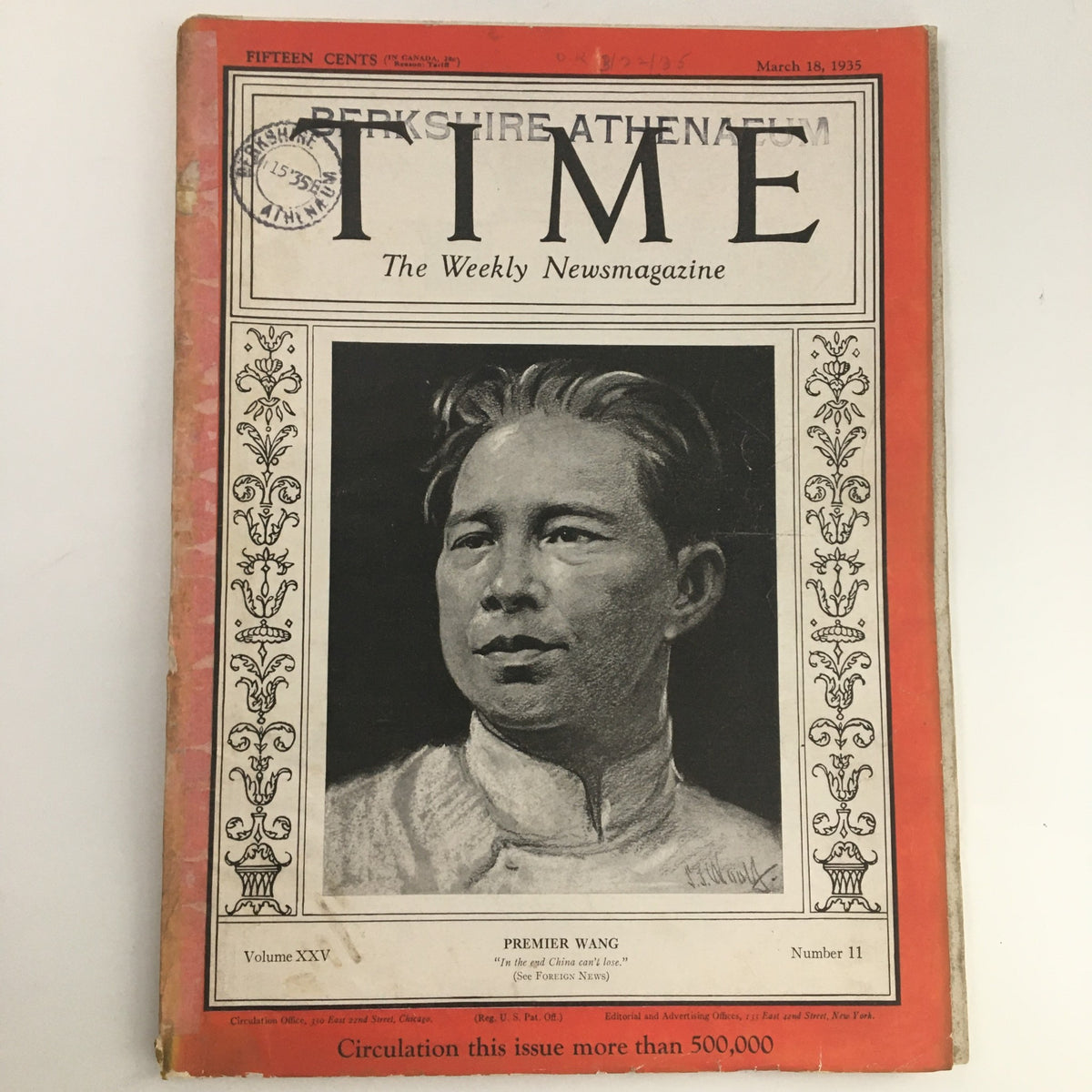
The March 18, 1935 issue of Time Magazine, Volume 25, Number 11, featuring Wang Jingwei on the cover, is one of the most historically complex and intellectually charged international political portraits in the publication's pre-war archive. By March 1935, Wang Jingwei occupied one of the most contradictory positions in Chinese politics — a figure who had been a revolutionary hero of the early Republican period, a close associate of Sun Yat-sen, and a serious rival to Chiang Kai-shek for leadership of the Nationalist movement, but who was increasingly drawn toward a policy of accommodation with Japan as Japanese military pressure on China intensified. His trajectory would culminate in 1940 when he accepted leadership of a Japanese-sponsored collaborationist government in Nanjing — a decision that permanently defined his historical legacy as one of the most controversial figures in modern Chinese history. But in March 1935, that trajectory was still unfolding, and a Time Magazine cover reflects the American press's serious engagement with Chinese politics at a moment when the country's future was genuinely uncertain. For collectors building an archive of Time Magazine issues documenting international political history, this March 1935 cover is a primary document of one of the twentieth century's most debated political figures at a pivotal moment in his career.
The March 1935 date places this issue in a specific and historically charged context. Japan had occupied Manchuria since 1931 and was pressing for greater influence over northern China. Chiang Kai-shek's Nationalist government was pursuing a policy of internal pacification — the ongoing campaigns against the Communist forces that had just completed the Long March — while attempting to manage Japanese pressure through a combination of appeasement and resistance. Wang Jingwei, as head of the government's Executive Yuan, was at the center of those negotiations, and his advocacy for a more accommodationist approach to Japan was generating intense political controversy. A Time cover in March 1935 introduced this specific intra-Nationalist political debate to an American readership that was following Chinese affairs with increasing attention as Japanese expansion threatened the regional stability that American commercial interests in China depended upon. Publications from 1935 document the world at an extraordinarily dangerous moment in the path toward the Second World War, and this Time issue provides a specific and historically grounded perspective on the Asian dimension of that gathering crisis.
About the Publication
Time Magazine, founded by Henry Luce and Briton Hadden in 1923, was by March 1935 the most widely read weekly news magazine in the United States, with a circulation and institutional authority that made its cover selections genuine cultural and political events. Henry Luce himself had a personal connection to China — he had been born in Shandong Province to missionary parents — and Time's coverage of Chinese politics during this period was more sustained and analytically serious than that of most American publications. The selection of Wang Jingwei for the March 18, 1935 cover reflects both the magazine's institutional engagement with Chinese affairs and its recognition that Wang was one of the most consequential political figures in the country whose future Luce had spent his childhood.
Key Highlights Inside
- Cover portrait of Wang Jingwei — published March 18, 1935, documenting one of China's most controversial political figures at a pivotal moment in his career, just years before his decision to lead a Japanese-sponsored collaborationist government would permanently define his historical legacy.
- Time's framing of Wang within the context of Chinese Nationalist politics and the Japanese pressure on northern China — a primary source for how the American mainstream press understood the internal dynamics of Chiang Kai-shek's government and its most prominent internal critic in 1935.
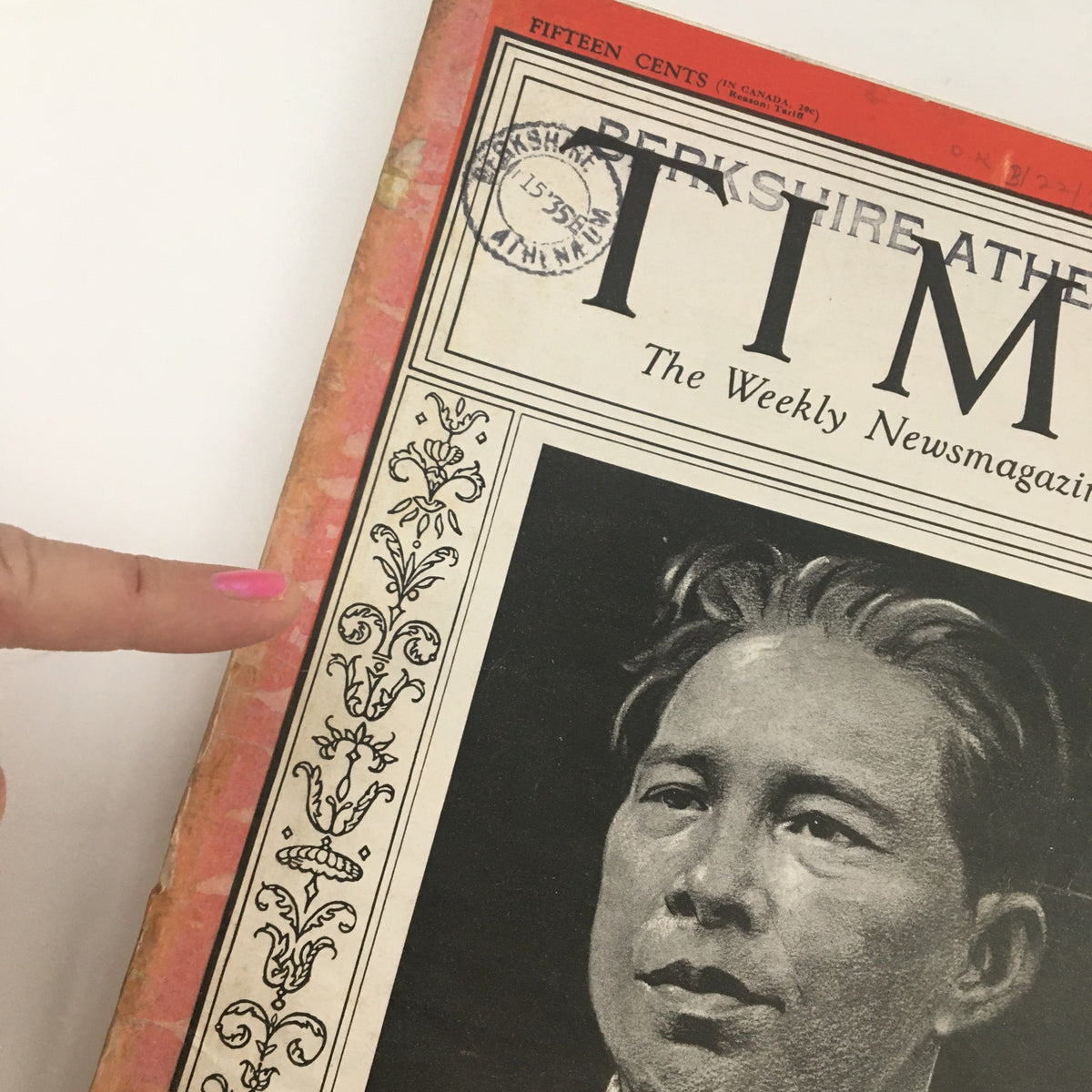
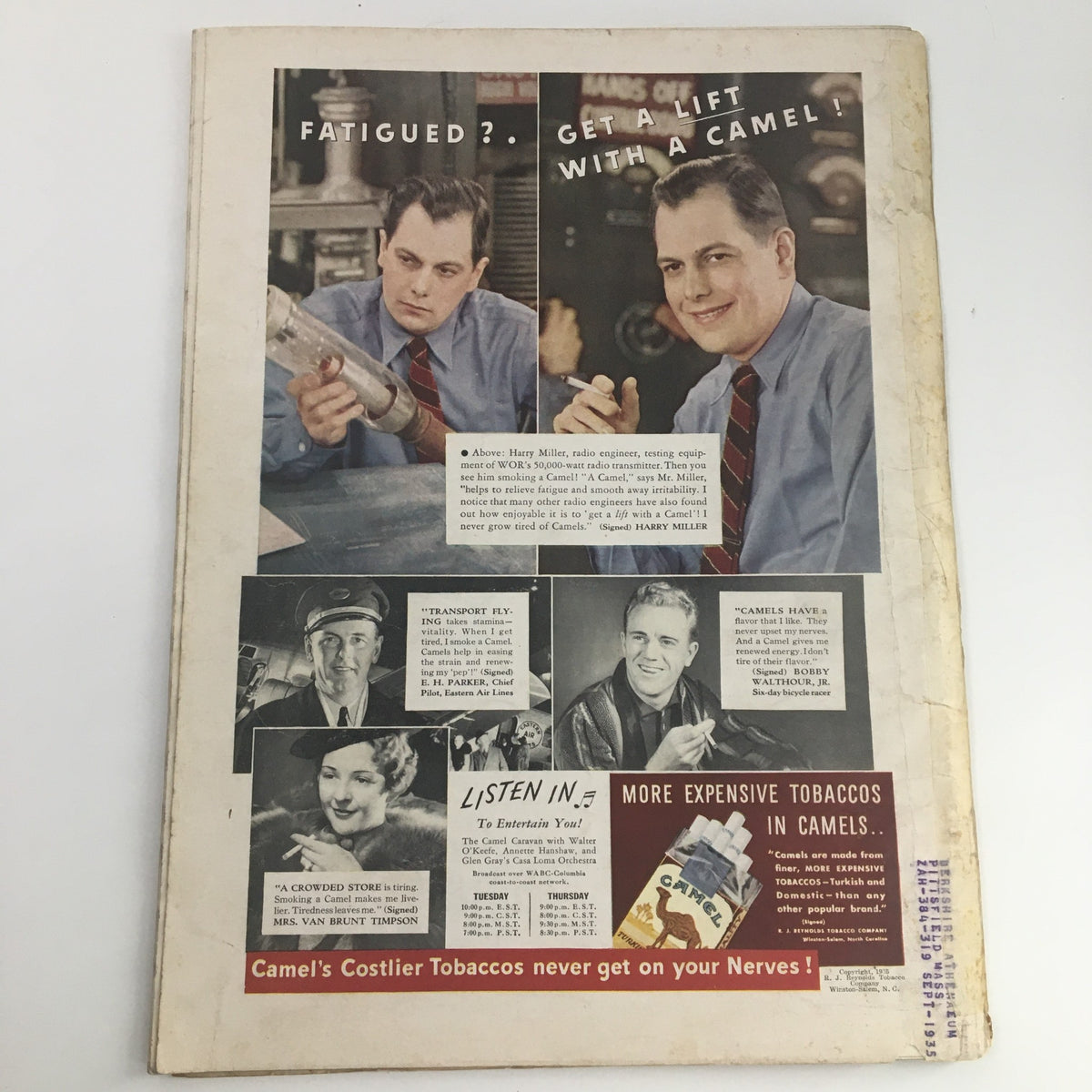
- Stamped mark on the front and label on the back — authenticating details that confirm the issue's genuine circulation history and add provenance documentation to a publication of this historical age.
- Note: Specific interior articles and features beyond the confirmed cover story are unverified for this issue. The above reflects what is documented in the listing and well-established historical context of Wang Jingwei's political position in March 1935.
Condition & Rarity
The acceptable condition classification for this issue requires honest and careful assessment against the specific disclosures in the listing. The confirmed presence of rips, stains, marks, potential water damage, missed or detached pages, and taped binding represents a significant set of structural and cosmetic condition issues that collectively affect both the display value and the research utility of the magazine. The taped binding indicates a structural repair that has been made to preserve the issue's integrity, and while this confirms deliberate preservation intent, it is a condition factor that collectors should assess directly from the provided photographs. The stamped mark on the front and label on the back are authenticating details rather than condition detractors. The plastic protective covering indicates subsequent preservation storage. For a publication now ninety years old, survival in any form is historically meaningful, but the confirmed condition issues are factors that collectors should weigh carefully against their intended use of the piece.
Looking for More Issues Like This?
A March 1935 Time Magazine with Wang Jingwei on the cover is a historically specific find for collectors of pre-war Asian political history and early Time Magazine international coverage — this is one of the more consequential and ultimately tragic figures in twentieth-century Chinese politics, documented at a moment before his most controversial decisions. If this issue has already been claimed, the full archive of Time Magazine issues spans the publication's entire run and surfaces other landmark international political covers from the pre-war years and beyond. The broader 1935 magazine collection offers essential context for this specific and historically charged year in international affairs across multiple publications.