



Description
Collector's Note – Why This Issue Matters
The May 3, 1993 issue of Time Magazine, with the cover headline "His Name Was Death, and Hell Followed with Him," documents one of the most dramatic and morally complex standoffs in American law enforcement history at its conclusion. The Branch Davidian siege at Waco, Texas had begun on February 28, 1993 when a Bureau of Alcohol, Tobacco and Firearms raid on the compound of David Koresh's religious sect went catastrophically wrong, killing four federal agents and six Branch Davidians. The fifty-one-day standoff that followed — broadcast continuously on national television, debated across the political spectrum, and watched by an American public that oscillated between fascination and horror — ended on April 19, 1993 when fire consumed the compound, killing approximately seventy-six Branch Davidians including Koresh himself and twenty-five children. The May 3 issue, appearing two weeks after the fire, was one of the primary mainstream press attempts to process what had happened and what it meant. Time's cover headline — drawn from the Book of Revelation's description of the pale rider — engaged Koresh's own biblical self-presentation directly, using his apocalyptic framework against him as an editorial judgment on the outcome. For collectors building an archive of Time Magazine issues documenting landmark American events, this May 1993 issue is a primary document of the Waco siege's immediate press aftermath.
The May 3, 1993 Waco issue also carries significant historical weight in retrospect because of what followed it. The siege's controversial ending — particularly the role of federal law enforcement's decision-making in the fire's cause — became a defining grievance for American militia and anti-government movements in the early 1990s. Timothy McVeigh cited Waco as a primary motivation for the Oklahoma City bombing on April 19, 1995 — exactly two years after the Waco fire — and the siege's political and cultural legacy shaped American domestic politics for the remainder of the decade and beyond. A Time cover from May 1993 documenting the immediate press response to Waco is therefore also a document of an event whose significance would only grow in the years that followed, and whose interpretation was already being contested in the issue's publication week. The specific headline choice — apocalyptic, judgmental, and editorially decisive — reflects the specific moral clarity that Time was asserting in a moment when that clarity was not universally shared.
About the Publication
Time Magazine, founded by Henry Luce and Briton Hadden in 1923, was by May 1993 one of the two dominant American weekly news magazines, with a global readership and an institutional authority that made its cover selections genuine cultural events. Its format — opinionated summaries of world events organized by category and built around a weekly cover — gave its domestic crisis coverage the specific kind of mainstream American visibility that shaped public understanding of major events in real time. A Time cover story on Waco two weeks after the fire was one of the primary vehicles through which American mainstream opinion was being formed about one of the most discussed and contested domestic events of the early Clinton years.
Key Highlights Inside
- Cover story on the Branch Davidian siege conclusion — published May 3, 1993, two weeks after the April 19 fire that ended the fifty-one-day standoff at the Waco compound, documenting the mainstream press's primary immediate response to one of the most contested domestic events in early-1990s American history.
- Cover headline drawn from the Book of Revelation — "His Name Was Death, and Hell Followed with Him" — an editorial choice that engaged David Koresh's own biblical self-presentation as an apocalyptic prophet, using his framework as a judgment on the outcome of the siege.
- Address label on front cover — identifying this as a subscriber copy and confirming its genuine circulation history from the period of the story's immediate national engagement.
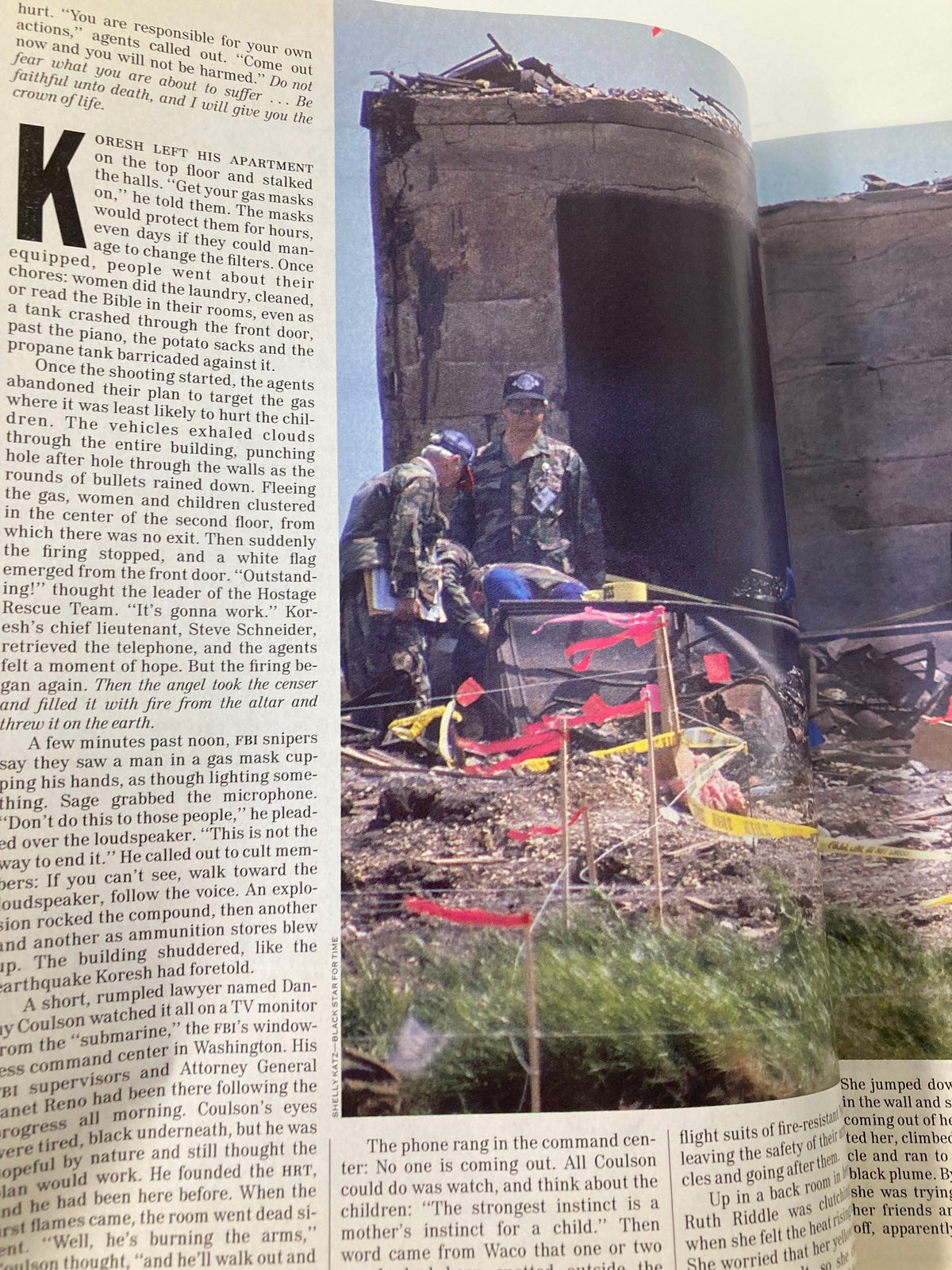
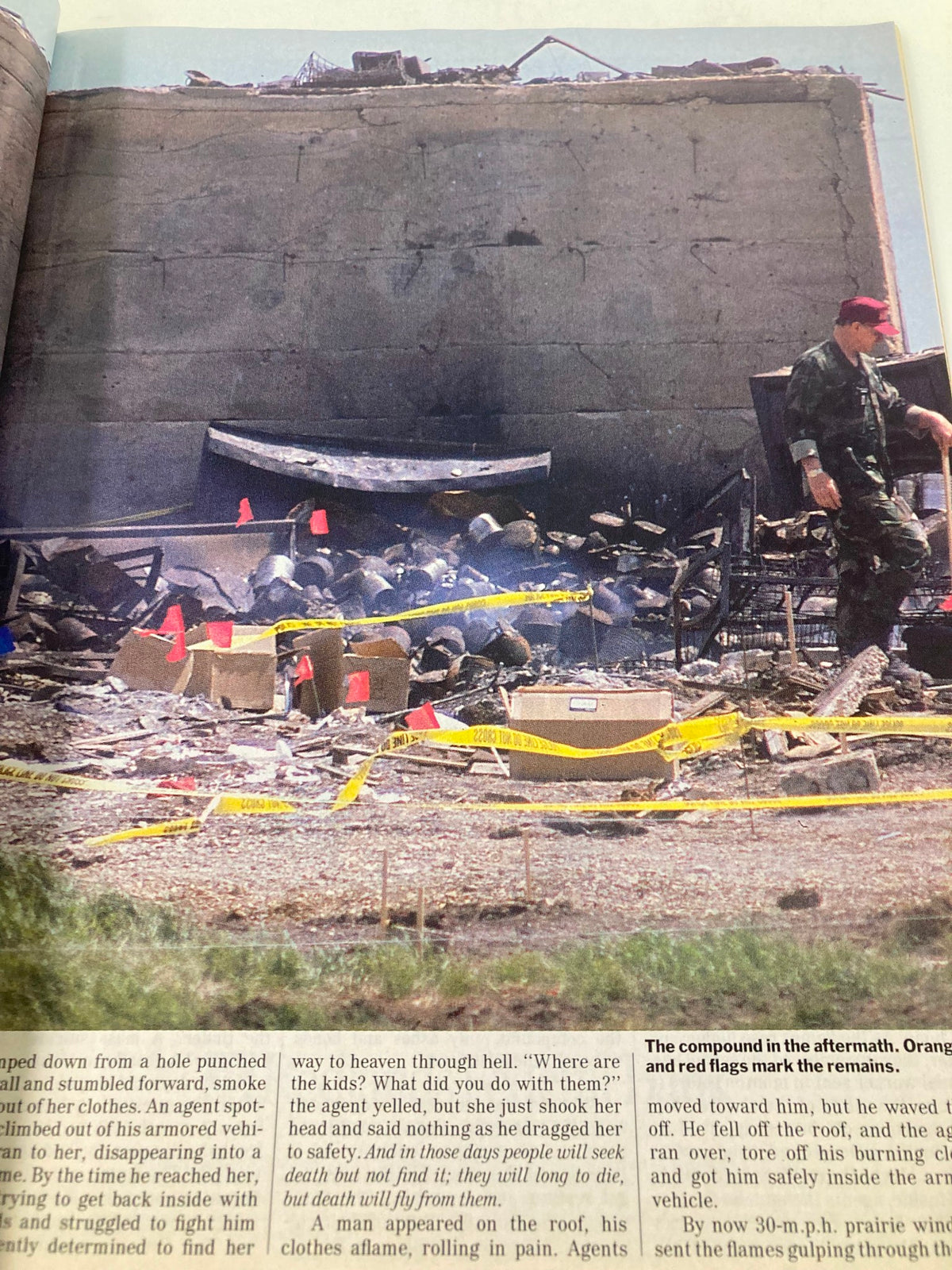
- Note: Specific interior articles, photographs, and features beyond what is confirmed in the listing are unverified for this issue. The above reflects what is documented in the listing and well-established historical context of the Waco siege's conclusion in April-May 1993.
Condition & Rarity
Good condition with minor wear throughout and the presence of an address label on the front cover is an appropriate assessment for a weekly magazine now over thirty years old. The address label identifies this as a subscriber copy — the standard distribution method for Time during this period — and label presence is the norm rather than the exception for surviving copies of early-1990s issues. Label-free newsstand examples of this specific issue exist and are the preferred display configuration for collectors for whom cover presentation is a priority. The plastic protective covering indicates deliberate preservation storage. For a glossy-stock weekly of this vintage, the primary condition factors are cover surface brightness and image clarity — the striking cover design is the primary visual and historical attribute — and the completeness of interior pages.
Looking for More Issues Like This?
A May 1993 Time Magazine documenting the immediate aftermath of the Waco siege is a historically specific find for collectors of 1990s domestic political history, American religious movement journalism, and the primary press record of events whose significance grew considerably after their initial publication. If this issue has already been claimed, the full archive of Time Magazine issues spans the publication's entire run and surfaces other landmark domestic and international crisis covers from across its history. The broader 1993 magazine collection offers additional context for this specific and turbulent year in American political and cultural history.