



Description
Collector's Note – Why This Issue Matters
The November 5, 1965 issue of Time Magazine — Vol. 86, No. 19 — arrived on newsstands just six days before one of the most consequential and controversial acts in the history of African decolonization. On November 11, 1965, Rhodesian Prime Minister Ian Smith signed the Unilateral Declaration of Independence (UDI), severing the British colony of Southern Rhodesia from the Crown without London's consent and without any provision for majority rule in a country where the white minority government held absolute power over a Black population that outnumbered it by roughly twenty to one. Time's decision to put Smith on the cover the week before UDI was not merely reactive journalism — it was the American press recognizing, in real time, that a genuinely historic rupture was imminent. This issue is a document frozen at the precise moment of anticipation before that rupture occurred.
Ian Smith himself is one of the more complex and polarizing figures in twentieth-century political history. A World War II RAF pilot and lifelong Rhodesian, he led his country's white minority government with the stated conviction that Black majority rule would destroy what he considered a functioning civilization. The international community largely refused to accept that framing. Britain imposed sanctions. The United Nations condemned UDI. The Organization of African Unity supported the liberation movements that would eventually, after a prolonged bush war, produce the independent nation of Zimbabwe in 1980. A Time cover feature on Smith published in the week before UDI captures the full complexity of that geopolitical moment — the defiance, the sanctions debate, the racial politics, and the broader context of a continent in the middle of a sweeping decolonization process. For collectors building a documentary record of the magazine journalism of 1965, this issue sits at the intersection of African history, Cold War geopolitics, and the global civil rights moment.
The mid-1960s were the peak years of African independence, with dozens of former colonies achieving statehood in the decade following Ghana's independence in 1957. Rhodesia's UDI ran directly against that current — a white minority government choosing permanent separation from Britain rather than accepting the decolonization framework that had reshaped the rest of the continent. Time's coverage of Smith and Rhodesia in this issue reflects how American mainstream journalism was processing that contradiction. As a primary source document, it belongs in the same collecting category as other landmark Time Magazine issues covering the defining political crises of the postwar era — issues that reported on history while it was still happening and whose covers became, in retrospect, iconic images of their moment.
About the Publication
Time Magazine was founded in 1923 by Henry Luce and Briton Hadden as the first American weekly news magazine, and by 1965 it had long occupied a position of unrivaled authority in mainstream American journalism. Its signature red-bordered cover, its Person of the Year franchise, and its dense, reported long-form features made it the publication of record for educated Americans seeking to understand international affairs in depth. In the mid-1960s, Time's international coverage was particularly substantial, reflecting both the global reach of American Cold War interests and the genuine complexity of a world in which dozens of new nations were defining themselves against the backdrop of superpower rivalry and the legacy of European colonialism.
Key Highlights Inside
- Ian Smith cover portrait: Smith appears on the cover of this issue, confirming it as a primary Time document of his leadership in the days immediately preceding Rhodesia's Unilateral Declaration of Independence on November 11, 1965.
- In-depth Rhodesia political feature: Per the listing, the issue explores the complexities of Rhodesia's political landscape, including the racial tensions underpinning the UDI crisis and the anticipated international response.
- Decolonization context: The listing confirms the issue addresses the broader global affairs and cultural shifts of the mid-1960s, situating the Rhodesia story within the wider narrative of African decolonization and postwar geopolitics.
- Pre-UDI historical document: Published six days before the declaration itself, this issue represents anticipatory journalism — a contemporaneous assessment of Smith and his intentions written before the full consequences of UDI were known.
- Note: Specific additional article titles and full interior content beyond the confirmed Rhodesia and Ian Smith feature have not been independently verified for this issue. Collectors seeking a complete content inventory may wish to consult the Time Inc. archive or a university periodicals library.
Condition & Rarity
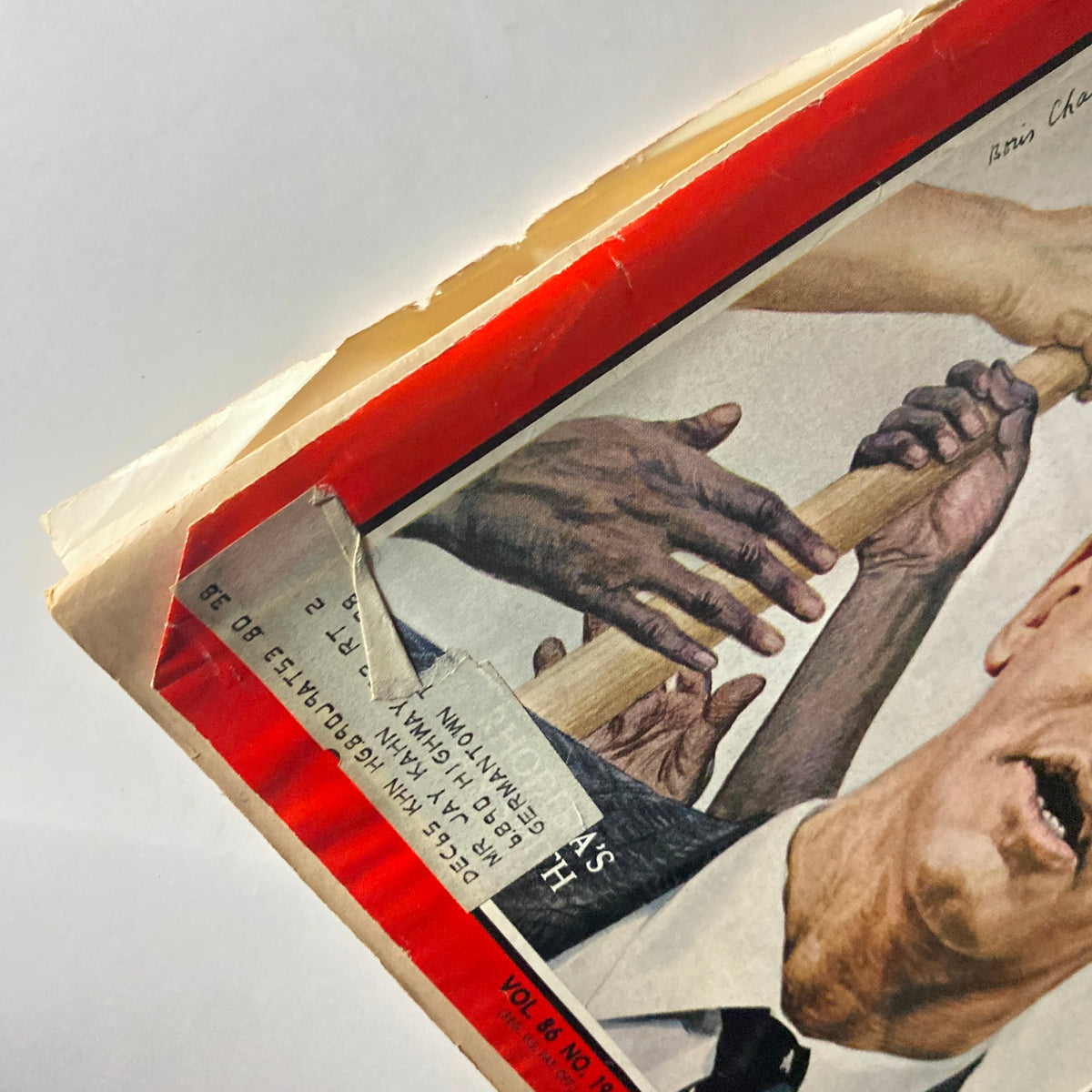
The listing describes this issue as being in acceptable condition, with noted exterior wear including possible rips, water damage, and a blurred address label on the front cover — attributes that place it in the lower tier of the collector grading spectrum but do not eliminate its value as a historical document. The presence of a mailing label confirms it as an original subscriber copy from 1965. Critically, the listing specifies that the interior remains in good shape with only minor creases and wear, which is the most important functional attribute for a research or display copy: the Smith cover feature and the Rhodesia reporting are the core collectible content, and intact interior pages preserve that content regardless of exterior condition. For a nearly sixty-year-old newsprint weekly, acceptable exterior condition with solid interior integrity is a realistic and honest assessment. The plastic protective covering indicates deliberate preservation. When evaluating any surviving copy of this issue, interior page completeness and the legibility of the Smith cover portrait are the primary grading considerations.
Looking for More Issues Like This?
A Time Magazine cover issue documenting Ian Smith and Rhodesia in the week before UDI is a specialized find that appeals to collectors of African political history, Cold War journalism, and mid-1960s Americana alike — and it doesn't surface in collectible condition with any regularity. If this issue is unavailable, the broader Time Magazine archive at OriginalMagazines.com spans decades of landmark covers and is the best place to search for other issues documenting the political crises of the 1960s. The full 1965 magazine collection is equally worth exploring for collectors building a primary-source record of one of the most consequential years in postwar world history.