
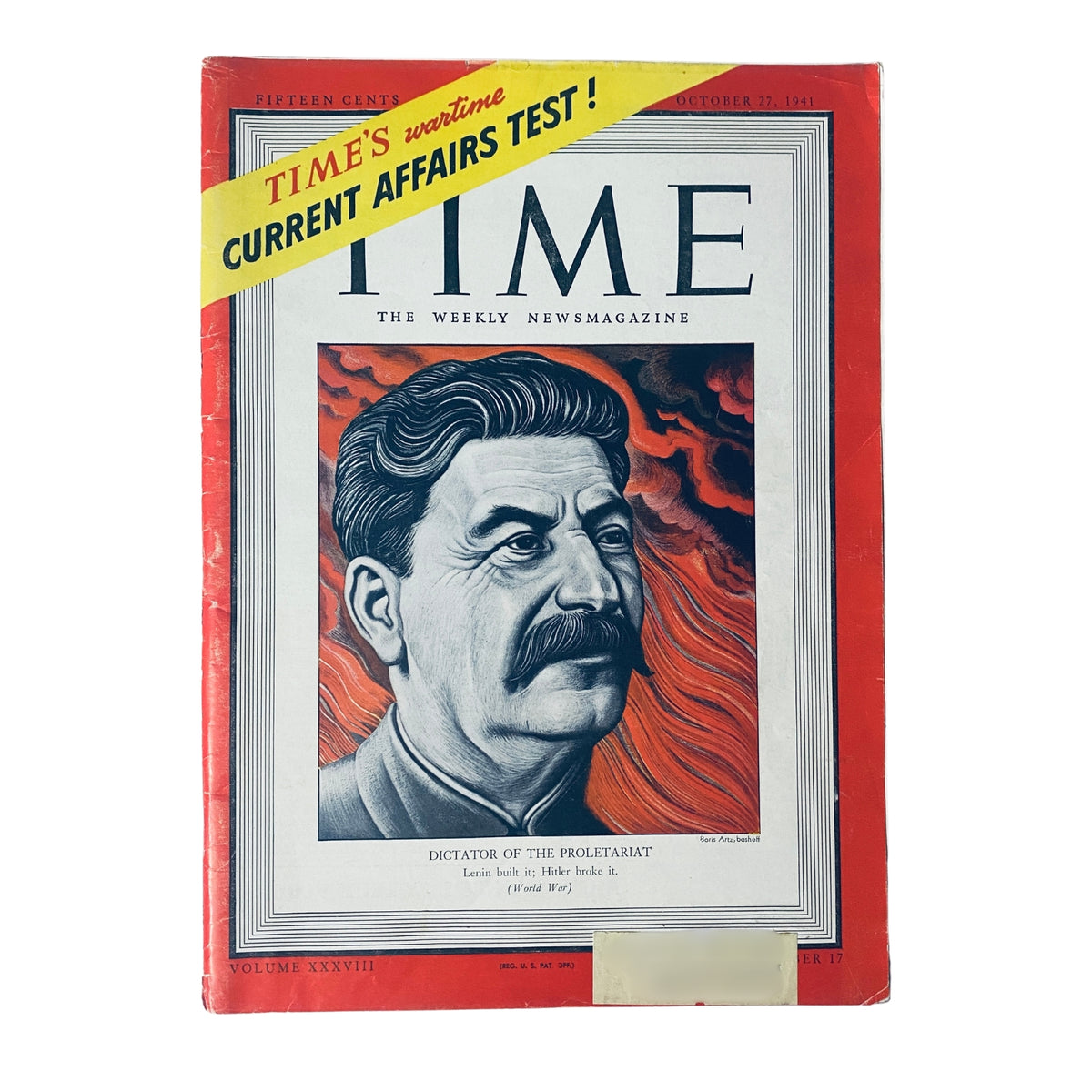


Description
Collector's Note – Why This Issue Matters
The October 27, 1941 issue of Time magazine featuring Joseph Stalin on the cover is a primary document of one of the most consequential moments of the Second World War — and the specific date places it with extraordinary precision within the Eastern Front's most catastrophic phase. By October 27, 1941, Operation Barbarossa had been underway for four months, and the German advance was approaching its maximum penetration: Moscow itself was under direct threat, German forces had reached within sixty miles of the city, and the Soviet government had begun evacuation preparations. The Battle of Moscow — the engagement that would determine whether the Soviet Union could survive the German onslaught — was in its most critical early phase. Stalin had remained in Moscow rather than evacuating, a decision of enormous military and symbolic significance that was itself being debated and discussed in the international press at this precise moment. A Time cover featuring Stalin in October 1941 was engaging with the most urgent military and political question in the world at that week: whether the Soviet Union would hold, whether Stalin's command decisions were adequate to the crisis, and whether the Eastern Front would be the decisive theater of the war. The full scope of Time's coverage of the Second World War and Soviet wartime leadership across this period is traceable through the Time magazine collection.
October 27, 1941 was also a historically specific moment in American foreign policy that gives this issue additional documentary weight. The United States had not yet entered the war — Pearl Harbor was still six weeks away — and American public opinion about the European conflict, about aid to the Soviet Union, and about the likelihood of American involvement was actively and urgently contested. The Lend-Lease Act had been extended to the Soviet Union in October 1941, making the American government's commitment to Soviet survival a matter of active political debate at home. A Time cover on Stalin in this context was not merely a foreign news story but a contribution to the American domestic debate about who Stalin was, whether his regime was a worthy recipient of American military assistance, and what the implications of Soviet survival meant for the war's outcome. The magazine's characterization of Stalin as "dictator" in the listing title reflects the specific editorial complexity of that moment — the Soviet leader was simultaneously a recipient of American aid and an authoritarian whose domestic record the American press had documented for decades. The broader context of this pivotal year in American and world history is documented across the 1941 magazine collection, which brings together publications from the year that includes both the Eastern Front's opening and America's entry into the war.
The complete and legible page integrity noted in the listing is a meaningful positive for a nearly eighty-five-year-old periodical. For a wartime Time issue whose primary research value rests on its editorial content — the contemporaneous analysis of Stalin's leadership, the coverage of the Eastern Front, the American domestic opinion coverage, and the period advertising that together constitute a comprehensive weekly primary source — complete interior legibility preserves all of those research dimensions intact. The light edge wear and toning noted are the honest and expected attributes of an original, unrestored weekly periodical from this era.
About the Publication
Time magazine was founded by Henry Luce and Briton Hadden in 1923 and established itself over the following decades as the most widely read weekly newsmagazine in America, its distinctive cover portrait format — a single person anchoring the week's most significant story — becoming one of the most recognized editorial conventions in American journalism. By October 1941 it had been publishing for eighteen years and had developed the combination of accessible narrative journalism, international scope, and confident editorial voice that made it the primary weekly current events resource for the educated American middle class. Its wartime covers were among its most consequential editorial choices, selecting the military, political, and strategic figures whom the magazine judged most important for its readership to understand at each specific moment of the conflict — and an October 1941 Stalin cover reflects that editorial judgment at the most militarily acute moment of the war's Eastern theater.
Key Highlights Inside
- Joseph Stalin cover feature — a primary document of American mainstream journalism's contemporaneous engagement with the Soviet wartime leader at the most critical moment of the Eastern Front's first year, published as German forces approached Moscow and the question of Soviet survival was the most urgent military issue in the world.
- October 1941 Eastern Front coverage — journalism published during the Battle of Moscow's opening phase, providing the contemporaneous American media's analytical framework for understanding the military situation on a front whose outcome would prove decisive for the entire course of the war.
- Pre-Pearl Harbor American foreign policy and public opinion coverage — journalism from a country that was six weeks away from entering the war, actively debating Lend-Lease aid to the Soviet Union, and constructing its understanding of Stalin and the Soviet war effort through the specific editorial lens of a publication whose influence on that understanding was substantial.
- Period advertising and domestic American content — authentic 1941 advertising and cultural journalism providing a comprehensive baseline document of American consumer culture and public life at the last weeks of American peace before Pearl Harbor.
- Note: Specific additional article titles, bylines, and further interior content beyond those indicated in the listing have not been confirmed from available sources. The highlights above reflect what is documented in the listing and Time's well-established editorial format for major wartime cover stories of this period.
Condition & Rarity
Surviving copies of the October 27, 1941 Time in good condition with complete and legible pages represent a meaningful find for collectors of World War II history, Soviet wartime leadership documentation, and pre-Pearl Harbor American foreign policy journalism. Complete page integrity is the most meaningful positive condition attribute for a research-quality primary source from this era — all of the editorial and advertising content is fully accessible. Light edge wear and toning are the honest and expected attributes of an original, unrestored weekly periodical that has passed through nearly eighty-five years of existence without archival preservation. The provided photographs are the appropriate reference for assessing the specific wear characteristics and confirming the complete page condition. The plastic protective sleeve is the correct conservation measure for a publication of this age and paper stock, stabilizing further deterioration without altering the original item.
Looking for More Issues Like This?
An October 1941 Time with Stalin on the cover — published at the most critical moment of the Eastern Front's first year, six weeks before Pearl Harbor, with complete pages intact — is a primary document of extraordinary historical density that rewards serious collector attention from multiple research directions simultaneously. If this particular issue is no longer available, the full Time magazine collection at OriginalMagazines.com is the most comprehensive source for exploring other issues across the publication's long and historically rich wartime run. For collectors building a broader archive of this pivotal year in American and world history, the complete 1941 magazine collection brings together publications from the year that spans both the Eastern Front's opening and America's entry into the Second World War.