
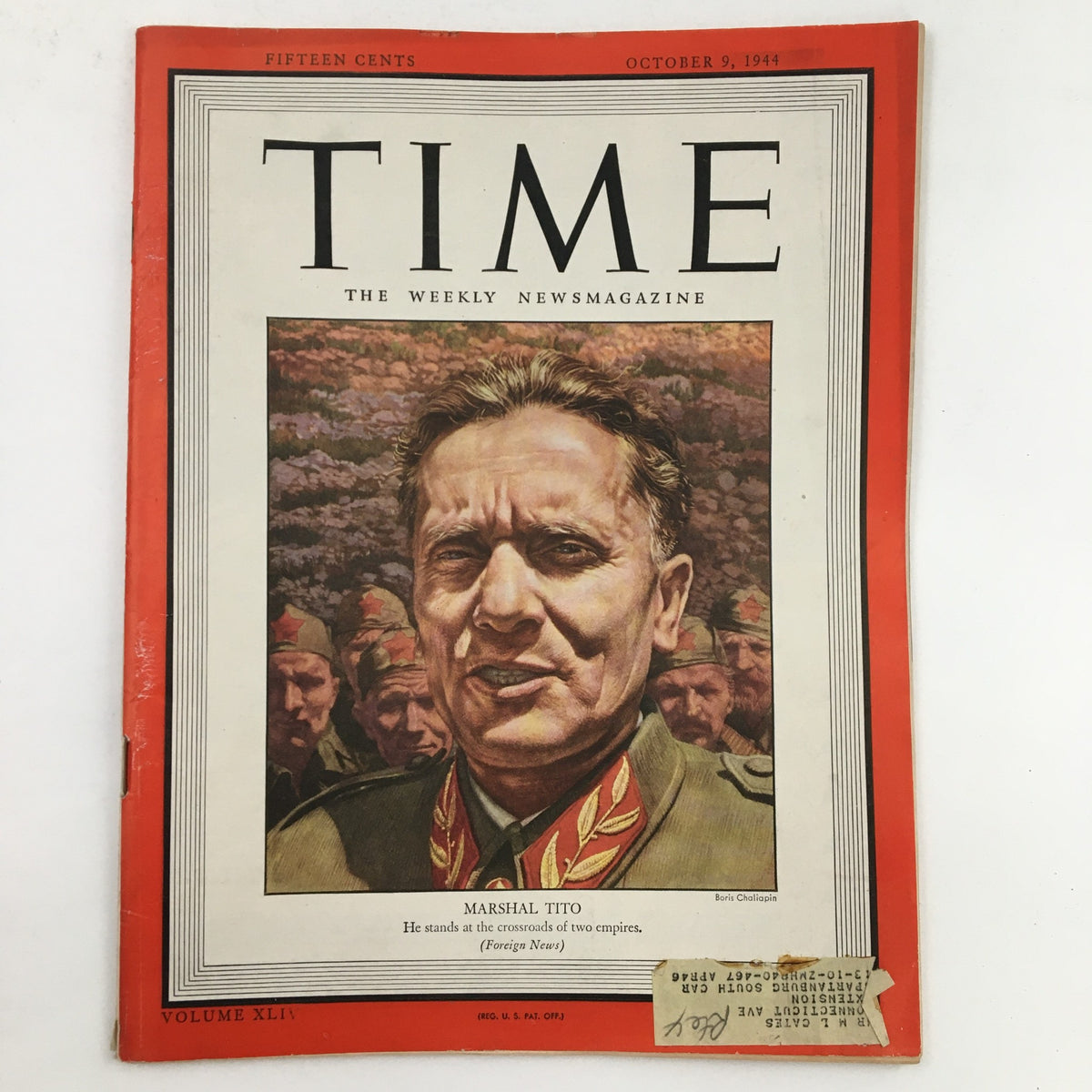

Description
Collector's Note – Why This Issue Matters
The October 9, 1944 issue of Time magazine featuring Marshal Josip Broz Tito on the cover with the designation "of Two Empires" is a primary document of one of the most consequential and most strategically significant figures of the Second World War at the specific moment of his maximum historical importance — and one of the more remarkable single issues in Time's wartime archive for the specific figure it chose to honor at this specific date. By October 1944, Tito's Yugoslav Partisans had been conducting one of the most effective resistance operations against Nazi occupation in all of occupied Europe for three years, surviving multiple German offensives designed to eliminate them — including the Sixth Enemy Offensive in May-June 1944, in which Tito himself had narrowly escaped capture — and had emerged by autumn 1944 as the dominant military and political force in Yugoslavia. The specific timing of the October 9, 1944 cover is extraordinary: it appeared in the same days as the Moscow Conference (October 9-19, 1944), at which Churchill and Stalin negotiated the "percentages agreement" that divided Eastern Europe into British and Soviet spheres of influence — an agreement in which Yugoslavia was split fifty-fifty between the two powers, a diplomatic reality that Tito himself would ultimately defy by charting Yugoslavia's independent course between the superpowers. The "Two Empires" designation of the cover story is primary evidence of how Time's editors were framing Tito's specific geopolitical position — navigating between the Soviet and Western Allied spheres — at the precise moment when that navigation was most consequential. For collectors building a serious archive of Second World War-era American journalism and wartime political figures, the Time magazine collection at OriginalMagazines.com provides essential depth, with this October 9, 1944 Tito cover occupying one of its most historically precise and most geopolitically significant positions.
The broader historical context of October 9, 1944 gives this issue a primary source significance that researchers of Second World War political history will recognize as extraordinary. By this date, the war's outcome in Europe was no longer in serious doubt — the D-Day landings had succeeded in June, Paris had been liberated in August, and the Soviet forces were advancing rapidly through Eastern Europe — but the specific question of what the postwar political order in Eastern and Southern Europe would look like was the most actively negotiated and most consequentially unresolved issue in Allied diplomacy. Tito's Yugoslavia occupied a unique position within this negotiation: a communist-led resistance movement that had earned its authority through genuine military effectiveness rather than Soviet installation, and a leader whose specific combination of ideological independence and military capability gave him a freedom of maneuver that no other Eastern European communist leader possessed. The October 9, 1944 Time "Two Empires" cover is primary American mainstream journalism documentation of how Tito's specific geopolitical independence was being recognized and framed by the most widely read American newsweekly at the specific moment when the postwar order was being most actively negotiated. The address label confirmed on the front cover is authentic provenance documentation connecting this issue to a specific subscriber household reading about Tito's extraordinary position in American life in October 1944. The full range of 1944 magazines and publications from this decisive final year of the European war documents American journalism's engagement with the most consequential geopolitical negotiations of the twentieth century.
Tito's subsequent history gives this October 1944 Time cover an additional retrospective significance that historians of the Cold War and of Yugoslav history will recognize. The man featured on this cover as navigating between "Two Empires" would go on to defy Stalin's authority in the 1948 Tito-Stalin split — the most significant challenge to Soviet authority in Eastern Europe until the Hungarian Revolution of 1956 — and to establish the Non-Aligned Movement as the primary institutional expression of Cold War independence from both superpower blocs. A Time cover from October 1944 identifying Tito as a figure positioned between two empires is primary documentation of the specific geopolitical intelligence that was recognizing, even before the war's end, the specific independent capacity that would define his subsequent historical role.
About the Publication
Time magazine was founded in 1923 and had established itself by 1944 as the most widely read American newsweekly, its weekly summary of national and international news reaching millions of American households through subscription and newsstand distribution. By October 9, 1944, the publication was covering the most consequential phase of the Second World War's European theater with the editorial authority and the cover story format that made its selection of cover subjects a primary institutional statement about which figures and which political developments constituted the most significant international narratives of any given week. Tito's October 1944 cover represents the publication's editorial judgment that the Yugoslav Partisan leader's specific geopolitical position between the Allied powers was one of the most significant and most consequential stories in the war's final European phase.
Key Highlights Inside
- Marshal Tito "of Two Empires" cover — Yugoslav Partisan leader's geopolitical independence documented at Moscow Conference week — The confirmed Tito "Two Empires" cover is primary Time documentation of the most militarily effective resistance leader in occupied Europe at the specific week of the Churchill-Stalin percentages agreement that divided Eastern Europe's postwar fate, capturing the publication's editorial recognition of Tito's specific independence between the Soviet and Western Allied spheres at the precise moment when that independence was most geopolitically consequential.
- October 9, 1944 — Moscow Conference week, wartime postwar negotiation threshold documented — The confirmed October 9, 1944 date places this issue in the specific week of the Moscow Conference (October 9-19, 1944) at which Churchill and Stalin were negotiating the percentages agreement dividing Eastern Europe — with Yugoslavia designated fifty-fifty — making this cover primary journalism documentation of Tito at the exact moment when the postwar order he would ultimately defy was being negotiated.
- Address label front cover — subscription distribution provenance at wartime peak documented — The confirmed address label connects this issue to a specific subscriber household reading Time's Tito cover story in the specific week when Allied diplomatic negotiations were most actively shaping the postwar European order, preserving authentic evidence of the publication's direct-mail distribution for one of its most geopolitically significant wartime covers.
- Wartime "Two Empires" framing — Tito's superpower independence recognized in primary American journalism form — The confirmed "Two Empires" cover designation is primary evidence of Time's editorial recognition of Tito's specific geopolitical position between the Soviet and Western Allied powers four years before his 1948 Stalin split would prove that independence's most dramatic and most consequential expression, documenting the specific American journalistic intelligence that was recognizing this capacity in real time.
- Note: Specific article titles, the complete editorial contents beyond the confirmed Tito "Two Empires" cover story, and other features of this issue have not been independently verified beyond the listing description. The highlights above reflect what is documentable from the listing and the well-established historical context of Marshal Tito and Time's October 9, 1944 publication.
Condition & Rarity
This issue is described as being in good condition with an address label on the front, minor wear throughout, and a plastic protective covering — a condition profile that is honest and representative for a weekly newsweekly now over eighty years old that was produced for active reading use during the most consequential months of the Second World War. Good condition with minor wear for a publication of this age and original use context indicates consistent storage care that has preserved the publication above the typical survival condition for a subscription newsweekly from the wartime era. The address label is permanently bonded to the cover stock after eight decades and is best understood as provenance documentation connecting the issue to a specific subscriber household reading Tito's extraordinary wartime story in October 1944. The plastic protective covering indicates deliberate preservation care. Time wartime covers from October 1944 featuring Tito's "Two Empires" designation are specifically sought by Second World War political history researchers, Yugoslav history specialists, Cold War origins historians, Non-Aligned Movement scholars, and wartime journalism collectors who recognize this specific issue as primary mainstream American journalism documentation of one of the war's most geopolitically significant and most historically consequential resistance figures at the precise moment of his maximum strategic importance.
Looking for More Issues Like This?
The October 9, 1944 Time Marshal Tito "Two Empires" cover is among the most historically precise and most geopolitically significant wartime magazine covers in American journalism — primary documentation of the Yugoslav Partisan leader's independence between the Allied superpowers at the specific week of the Churchill-Stalin percentages negotiations, by a man who would go on to defy Stalin and lead the Non-Aligned Movement. If this issue is no longer available, the Time magazine collection at OriginalMagazines.com is the most comprehensive resource for exploring what else has surfaced from the publication's extraordinary wartime archive. For collectors building a broader documentary record of American wartime journalism and the most consequential political developments of the war's final European year, the 1944 magazines collection brings together a wide range of primary source material from that decisive year.